
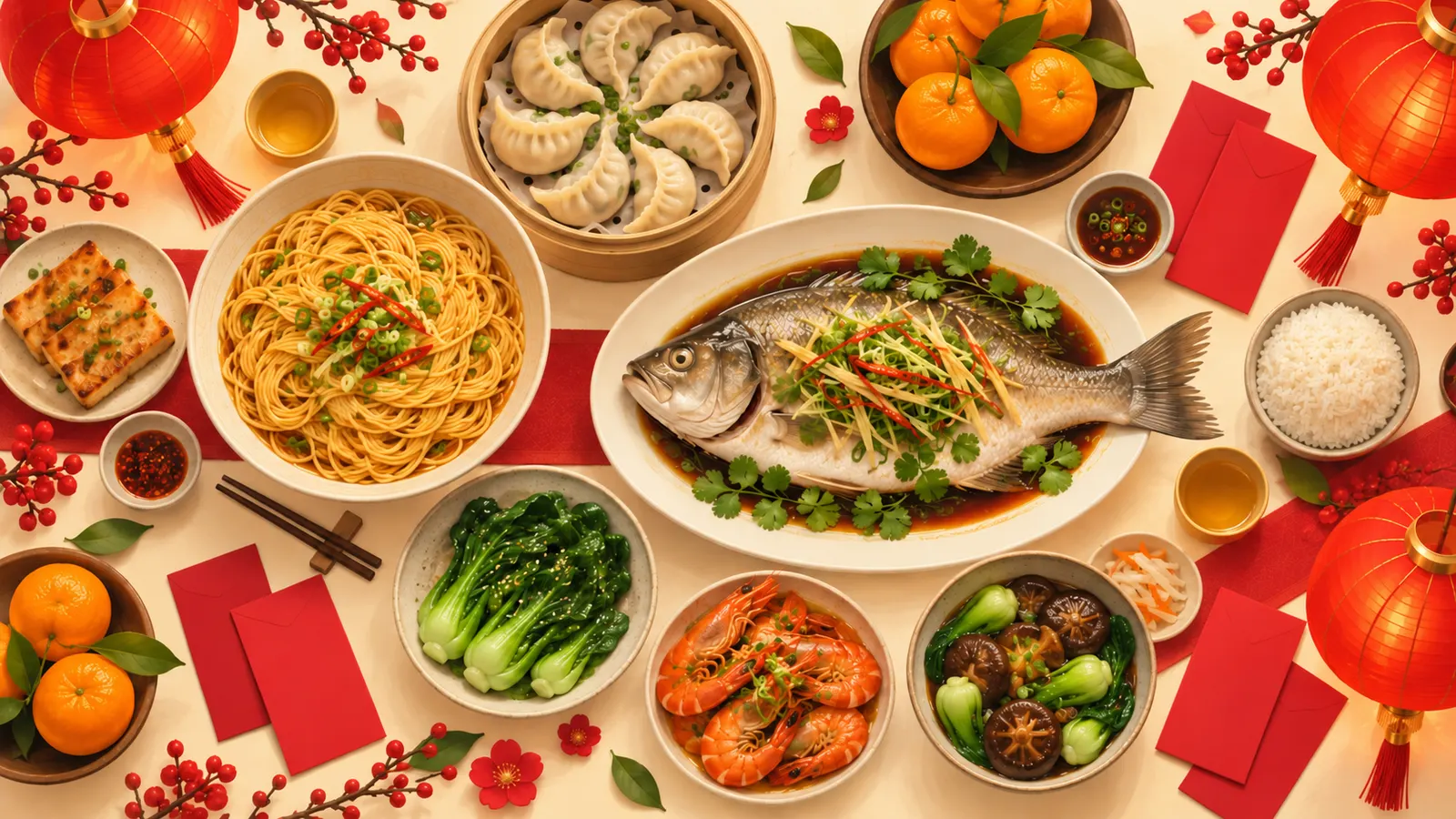
The classic Lunar New Year foods are whole fish for surplus, dumplings for wealth, long uncut noodles for a long life, spring rolls and mandarins for gold and good fortune, and sticky rice cakes and sweet rice balls for progress and family togetherness. Most of them get their meaning from wordplay: the name of the dish sounds like a lucky word in Chinese.
Lunar New Year, also called Chinese New Year or the Spring Festival, is the biggest food occasion of the year for Chinese families, and Korean and Vietnamese households mark it too, as Seollal and Tết. The next one falls on Saturday 6 February 2027, the start of the Year of the Goat (sometimes translated as Sheep), with the Lantern Festival 15 days later. Customs vary a great deal by region and by family, so treat the meanings below as the common traditions rather than fixed rules. Here is what the main dishes are, a manageable supper menu for a UK kitchen, what to buy at an Asian supermarket, and a recipe for longevity noodles.
Lucky foods and what they mean
The reunion dinner on New Year's Eve is the main event, and the dishes on the table are often chosen as much for what their names sound like as for how they taste. This table covers the foods you'll most often see, and where to look for the ingredients in a Chinese supermarket.
| Dish | Why it's eaten | Where to find ingredients |
|---|---|---|
| Whole steamed fish (魚, yú) | Yú sounds like the word for surplus, as in the saying nián nián yǒu yú, "may there be surplus every year". It is usually served whole, and some families deliberately leave a little uneaten. | Fresh fish counter or freezer (sea bass, sea bream, pomfret); ginger and spring onions in the fresh produce section. |
| Dumplings (餃子, jiaozi) | Traditionally a northern Chinese New Year's Eve dish. Their shape is said to resemble old gold and silver ingots, so they stand for wealth. | Freezer aisle for ready-made dumplings; wrappers in the chiller or freezer; Chinese leaf in fresh produce. |
| Longevity noodles (長壽麵) | Long noodles represent a long life, so they are never cut and are often eaten without biting through them. | Dried noodle aisle (yi mein, wheat noodles); fresh egg noodles in the chiller. |
| Spring rolls (春卷) | Named after the Spring Festival. Fried golden, they are often likened to gold bars. | Freezer for ready-made rolls and spring roll pastry. |
| Nian gao (年糕) | The name sounds like "higher year", a wish to do better each year. Eaten sweet in the south, sliced and stir-fried in Shanghai. | Chiller or freezer for sliced rice cakes; sweet brown sugar cakes appear on seasonal displays. |
| Tangyuan (湯圓) | Round glutinous rice balls in sweet soup, associated with reunion and togetherness, especially at the Lantern Festival. | Freezer (black sesame or peanut fillings); glutinous rice flour in the flour and baking aisle. |
| Mandarins and oranges | Their golden colour suggests wealth, and in Cantonese the word for mandarin sounds like the word for luck. Often given in pairs when visiting. | Fresh produce; around New Year many shops sell them with leaves still attached. |
| Whole chicken | Served whole, often with head and feet, to represent completeness and family unity. Many families offer it to ancestors first. | Fresh meat counter or freezer; some shops have a roast meat counter selling soy or white-cut chicken. |
| Eight-treasure rice (八寶飯) | Eight is a lucky number, and the "treasures" are colourful dried fruits and nuts set into sweet sticky rice with red bean paste. | Glutinous rice and tinned red bean paste in dry goods; ready-made puddings are often in the freezer. |
You don't need all of them. A fish, something wrapped (dumplings or spring rolls), a plate of noodles and a bowl of mandarins already covers the main wishes for surplus, wealth, long life and luck. If you're making dumplings from scratch, our dumpling night shopping list has fillings, wrappers and dipping sauces.
A simple Lunar New Year supper menu
This menu feeds 4–6 people, uses one wok (affiliate link, opens in a new tab), one bamboo steamer (affiliate link, opens in a new tab) and a frying pan, and keeps the last-minute cooking short. It works on a weekday evening as well as a weekend.
The menu
- Steamed whole sea bass with ginger and spring onion: see our bamboo steamer guide for the full recipe and timings.
- Pan-fried dumplings: homemade or from the freezer, with a black vinegar and ginger dip.
- Longevity noodles: the recipe is below.
- Garlic pak choi or choi sum: a two-minute stir-fry; our guide on how to stir-fry at home covers heat and timing.
- Tangyuan in ginger syrup, then mandarins: frozen tangyuan cook in about 5 minutes.
Timings for eating at 7pm
- The day before: shop, make and freeze dumplings if you're making your own, and put the dried shiitake to soak in the fridge.
- 5.30pm: slice ginger and spring onions for the fish and noodles, wash the greens, mix the noodle sauce and the dumpling dip.
- 6.15pm: blanch the noodles, drain them and toss with a little oil. Make a quick ginger syrup for the tangyuan and set it aside.
- 6.30pm: bring the wok of water to the boil and put the fish on to steam (8–10 minutes for a 500–600 g fish). Start the dumplings in the frying pan.
- 6.45pm: lift out the fish and keep it covered. Dry the wok, stir-fry the noodles, then the greens. Pour the hot oil over the fish just before serving.
- After the main course: boil the tangyuan, drop them into the warm syrup and put the mandarins out.
Recipe: longevity noodles (yi mein)
Yi mein (伊麵, also sold as e-fu noodles) are springy wheat-and-egg noodles that are fried before drying, so they come in crinkly golden nests. They soak up a savoury sauce without going soggy, which makes them the classic Cantonese choice for birthday and New Year longevity noodles. If you can't find them, fresh thin egg noodles work well. The one rule: don't cut them.
Recipe
Longevity noodles with shiitake and chives (yi mein)
Braised and stir-fried yi mein noodles with dried shiitake, Chinese chives and beansprouts in an oyster sauce glaze. Served long and uncut for a long life at Lunar New Year.
- Serves
- 4 people as part of a shared meal
- Prep
- 35 min
- Cook
- 10 min
- Total
- 45 min
Ingredients
- 8 dried shiitake mushrooms
- 300 g dried yi mein (e-fu) noodles, or 500 g fresh thin egg noodles
- 150 g yellow chives or garlic chives, or 6 spring onions
- 150 g beansprouts
- 2 garlic cloves, finely chopped
- 2 tbsp groundnut or other neutral oil
- 3 tbsp oyster sauce
- 1 tbsp light soy sauce
- 1 tsp dark soy sauce
- 1 tsp caster sugar
- 150 ml mushroom soaking liquid or chicken stock
- 1 tsp toasted sesame oil
Method
- 1Put the shiitake in a bowl, cover with 300 ml just-boiled water and soak for 30 minutes, or soak in cold water in the fridge overnight. Squeeze them out, keep 150 ml of the liquid, trim off the stalks and slice the caps thinly.
- 2Cut the chives into 5 cm lengths, keeping the whiter base ends separate from the leafy tops. Rinse and drain the beansprouts.
- 3Stir together the oyster sauce, light and dark soy sauce, sugar and mushroom liquid or stock.
- 4Bring a large pan of water to the boil. Add the yi mein and cook for 2–3 minutes, loosening them with chopsticks, until just pliable but still springy (fresh egg noodles need about 1 minute). Drain well and toss with a few drops of the oil.
- 5Heat a wok over high heat, add the oil, then the garlic and sliced shiitake. Stir-fry for 1–2 minutes until the mushrooms smell toasty, then add the chive ends.
- 6Add the noodles and pour the sauce around the edge of the wok. Lift and toss with tongs or long chopsticks, rather than stirring, for 2–3 minutes until the noodles have absorbed the liquid and look glossy.
- 7Add the beansprouts and chive tops and toss for about a minute, until just wilted. Turn off the heat, drizzle with sesame oil and pile the noodles onto a platter in one long tangle. Serve straight away.
Oyster sauce does most of the seasoning here, so it's worth buying a good one; our guide to Chinese sauces and condiments explains what to look for. For a richer plate, add strips of char siu or cooked prawns with the beansprouts.
Seollal and Tết: Korean and Vietnamese New Year dishes
Lunar New Year isn't only Chinese. Korean Seollal and Vietnamese Tết follow the same lunar calendar and usually fall on the same day, each with its own table of traditional dishes.
- Tteokguk (Korea): a clear soup of sliced rice cakes in beef or anchovy broth, topped with egg ribbons and seaweed. Traditionally, finishing your bowl on Seollal morning means you've gained a year of age. The oval rice cake slices for soup are sold chilled or frozen at Korean grocers.
- Jeon and japchae (Korea): pan-fried savoury pancakes and glass noodles stir-fried with vegetables are common on the Seollal table. Look for sweet potato starch noodles (dangmyeon) in the dried noodle aisle.
- Bánh chưng (Vietnam): a square parcel of sticky rice filled with mung beans and pork, wrapped in dong leaves and boiled for hours. In the south a cylindrical version, bánh tét, is more common. Vietnamese shops often stock them ready-made around Tết; banana leaves are the usual substitute if you make your own.
- Thịt kho and pickles (Vietnam): pork and eggs braised in caramel and coconut water, served with pickled shallots or mustard greens to cut through the richness, especially in southern Vietnam.
Lunar New Year shopping list
Here's what to buy for the menu above, grouped by where you'll usually find it in an Asian supermarket. Layouts differ, but most shops follow a similar pattern.
- Fresh produce: ginger, garlic, spring onions, Chinese or garlic chives, pak choi or choi sum, Chinese leaf, beansprouts and mandarins.
- Fish and meat counter: a whole sea bass or sea bream (ask them to scale and gut it), pork mince for dumplings, and a whole chicken if you're serving one.
- Chiller: fresh egg noodles, dumpling wrappers, sliced rice cakes and tofu.
- Freezer: dumplings, spring rolls or spring roll pastry, tangyuan, eight-treasure rice and banana leaves.
- Dry goods: dried shiitake, yi mein, glutinous rice, glutinous rice flour and tinned red bean paste.
- Sauces: light and dark soy sauce, oyster sauce, Shaoxing wine, Chinese black vinegar and toasted sesame oil. If you're unsure which soy to buy, see light vs dark soy sauce.
- Seasonal displays: red envelopes, decorations, sweets and snacks for a tray of togetherness, usually near the entrance or tills in the weeks before.
Where to buy Lunar New Year ingredients in the UK
Our directory lists 259 stores stocking Chinese groceries, which will cover almost everything on this page, from yi mein and dried shiitake to frozen dumplings and tangyuan. For Seollal, 125 stores carry Korean groceries such as tteok and dangmyeon, and for Tết, 46 stores stock Vietnamese groceries. Seasonal stock varies from shop to shop, so call ahead if you're travelling for something specific like bánh chưng or a particular fish.
Chinese supermarkets by city