
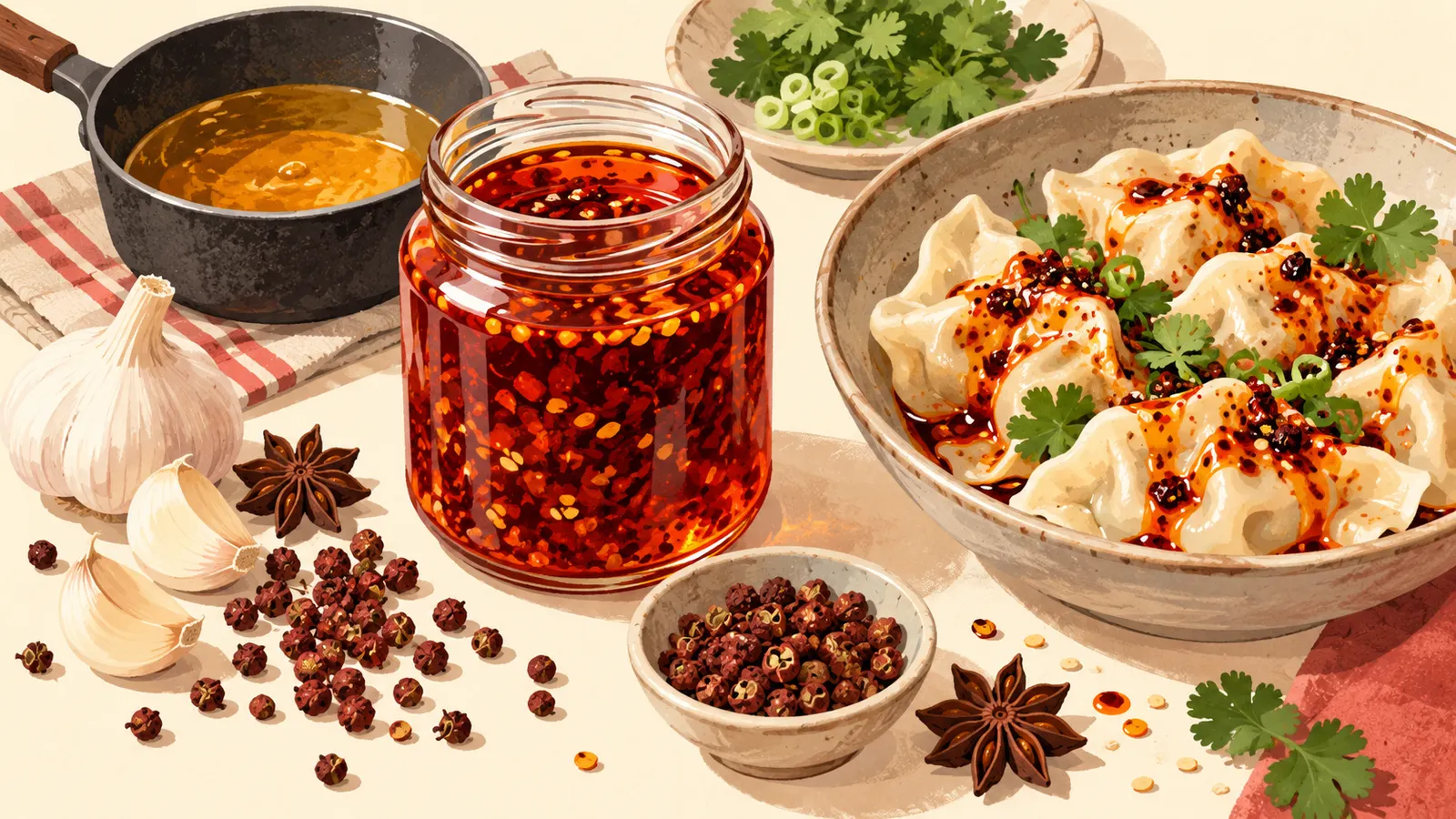
To make chilli oil, gently heat a neutral oil with whole spices and aromatics to infuse it, strain it, then pour it at about 120 to 130°C over a bowl of chilli flakes, ground Sichuan pepper, salt and sesame seeds. The hot oil sizzles, toasts the chilli and turns deep red. Once cool, jar it and keep it in the fridge.
Homemade chilli oil takes about 40 minutes, costs a fraction of a jar from the shop, and lets you choose exactly how hot, numbing and fragrant it is. This guide explains which chillies and peppercorns to buy, how to get the temperature right so nothing burns, how long it keeps safely, and what to do with it, followed by a recipe for an aromatic Sichuan-style chilli oil.
What is the difference between chilli crisp and chilli oil?
They are made the same way but eaten differently. Chilli oil (红油, red oil) is mostly oil, with a layer of chilli sediment at the bottom of the jar; you drizzle the oil and spoon up the flakes as you like. Chilli crisp reverses the ratio: it is mostly crunchy solids, such as fried garlic, shallots, chilli pieces, soybeans or peanuts, held together with just enough oil. It is spooned on as a topping rather than drizzled.
Chilli crisp contains far more fried fresh aromatics left in the jar, which matters for storage (see the safety section below). The recipe here is a classic infused chilli oil with the aromatics strained out, which is simpler, safer to keep and more versatile.
Which chilli flakes are best for chilli oil?
The chilli flakes decide the colour, heat and fragrance. Many cooks mix two kinds: one for colour and aroma, one for heat.
| Chilli | Heat | What it brings |
|---|---|---|
| Sichuan chilli flakes (often erjingtiao) | Mild to medium | Deep red colour and a rich, fruity fragrance; the classic choice |
| Facing-heaven chillies (chaotian), crushed | Medium to hot | Sharper heat and good aroma; mix with milder flakes |
| Korean gochugaru | Mild | Brilliant red colour and a sweet, slightly smoky flavour; fine-ground versions can scorch more easily |
| Supermarket crushed chillies | Hot | Lots of seeds and heat but less colour and aroma; use as part of a mix |
| Whole dried chillies you grind yourself | Varies | The freshest flavour; snip, shake out some seeds and pulse to coarse flakes |
Aim for flakes that are a mix of coarse and fine. Fine powder gives colour quickly but burns easily; coarse flakes give texture and stay crisp in the sediment. Buy from a shop with a good turnover: chilli flakes that have gone brownish and dusty have lost much of their aroma.
Do you need Sichuan peppercorns?
Not strictly, but they are what makes chilli oil taste Sichuan. Sichuan peppercorns (花椒) are not related to black pepper; they are the dried husks of a prickly ash, with a citrusy aroma and a tingling, numbing effect on the lips known as ma, which pairs with chilli heat (la) to make the famous ma la flavour.
- Red Sichuan peppercorns are the most common: warm, woody and floral.
- Green Sichuan peppercorns are sharper, more lime-like and often more numbing. A few added to the mix give a fresh edge.
- Pick out the grit: bags often contain black seeds and twigs. The black seeds are gritty and bitter, so remove what you can.
- Toast before grinding: warm them in a dry pan over a low heat for 2 to 3 minutes until fragrant, cool, then grind and sieve out the woody husk.
- Use them twice: whole peppercorns infuse the oil, and a little ground pepper goes in the chilli bowl.
What oil should you use for chilli oil?
A neutral oil that copes with heat. Rapeseed oil is traditional in Sichuan, where roasted rapeseed oil has a distinctive flavour; ordinary refined rapeseed (vegetable) oil works well in the UK. Groundnut and sunflower oil are fine too. Avoid olive oil, which brings its own flavour, and don't use toasted sesame oil as the main oil because it burns at the temperatures you need, though a tablespoon stirred in at the end adds a nutty finish.
What temperature should the oil be for chilli oil?
Temperature is the step that makes or ruins chilli oil. Too hot and the chilli flakes turn black and bitter in seconds; too cool and they stay raw-tasting and the oil never turns properly red. A cooking thermometer (affiliate link, opens in a new tab) takes the guesswork out.
- Infusing the spices: keep the oil at a gentle bubble, roughly 120 to 150°C, for 20 to 25 minutes. The aromatics should colour slowly to golden brown, not fry hard.
- Pouring over the flakes: about 120 to 130°C for most chilli flakes. Fine-ground chilli or gochugaru prefers the lower end.
- No thermometer? Drop in a single chilli flake: it should sizzle steadily and darken slightly over a few seconds. If it blackens instantly, let the oil cool for a few minutes; if it barely bubbles, heat it a little more.
- Pour in stages: add the oil in two or three additions, stirring between each, so the flakes all toast evenly and the bowl doesn't overflow as it foams.
How long does homemade chilli oil last?
This is the most important part of making chilli oil at home. Fresh garlic, ginger, shallots, spring onions and herbs can carry spores of the bacteria that cause botulism, and storing them under oil cuts off the air in a way that can let those spores grow, without any change in smell or look. UK food safety advice is to treat homemade oils containing fresh aromatics with real caution:
- If fresh aromatics stay in the oil (garlic, shallot, ginger, fresh chilli, including fried crispy garlic or shallot as in chilli crisp): keep it in the fridge from the start and use it within a few days. Don't keep it at room temperature.
- If aromatics are strained out and only dried chilli, dried spices, salt and sesame seeds remain, as in the recipe below: the risk is lower, but still keep it in a clean jar in the fridge and use it within about a month.
- Always use a clean, dry spoon: water or crumbs from a used spoon can introduce bacteria and mould.
- Throw it out if it smells rancid, looks mouldy or the lid bulges.
Chilli oil may turn cloudy or partly solid in the fridge. That's normal: let it stand at room temperature for 10 to 15 minutes, or spoon out what you need, and it will loosen. Shop-bought chilli oils and crisps are made with controlled processes, so follow the storage instructions on their labels.
How do you use chilli oil?
Chilli oil is a seasoning, not just a heat source. A spoonful of oil and sediment lifts almost anything savoury:
- Dumpling dip: 1 tbsp chilli oil, 1 tbsp light soy sauce, 1 tbsp Chinkiang black vinegar and a pinch of sugar. Our dumpling night pantry essentials has more dipping sauce ideas.
- Wontons in chilli oil: boiled wontons tossed in chilli oil, soy sauce, black vinegar, garlic and spring onion.
- Noodles: stir through hot or cold wheat noodles with soy sauce, sesame paste and vinegar for a quick dan dan-style bowl.
- Eggs: spooned over fried eggs, scrambled eggs or egg fried rice.
- Cold dishes: dress smacked cucumber, cooked chicken, tofu or blanched greens with chilli oil, soy and vinegar.
- Soups and hot pots: a swirl on top of noodle soup or a ladleful in a hot pot dipping bowl.
- Beyond Chinese food: on pizza, avocado toast, roasted vegetables or stirred into mayonnaise.
For the soy sauces, vinegars and pastes that go with it, see our Chinese sauces and condiments guide.
What you'll need
A thermometer takes the guesswork out of the oil temperature.
- Digital cooking thermometerPour the oil at the right temperature so the chilli toasts without burning.See options on Amazon (affiliate link, opens in a new tab)
- Heatproof glass jarsFor pouring and storing the oil; sterilise them first.See options on Amazon (affiliate link, opens in a new tab)
- Fine mesh strainerStrains broths, oils and sauces cleanly.See options on Amazon (affiliate link, opens in a new tab)
- Sichuan peppercornsFor the tingle; buy whole and fry them in the oil.See options on Amazon (affiliate link, opens in a new tab)
Some links on this page are affiliate links: if you buy through them we may earn a small commission, at no extra cost to you. It never affects which shops we list. How we make money.
Where to buy chilli flakes and Sichuan peppercorns
Chinese supermarkets are the best place for Sichuan chilli flakes, whole dried chillies, red and green Sichuan peppercorns, star anise, cassia bark and black cardamom. Our directory lists 259 shops stocking Chinese groceries, where Sichuan peppercorns, chilli flakes and whole spices are sold in bags far bigger and cheaper than supermarket jars. You'll find the widest choice in London, Edinburgh, Manchester and Birmingham. For gochugaru, try Korean grocers, especially in London and Glasgow.
Recipe
Aromatic Sichuan-style chilli oil (红油)
A deep red, fragrant chilli oil with gentle numbing heat from Sichuan peppercorns. The aromatics are strained out before the oil goes over the chilli, so it keeps in the fridge for about a month.
- Serves
- Makes about 350 ml
- Prep
- 10 min
- Cook
- 30 min
- Total
- 40 min
Ingredients
- 300 ml rapeseed, groundnut or sunflower oil
- 40 g Sichuan chilli flakes (or 25 g Sichuan flakes and 15 g gochugaru)
- 1 tbsp red Sichuan peppercorns, toasted and finely ground
- 1 tbsp whole red Sichuan peppercorns
- 2 tbsp toasted white sesame seeds
- 1 tsp salt
- 1 tsp caster sugar
- 2 star anise
- 5 cm piece cassia bark or cinnamon stick
- 2 bay leaves
- 1 black cardamom pod, lightly crushed (optional)
- 1 banana shallot, thinly sliced
- 3 thick slices fresh ginger
- 2 spring onions, cut into 5 cm lengths
- 1 tbsp toasted sesame oil (optional)
Method
- 1Put the chilli flakes, ground Sichuan pepper, sesame seeds, salt and sugar in a large, dry heatproof metal or ceramic bowl and mix well.
- 2Put the oil, whole Sichuan peppercorns, star anise, cassia, bay leaves, black cardamom, shallot, ginger and spring onions in a small saucepan.
- 3Heat over a low to medium heat so the oil bubbles gently (roughly 120 to 150°C). Infuse for 20 to 25 minutes, until the shallot and spring onions are golden brown and crisp at the edges. Don't let the oil smoke.
- 4Strain the oil through a heatproof sieve into a clean pan or jug and discard all the aromatics and spices. Check the temperature: you want 120 to 130°C. Warm it briefly or let it cool for a few minutes as needed.
- 5Pour about a third of the hot oil over the chilli mixture; it will foam and sizzle. Stir, wait 30 seconds, then add the rest in two more additions, stirring each time. The oil should turn a deep, clear red.
- 6Stir in the sesame oil if using and leave to cool completely, about 1 hour. Spoon into a clean, dry jar, seal and keep in the fridge. Use within about a month, always with a clean, dry spoon.
The flavour improves after a day as the chilli settles and the oil takes on more colour. Once you have a batch in the fridge, it will quickly become the condiment you reach for most, from dumplings and noodles to eggs on toast.