
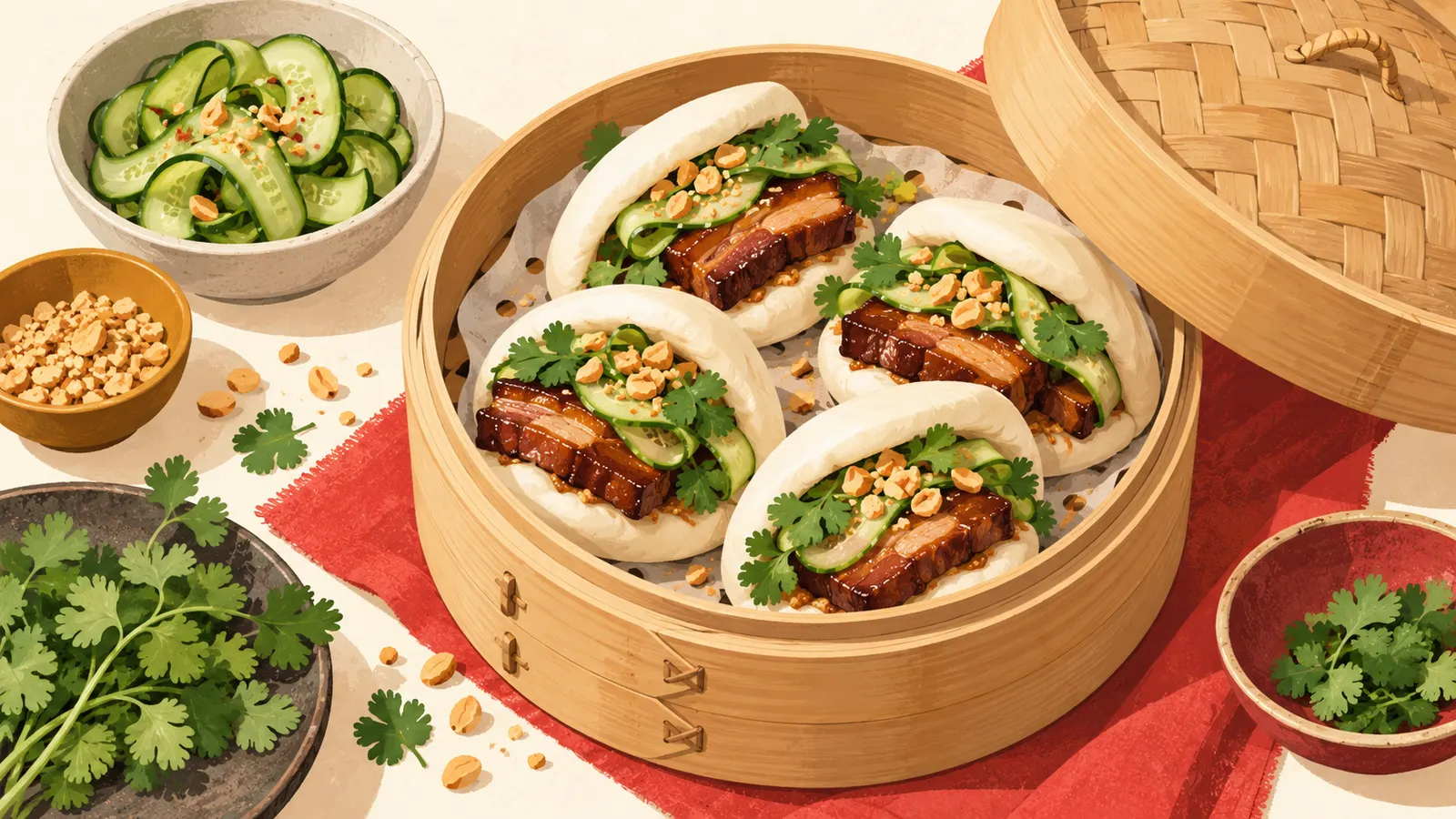
To make bao buns, knead a soft dough of plain flour, yeast, baking powder, sugar, milk and a little oil, let it double in size, then roll it into ovals, fold each one over an oiled chopstick, prove again for 20 to 30 minutes and steam over a medium-high heat for 10 to 12 minutes. Leave the lid on for a few minutes after turning the heat off so the buns don't wrinkle.
Folded bao, known as gua bao (割包) in Taiwan and often called "bao buns" or "bao sandwiches" in the UK, are the soft, white, clam-shaped buns stuffed with braised pork belly, crispy chicken or tofu. They look restaurant-only, but they are one of the easiest yeasted doughs to make at home. This guide covers the dough, shaping, steaming, the common problems and how to freeze them, followed by a recipe for ten buns with a quick hoisin chicken filling.
What flour is best for bao dough?
Bao want a soft, tender crumb, so a lower-protein flour works best. Ordinary UK plain flour (around 9 to 10% protein) gives very good results. Strong bread flour makes chewier, denser buns that can wrinkle. Asian supermarkets also sell flour labelled bao flour, Hong Kong flour or dim sum flour, a very fine, low-protein wheat flour that gives the whitest, smoothest buns; it is the closest you'll get to restaurant bao.
- Plain flour: reliable, easy to find and slightly creamy in colour.
- Bao or Hong Kong flour: whiter and fluffier; use the same quantity.
- Mix in cornflour: if you only have plain flour, swapping 30 g of every 300 g for cornflour lowers the protein and gives a softer, paler bun.
- Avoid self-raising flour: the amount of raising agent isn't controlled, and too much can give yellow, bitter-tasting buns.
How do you make bao dough?
The dough is a lightly enriched yeast dough with a little baking powder for extra lift. For ten buns you need about 300 g of flour. The method is simple, but two things matter: knead until the dough is completely smooth, and don't let it over-prove.
- Mix: combine flour, sugar, fast-action yeast and baking powder, then add warm milk (or water) and oil. Milk gives a softer, richer bun; water gives a slightly whiter one.
- Knead: 8 to 10 minutes by hand or 5 to 6 minutes with a dough hook, until the dough is smooth, soft and springs back when pressed. It should feel like an earlobe, not sticky and not stiff.
- First prove: cover and leave somewhere warm until doubled, usually 1 to 1½ hours. In a cold kitchen it can take 2 hours.
- Knock back and knead again: knead for a minute or two to push out large air bubbles. This step is what gives bao a fine, even, smooth surface.
How do you fold gua bao?
- Divide the dough into ten equal pieces of about 50 g and roll each into a ball. Keep them covered so they don't dry out.
- Roll each ball into an oval about 12 cm long, 8 cm wide and 4 to 5 mm thick. Rolling from the centre outwards keeps the thickness even.
- Brush the top lightly with oil. This stops the two halves sticking together as they steam.
- Lay a chopstick (lightly oiled) across the middle, fold the oval over it, then slide the chopstick out. The chopstick leaves a neat gap so the bun opens easily later. A strip of baking paper inside the fold does the same job.
- Put each bun on its own square of baking paper, about 10 cm, so you can lift it in and out of the steamer.
Cover the shaped buns and leave them for a second prove of 20 to 30 minutes, until they look puffy and feel light. They should grow by about a third, not double; over-proved buns spread, lose their shape and wrinkle in the steamer.
How long do you steam bao buns?
Steam bao over a medium-high heat for 10 to 12 minutes, then turn off the heat and leave the lid on for 3 to 5 minutes before lifting it. Bring the water to the boil before the buns go in, and space them at least 3 cm apart, because they expand. A bamboo steamer (affiliate link, opens in a new tab) is ideal because the lid absorbs condensation instead of dripping it onto the buns; our guide on how to use a bamboo steamer covers setting one up over a wok (affiliate link, opens in a new tab) or pan.
| Bao | Heat | Time |
|---|---|---|
| Fresh folded bao (50 g dough) | Medium-high, water at a steady boil | 10 to 12 minutes, then 3 to 5 minutes resting with the lid on |
| Fresh round filled bao (about 80 g) | Medium-high | 14 to 15 minutes, then 5 minutes resting |
| Bao made earlier, chilled | Medium-high | 5 to 6 minutes, until soft and hot |
| Homemade or shop-bought frozen bao | Medium-high | 8 to 12 minutes from frozen, until hot right through (follow the pack for shop-bought) |
Why are my bao yellow, wrinkled or flat?
Most bao problems trace back to proving, raising agents or steam. Use this list to diagnose a batch:
- Yellow buns or yellow spots: usually too much baking powder or bicarbonate of soda, or raising agent that didn't mix in evenly. Measure carefully and whisk it into the flour first. Plain flour also gives a slightly creamier colour than bao flour, which is normal.
- Wrinkled or shrivelled skin: the most common cause is lifting the lid straight away, so the sudden drop in temperature makes the surface collapse. Rest them with the lid on. Over-proving and under-kneading also cause wrinkles.
- Wet patches or dimples: condensation dripping from a metal lid. Wrap the lid in a clean tea towel, tied up well away from the flame, or use a bamboo steamer.
- Dense, flat buns: under-proved dough, old yeast, or flour that's too strong. Check the yeast's use-by date and give the dough the full first prove.
- Buns stuck together inside: the fold wasn't oiled, or the dough was too thick.
- Rough, uneven surface: the dough wasn't kneaded smooth, or it was left uncovered and dried out. Knead longer and keep pieces covered while you work.
- Bubbles or holes on the surface: large air pockets left in the dough. Knead after the first prove, and roll each piece firmly.
Can you freeze bao buns?
Yes, and they freeze extremely well. Steam the buns fully, let them cool completely, then freeze them on a tray in a single layer (still on their paper squares) before packing them into a freezer bag. Use within about three months. Steam from frozen for 8 to 12 minutes until soft and hot all the way through; there's no need to defrost. You can also freeze shaped, unsteamed buns, but they rise less reliably, so steaming first is the safer option. If you'd rather skip making dough, most Asian supermarkets sell ready-made frozen bao in the freezer cabinets; our guide to the Asian supermarket frozen aisle covers what else is worth stocking up on.
What are the best fillings for bao buns?
Gua bao are built like a sandwich: something rich, something sharp and crunchy, and something fresh. Some favourite combinations:
- Braised pork belly (the classic Taiwanese filling) with pickled mustard greens, crushed peanuts, sugar and coriander.
- Crispy fried chicken with a sweet chilli or gochujang mayonnaise and quick-pickled cucumber.
- Hoisin chicken or duck with cucumber, spring onion and a drizzle of hoisin sauce.
- Crispy tofu or mushrooms glazed in soy, sugar and a little chilli, for a vegan version (make the dough with water or plant milk). See our guide on how to cook tofu.
- Char siu pork with spring onion and a dash of homemade chilli oil.
- Fried fish with tartare sauce, shredded lettuce and pickled red onion.
What you'll need
Bao need a steamer and very little else.
- Two-tier bamboo steamer (25 cm)Fits most woks and large pans; two tiers cook a full batch at once.See options on Amazon (affiliate link, opens in a new tab)
- Perforated steamer linersStop dumplings and bao sticking without blocking the steam.See options on Amazon (affiliate link, opens in a new tab)
- Rolling pinRolls the dough into even ovals before folding.See options on Amazon (affiliate link, opens in a new tab)
- Hoisin sauceThe sweet, savoury sauce for pork belly bao.See options on Amazon (affiliate link, opens in a new tab)
Some links on this page are affiliate links: if you buy through them we may earn a small commission, at no extra cost to you. It never affects which shops we list. How we make money.
Where to buy bao flour, a bamboo steamer and fillings
Chinese and pan-Asian supermarkets sell bao or Hong Kong flour, bamboo steamers in every size, pre-cut steamer papers, hoisin sauce, pickled mustard greens and frozen ready-made bao. Our directory lists 259 shops stocking Chinese groceries. The best-served cities are London, Edinburgh, Manchester and Birmingham. Korean grocers are worth a look for gochujang and fried chicken coatings if you want a Korean-style filling.
Recipe
Fluffy folded bao buns (gua bao) with hoisin chicken
Soft, white, pillowy folded bao filled with sticky hoisin chicken, crunchy quick-pickled cucumber and fresh coriander. Prep time includes about 1½ hours of proving.
- Serves
- 10 buns (4 people)
- Prep
- 130 min
- Cook
- 25 min
- Total
- 155 min
Ingredients
- 300 g plain flour or bao flour, plus extra for dusting
- 25 g caster sugar
- 1 tsp (about 3 g) fast-action dried yeast
- 1 tsp baking powder
- 160 ml warm whole milk or water
- 1 tbsp neutral oil, plus extra for brushing
- For the filling: 500 g boneless, skinless chicken thighs, cut into strips
- 3 tbsp hoisin sauce, plus extra to serve
- 1 tbsp light soy sauce
- 1 tbsp neutral oil, for frying
- ½ cucumber, thinly sliced
- 2 tbsp rice vinegar and 1 tsp sugar, for the pickle
- 2 tbsp roasted peanuts, crushed
- Small bunch of coriander and 2 spring onions, thinly sliced
Method
- 1Mix the flour, sugar, yeast and baking powder in a large bowl. Add the warm milk and 1 tbsp oil and bring together into a dough. Knead for 8 to 10 minutes until completely smooth and soft.
- 2Cover and leave somewhere warm for 1 to 1½ hours, until doubled in size. Knock back and knead for 1 to 2 minutes to remove large air bubbles.
- 3Divide into 10 pieces of about 50 g. Roll each into an oval about 12 x 8 cm and 4 to 5 mm thick, brush the top with oil, fold over an oiled chopstick and slide the chopstick out. Put each bun on a 10 cm square of baking paper.
- 4Cover and prove for 20 to 30 minutes until puffy. Meanwhile, toss the cucumber with the rice vinegar, sugar and a pinch of salt, and mix the chicken with the hoisin and soy sauce.
- 5Bring a pan or wok of water to the boil under a bamboo steamer. Steam the buns in batches, 3 cm apart, over a medium-high heat for 10 to 12 minutes. Turn off the heat and leave the lid on for 3 to 5 minutes before lifting it.
- 6While the buns steam, heat 1 tbsp oil in a frying pan over a medium-high heat and fry the chicken for 6 to 8 minutes, turning, until sticky, caramelised and cooked through with no pink inside.
- 7Open each warm bun and fill with chicken, drained cucumber, peanuts, coriander and spring onion. Add a little more hoisin and serve straight away.
Once you've made bao a couple of times, the dough becomes second nature, and a batch of steamed buns in the freezer turns any leftover roast, braise or crispy tofu into a quick, impressive dinner.