
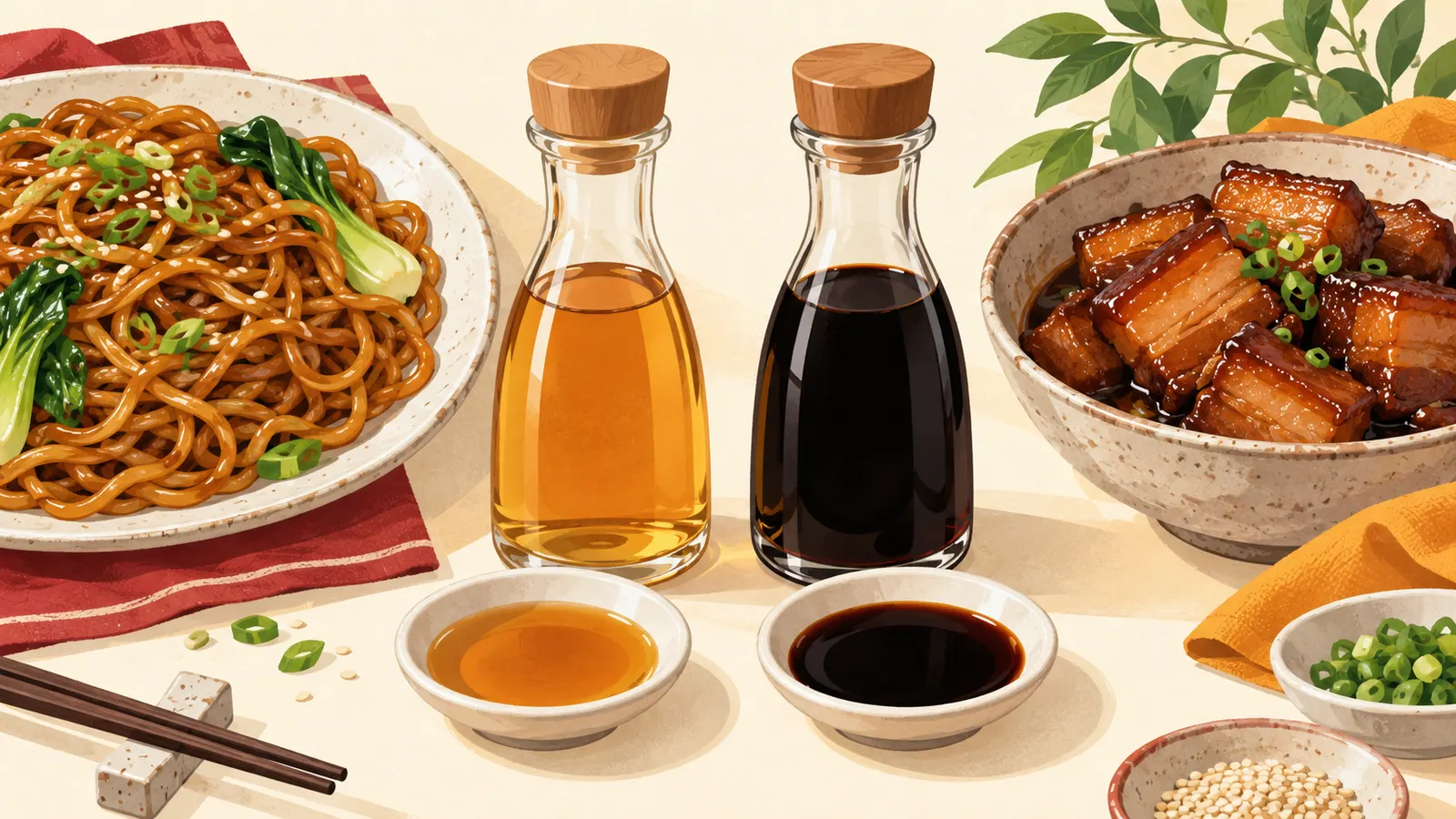
Light soy sauce is thin, pale and salty, and it is the one you season with. Dark soy sauce is thicker, darker, slightly sweet and less sharp, and it is used in small amounts mainly for colour. Most Chinese recipes that call for both use light soy for flavour and a splash of dark to turn noodles, braises and fried rice a glossy mahogany brown.
The names trip people up because "light" describes the colour, not the salt. Light soy is actually the saltier of the two, and reduced-salt soy sauce is a different product altogether. Add Japanese shoyu, tamari, kecap manis and Korean soup soy to the shelf and it is easy to buy the wrong bottle. Here is what each tastes like, when to add it and what you can swap, plus a Hong Kong-style soy sauce chow mein.
Light vs dark soy sauce: the key differences
- Light soy (生抽, sheng chou) is the first, thinner liquid drawn off the fermented soybean mash. It is reddish-brown, runny and salty, with a clean savoury flavour. On a Chinese label it may be called "superior light", "premium" or "first draw" (头抽).
- Dark soy (老抽, lao chou) is aged for longer and usually thickened with caramel or molasses, so it coats a spoon and stains everything it touches. It tastes rounder, a little sweet and less sharply salty than light soy.
- How much to use: light soy goes in by the tablespoon; dark soy by the teaspoon. A dish that tastes flat needs more light soy. A dish that looks pale needs a little dark soy.
- When to add it: light soy goes into marinades, sauces and dressings, and can be splashed in at the end. Dark soy needs heat and a little time to spread its colour, so add it to braises early and to noodles or fried rice while they are still in the wok (affiliate link, opens in a new tab).
| Type | Colour and texture | Flavour | Use it for |
|---|---|---|---|
| Chinese light soy (生抽) | Reddish-brown, thin | Salty, clean, savoury | Everyday seasoning, marinades, dipping sauces, steamed fish |
| Chinese dark soy (老抽) | Near-black, syrupy | Mellow, slightly sweet, less salty-tasting | Colour in red-braised pork, chow mein, fried rice |
| Mushroom dark soy (草菇老抽) | Near-black, syrupy | As dark soy with an earthy, mushroomy depth | Braises, vegetarian stir-fries, noodles |
| Japanese koikuchi shoyu (濃口醤油) | Dark brown, thin | Balanced, rounded, slightly sweet and aromatic | All-purpose Japanese cooking, sushi, teriyaki |
| Japanese usukuchi shoyu (淡口醤油) | Light amber, thin | Saltier than koikuchi, delicate | Clear soups, simmered vegetables, dashi broths |
| Tamari (たまり) | Very dark, slightly thicker | Rich, deep, less wheaty | Dipping, glazes, cooks who avoid wheat (check the label) |
| Kecap manis | Black, treacle-thick | Very sweet, caramel and soy | Nasi goreng, mie goreng, satay marinades, glazes |
| Korean guk-ganjang (국간장) | Light brown, thin | Very salty, funky | Seasoning soups and namul vegetable side dishes |
| Reduced-salt soy | As the standard version | Slightly softer | Swap 1:1 for the brand's standard soy |
What is light soy sauce used for?
Almost everything. Light soy is the salt in a Chinese kitchen: a tablespoon in a stir-fry sauce, a teaspoon in a marinade for 300g of sliced chicken, a dash in a dumpling filling, or stirred into vinegar and chilli oil for a dipping sauce. If a recipe just says "soy sauce", light soy is the safe choice; it seasons food without turning it brown.
What is dark soy sauce used for?
Dark soy is the reason restaurant chow mein, red-braised pork belly (红烧肉) and soy sauce chicken look the way they do. One or two teaspoons is enough to colour a wok of noodles for two; a tablespoon will darken a braise for four. On its own it makes food look right but taste under-seasoned, which is why most recipes pair it with light soy.
Mushroom dark soy is dark soy infused with straw mushroom extract. It does the same colouring job with a little extra earthy depth, and it is a good default if you only want to buy one dark soy. Use it exactly as you would regular dark soy.
Japanese vs Chinese soy sauce
Japanese soy sauce (shoyu) is typically brewed with roughly equal parts soybeans and roasted wheat, which gives it a rounder, slightly sweeter and more aromatic flavour than Chinese light soy. Koikuchi is the standard all-purpose Japanese soy: darker in colour than Chinese light soy but similar in saltiness. Usukuchi is the confusing one: it is lighter in colour than koikuchi but noticeably saltier, and it is used where cooks want seasoning without browning, such as clear soups and simmered vegetables.
In a pinch the two are interchangeable: koikuchi works in a stir-fry and Chinese light soy in a sushi dip. For more on Japanese seasonings, see our miso guide.
Tamari vs soy sauce
Tamari is a Japanese soy sauce made mostly or entirely from soybeans, with little or no wheat. It is darker, slightly thicker and richer than koikuchi, with a deep savoury flavour and less of the bready aroma that wheat gives. Many tamari bottles are wheat-free, which is why people avoiding wheat or gluten reach for it, but not all are, so always check the label rather than assuming. Use it 1:1 in place of light soy; its body makes it especially good for dipping and glazes.
What is kecap manis?
Kecap manis is Indonesian sweet soy sauce: soy sauce cooked down with palm sugar until it is as thick as treacle. It is much sweeter than Chinese dark soy and not a substitute for it. It is essential in nasi goreng and mie goreng and brushed over satay. If you run out, simmer equal volumes of light soy and dark brown sugar for a few minutes until syrupy. Look for it on the Indonesian and Malaysian shelves.
Korean soy sauce: guk-ganjang
Korean kitchens usually keep two soys. Everyday jin-ganjang (진간장) behaves much like Japanese koikuchi and goes into bulgogi marinades and braises. Guk-ganjang (국간장), or soup soy, is paler and saltier, with a funky, fermented flavour; a teaspoon or two seasons a whole pot of seaweed soup or a bowl of blanched spinach without darkening it. Our gochujang guide covers the rest of the Korean pantry.
Is low-sodium soy sauce worth buying?
Reduced-salt or "less salt" soy sauce is brewed in the usual way and then has some of the salt removed, so it tastes very similar to the standard version. If you are cutting back on salt it is an easy swap at 1:1; compare the salt per 100ml on the back of the bottles, because the reduction varies between brands. Light soy, despite its name, is not a low-salt product.
How to read a soy sauce label
- Naturally brewed or fermented: made by fermenting soybeans (and usually wheat) for months. It has more depth than cheaper blended or hydrolysed soy, which is made quickly and coloured with caramel.
- Ingredients: a good light soy lists little more than water, soybeans, wheat and salt. Sugar, colouring and flavour enhancers are common in dark soy and are not a bad sign there.
- Wheat: if you are avoiding it, read the allergen panel on every bottle, including tamari. Most Chinese and Japanese soy sauces contain wheat.
How to store soy sauce
Unopened soy sauce keeps for years in a cool cupboard. Once opened it slowly darkens and loses its aroma, so if a bottle will take you months to finish, keep it in the fridge. Many Japanese brands ask you to refrigerate after opening; follow the label. Kecap manis and other sweet soys are best kept in the fridge once opened.
Recipe: soy sauce chow mein (豉油皇炒麵)
Superior soy sauce noodles are a Hong Kong dim sum and breakfast classic, and the clearest demonstration of light and dark soy working together: light soy for seasoning, dark soy for the deep, even colour. Dry the noodles well, use a very hot wok and toss rather than stir. Our stir-fry guide covers wok heat and timing in more detail.
Recipe
Soy sauce chow mein (豉油皇炒麵)
Hong Kong-style superior soy sauce noodles: thin egg noodles fried until lightly crisp, then tossed with light and dark soy, beansprouts and spring onions. Ready in under 25 minutes.
- Serves
- 2 people
- Prep
- 15 min
- Cook
- 8 min
- Total
- 23 min
Ingredients
- 200g fresh thin egg noodles (Hong Kong-style pan-fry noodles), or 150g dried thin egg noodles
- 3 tbsp vegetable or groundnut oil
- ½ onion, thinly sliced
- 4 spring onions, cut into 5cm lengths, whites and greens separated
- 150g beansprouts, rinsed and drained well
- 2 tbsp light soy sauce
- 1 tbsp dark soy sauce
- 1 tsp caster sugar
- 1 tbsp water
- ½ tsp toasted sesame oil
- A pinch of ground white pepper
Method
- 1Cook the noodles in a large pan of boiling water for 30–60 seconds if fresh (or according to the packet if dried) until just loosened but still firm. Drain, rinse under cold water and shake very dry. Spread them on a tray, toss with 1 tsp of the oil and leave to air-dry for 10 minutes.
- 2Mix the light soy, dark soy, sugar and water in a small bowl until the sugar dissolves.
- 3Heat a wok or large frying pan over a high heat until smoking. Add 2 tbsp of the oil, then the noodles, spread out in an even layer. Leave them alone for 1–2 minutes until crisp and golden in places, then flip and fry for another minute. Tip them on to a plate.
- 4Add the remaining oil to the wok, then the onion and spring onion whites. Stir-fry for about 1 minute until fragrant and just softening.
- 5Return the noodles to the wok. Pour the sauce around the hot edge of the wok rather than straight on to the noodles, then toss with tongs or chopsticks for 1–2 minutes, lifting and shaking, until every strand is evenly coloured.
- 6Add the beansprouts and spring onion greens and toss for 30–60 seconds until just wilted but still crunchy. Turn off the heat, add the sesame oil and white pepper, toss once more and serve straight away.
Stock your pantry
The four soy sauces worth having, so you can use the right one for each dish.
- Light soy sauceYour everyday soy for seasoning; thin and salty.See options on Amazon (affiliate link, opens in a new tab)
- Dark soy sauceThicker and less salty, mainly for colour in braises and noodles.See options on Amazon (affiliate link, opens in a new tab)
- TamariOften wheat-free; check the label if you avoid gluten.See options on Amazon (affiliate link, opens in a new tab)
- Kecap manis (sweet soy sauce)Thick, molasses-sweet soy that gives nasi goreng and satay their colour.See options on Amazon (affiliate link, opens in a new tab)
Some links on this page are affiliate links: if you buy through them we may earn a small commission, at no extra cost to you. It never affects which shops we list. How we make money.
Where to buy light and dark soy sauce in the UK
Every UK supermarket stocks a light and a dark soy, but a Chinese grocer has the full range: large bottles of light soy, mushroom dark soy, first-draw and premium soys, tamari, kecap manis and Korean soup soy, usually for less per 100ml. Our directory lists 259 stores that stock Chinese groceries, with the most in London, Edinburgh and Birmingham.
Large Chinese supermarkets such as SeeWoo in London's Chinatown, Wing Yip Superstore Birmingham and W.H. Lung Supermarket in Manchester give soy sauce a whole aisle, so you can compare types side by side.
Chinese groceries by city
Once you have the soys sorted, our guide to Chinese sauces and condiments covers the rest of the shelf, from oyster sauce to Chinkiang vinegar, and the dumpling night pantry list puts them to work.