
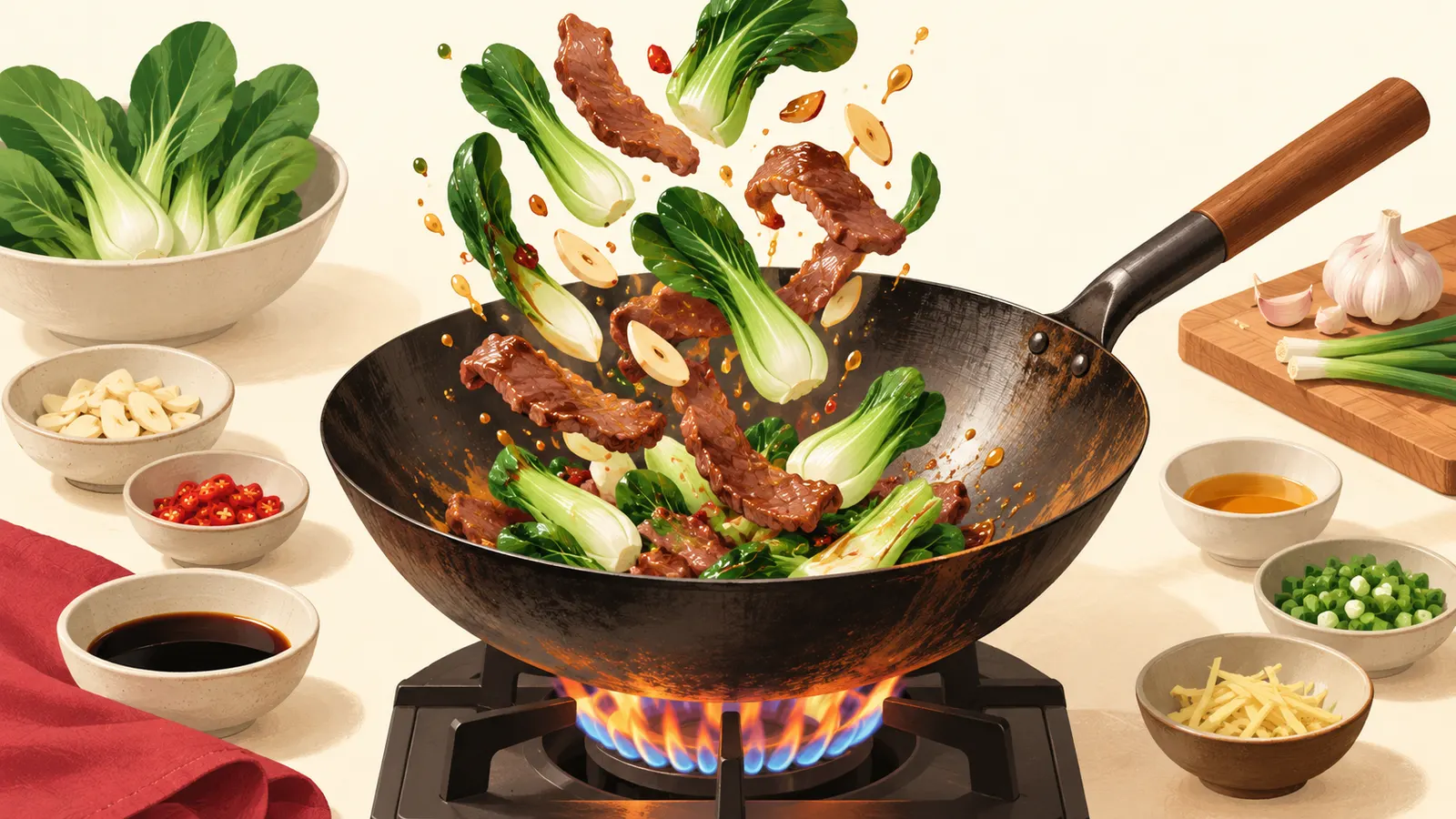
To stir fry, cut everything small and even, heat a wok (affiliate link, opens in a new tab) or wide frying pan until it just smokes, add a little high-smoke-point oil, sear the meat in small batches, then cook the vegetables hardest first and add a pre-mixed sauce only in the last minute. Cooking takes five to eight minutes, so every ingredient must be prepped and lined up before the heat goes on.
What is the best wok for gas, induction and electric hobs?
A carbon steel wok of 30 to 36 cm is the best all-rounder: it heats fast, responds quickly when you turn the heat down, and becomes naturally non-stick once seasoned. The shape depends on your hob.
- Gas: a round-bottomed wok on a wok ring, or a flat-bottomed one, sits in the flame so the sides get hot too. Gas gets closest to restaurant results.
- Induction: you need a flat-bottomed wok in a magnetic metal such as carbon steel or cast iron (look for the induction symbol). Induction only heats metal touching the glass, so a wok with a small flat base heats a small patch; a wide, heavy frying pan often works as well or better.
- Electric or ceramic: slow to heat and slow to recover, so use a heavy flat-bottomed pan, preheat it for longer and cook smaller batches. Stir with a spatula rather than lifting the pan off the heat to toss.
- Non-stick: fine for eggs and fried rice, but most manufacturers advise against heating them empty on high, so you won't get a proper sear.
How do you season a carbon steel wok?
- Scrub off the factory coating (oil or lacquer to stop rust in the shop) with hot soapy water and a scourer.
- Dry it, then heat it on the hob until the metal changes colour; on gas it turns straw-gold to blue-grey. Work round the pan so the sides colour too, with the window open and the extractor on.
- Wipe a very thin film of neutral oil over the inside with kitchen paper held in tongs, and heat until it smokes and darkens, two to three minutes. Repeat three or four times.
- Stir-fry a handful of sliced spring onion and ginger in a little oil for a few minutes, then discard them. This traditional first-use step helps build the coating.
Why is my stir fry soggy?
Almost always heat. Put too much food in at once and the pan temperature collapses, moisture leaks out of the vegetables and they stew instead of searing. The usual culprits:
- Overcrowding: on a home hob, cook no more than about 250 to 300 g of meat or vegetables at a time. If the sizzle turns into a bubble, the pan is too full. Cook in batches and combine at the end.
- Wet vegetables: water on washed greens turns straight to steam. Dry them in a salad spinner or tea towel.
- Sauce added too early: liquid stops browning instantly, so it goes in last, for 30 to 60 seconds.
- Not enough preheating: a drop of water flicked into the pan should skitter and vanish within a second or two.
- Too much sauce: for two people, about 7 tablespoons in total, including any water or stock, is plenty. You want a glaze, not a puddle.
- Constant stirring: let meat and firm vegetables sit for 20 to 30 seconds between tosses so they brown.
Can you get wok hei at home?
Wok hei, roughly "breath of the wok", is the smoky, slightly charred flavour of restaurant stir fries, produced by huge burners and oil and sauce scorching on very hot metal. A home hob can't fully copy it, but you can get closer: preheat longer than feels comfortable, cook small batches, let food take colour before tossing, and pour the sauce (or a splash of Shaoxing wine) down the hot sides of the wok so it sizzles and caramelises.
Which oil is best for stir-frying?
A neutral oil that copes with high heat: groundnut, rapeseed (often sold as vegetable oil) or sunflower. Groundnut is traditional, but check before cooking for anyone with a peanut allergy. Skip extra virgin olive oil, and keep toasted sesame oil for a few drops off the heat. Most batches need only 1 to 2 tablespoons.
How do you velvet meat for stir-frying?
Velveting is the restaurant trick that keeps sliced chicken, pork or beef silky. For 300 g of meat sliced 3 to 5 mm thick across the grain:
- Mix with 1 tbsp light soy sauce, 1 tsp Shaoxing wine, 2 tsp cornflour and 1 tsp oil; half a beaten egg white makes it softer still. For beef, many cooks add about ¼ tsp bicarbonate of soda to tenderise it.
- Leave in the fridge for 15 to 30 minutes.
- Sear in a single layer for 1 to 2 minutes, or blanch in barely simmering water for about a minute until the outside turns opaque and drain well.
- Set aside and return it to the wok with the sauce, cooking until chicken and pork are cooked through with no pink left.
What is a good stir fry sauce ratio?
A dependable all-purpose sauce for two: 2 tbsp light soy sauce, 1 tbsp oyster sauce, 1 tbsp Shaoxing wine, 1 tsp sugar, ½ tsp dark soy sauce, 3 tbsp water or stock and 1 tsp cornflour, stirred together before you start. Light soy seasons and dark soy colours: see light vs dark soy sauce, and our Chinese sauces and condiments guide covers oyster sauce, black bean sauce and the rest of the cupboard.
In what order should you add vegetables to a stir fry?
Dense vegetables first, leafy and delicate ones last, so everything finishes together. Slice hard vegetables thinly and on the diagonal for more surface area.
| Vegetable | Cut | When it goes in |
|---|---|---|
| Garlic, ginger, chilli | Finely chopped or thinly sliced | First, 10 to 20 seconds in the hot oil |
| Carrot | Thin diagonal slices or 3 mm batons | First, about 2 minutes before the rest |
| Broccoli, Tenderstem | Small florets, stems sliced thinly | First; add 2 tbsp water and cover for 1 minute |
| Green beans, long beans | 4 cm lengths | First, or blanch for 2 minutes beforehand |
| Onion | Wedges or 5 mm slices | Early, with the hard vegetables |
| Peppers | 2 cm squares or strips | Middle, 2 to 3 minutes before the end |
| Mushrooms | 5 mm slices or torn | Middle; leave for 30 seconds to brown |
| Pak choi, choi sum, gai lan | Stems and leaves separated | Stems in the middle, leaves in the last 30 to 60 seconds |
| Mangetout, sugar snaps | Whole, strings removed | Late, 1 to 2 minutes before the end |
| Bean sprouts | Whole, rinsed and dried | Late, but cook until piping hot throughout |
| Spring onion | 4 cm lengths, whites and greens separated | Whites with the aromatics, greens at the very end |
The stir fry order of work, step by step
- Prep everything (mise en place): cut the meat and vegetables, mix the sauce and line up bowls beside the hob in the order they go in.
- Preheat the empty wok on the highest heat until it just smokes, then add 1 tbsp oil and swirl.
- Sear the protein in batches in a single layer, take it out slightly underdone and set aside.
- Fry the aromatics for a few seconds in a little more oil, then add the vegetables, hardest first.
- Return the protein, stir the sauce and pour it down the sides. Toss for 30 to 60 seconds until glossy and the meat is cooked through, then serve straight away.
What about fried rice and noodles?
Egg fried rice needs day-old cooked rice: fresh rice is too soft and steamy and turns to mush, while chilled rice has firmed up and separates into grains. Cool cooked rice quickly (within an hour), keep it covered in the fridge and use it within a day; our guide to how to cook perfect rice covers the method. Cook noodles slightly under, drain, toss with a little oil and add them after the vegetables so they only need heating through.
What you'll need
You don't need much, but a proper wok and spatula make the method in this guide far easier.
- Flat-bottomed carbon steel wok (35 cm)Heats fast and works on gas, electric and induction; season it once and it becomes non-stick.See options on Amazon (affiliate link, opens in a new tab)
- Wok spatulaIts curved edge follows the wok so you can toss and scrape without leaving food behind.See options on Amazon (affiliate link, opens in a new tab)
- Bamboo wok brushCleans a seasoned wok with hot water and no soap.See options on Amazon (affiliate link, opens in a new tab)
- Chinese cleaverSlices meat thinly and scoops chopped vegetables straight into the wok.See options on Amazon (affiliate link, opens in a new tab)
- Shaoxing rice wineSplashed round the hot wok, it gives stir-fries their restaurant aroma.See options on Amazon (affiliate link, opens in a new tab)
Some links on this page are affiliate links: if you buy through them we may earn a small commission, at no extra cost to you. It never affects which shops we list. How we make money.
Where to buy wok ingredients and equipment
Chinese and pan-Asian supermarkets are the cheapest places for carbon steel woks, Shaoxing wine, big bottles of soy sauce, and greens such as pak choi, choi sum and gai lan. Our directory lists 259 shops stocking Chinese groceries, and 245 stores across all cuisines say they sell fresh produce. The best-served cities are London, Manchester, Edinburgh and Birmingham. Thai grocers are worth a look for holy basil and long beans. To keep your greens crisp until stir fry night, see how to store Asian herbs and vegetables.
Recipe
Garlic pak choi stir-fry (蒜蓉炒白菜)
The simplest Chinese greens dish: pak choi flashed in a hot wok with plenty of garlic and a light, glossy sauce. Four minutes of cooking, and the best way to practise heat control.
- Serves
- 2 as a side
- Prep
- 10 min
- Cook
- 4 min
- Total
- 14 min
Ingredients
- 400 g pak choi (about 4 small heads)
- 4 garlic cloves, finely chopped
- 1 tbsp groundnut or rapeseed oil
- 1 tbsp light soy sauce
- ½ tsp sugar
- ½ tsp cornflour
- 2 tbsp cold water
- Pinch of salt
- ½ tsp toasted sesame oil (optional)
Method
- 1Separate the pak choi leaves, wash well in cold water to remove grit and dry thoroughly. Cut the leafy tops from the stems and halve any thick stems lengthways.
- 2Stir the soy sauce, sugar, cornflour and cold water together in a small bowl.
- 3Heat a wok over the highest heat until it just smokes, add the oil and swirl.
- 4Add the garlic and stir for 10 to 15 seconds until fragrant and pale gold; don't let it brown.
- 5Add the stems and salt and stir-fry for 1½ to 2 minutes until bright and just translucent at the edges. Add the leaves and toss for 30 to 60 seconds until just wilted.
- 6Stir the sauce, pour it down the side of the wok and toss for 20 to 30 seconds until glossy. Drizzle with sesame oil if using and serve immediately.