
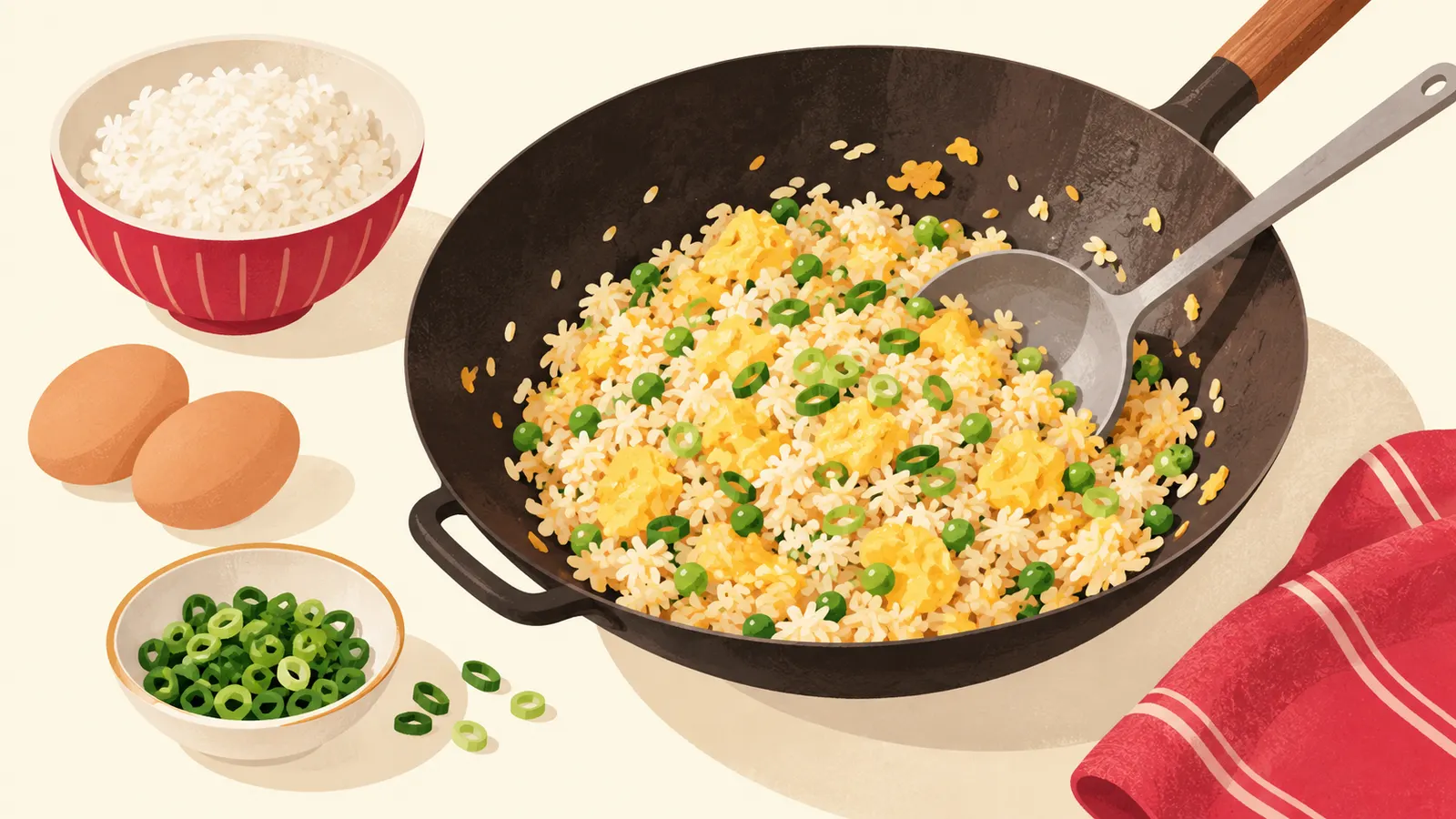
To make egg fried rice, stir-fry cold, cooked long-grain rice in a very hot wok (affiliate link, opens in a new tab) with a little oil, push it aside to scramble two beaten eggs, then toss everything together with light soy sauce, salt, white pepper and spring onion. It takes about eight minutes of cooking, and the secret is rice that was cooked the day before and chilled, so the grains are firm and separate rather than soft and sticky.
Egg fried rice is the dish most people learn first when they start cooking Chinese food at home, and it is also the one that most often goes wrong. This guide covers which rice to buy, why fresh rice turns to mush, what oil to use, how to get the dry, fluffy texture of a good takeaway, and how to store cooked rice safely, followed by a recipe for two.
Which rice is best for egg fried rice?
Use a long-grain rice. Chinese takeaways and home cooks in southern China mostly use jasmine rice, which is slightly fragrant and holds together just enough to toss without breaking. Ordinary long-grain white rice works almost as well and is cheaper. Basmati gives very separate, dry grains but tastes noticeably different and breaks more easily.
| Rice | Texture when fried | Verdict |
|---|---|---|
| Jasmine (Thai fragrant) | Separate, lightly springy, faint floral aroma | Best all-rounder; the takeaway choice |
| Long-grain white | Separate and neutral | Very good, and cheap |
| Basmati | Dry, very separate, distinctive flavour | Works, but tastes less authentic |
| Japanese or Korean short-grain | Soft and slightly clumpy | Fine for kimchi or Japanese-style fried rice, less so here |
| Glutinous (sticky) rice | Gluey | Avoid |
| Pouches of pre-cooked rice | Separate if broken up well | Handy shortcut; follow the pack's reheating advice |
Asian supermarkets sell jasmine rice in 4.5 kg, 10 kg and 20 kg bags at far better prices than small supermarket packs. If you are new to cooking it, our guide to how to cook perfect rice covers rinsing, water ratios and rice cookers.
Why do you need day-old rice for fried rice?
Freshly cooked rice is full of steam and moisture, and its surface starch is still soft. Fry it and the grains stick together, absorb the oil and sauce and quickly turn pasty. Rice that has been cooked, cooled and chilled overnight has firmed up as its starch sets, and it has dried out a little on the surface, so each grain can take the heat and fry individually.
Can you use fresh rice for fried rice?
Yes, if you plan for it. Cook the rice with slightly less water than usual (about 10% less), fluff it with a fork, spread it thinly on a large tray and let it steam off for 10 to 15 minutes, then chill it uncovered in the fridge for at least an hour. It won't be quite as good as day-old rice, but it will fry rather than stew. Don't use rice that is still warm and clumped straight from the pan.
Is leftover rice safe? UK food safety for cooked rice
Uncooked rice can contain spores of Bacillus cereus, bacteria which survive cooking. If cooked rice is left sitting at room temperature, the spores can grow and produce toxins that reheating won't destroy. UK food safety guidance is simple, and fried rice cooks should follow it every time:
- Cool it quickly: spread cooked rice on a tray so it cools fast, and get it into the fridge within an hour.
- Keep it in the fridge: covered, at 5°C or below, and use it within one day.
- Reheat only once: when you fry it, make sure it is steaming hot all the way through. Never reheat rice a second time.
- Make only what you'll eat: frying day-old rice counts as its one reheat, so fried rice made from leftover rice shouldn't be kept and reheated again. If you cook rice specifically for fried rice, cook only as much as you need.
Why is my fried rice soggy or mushy?
Soggy fried rice nearly always comes down to wet rice, a pan that isn't hot enough, or too much liquid. Check these before you change the recipe:
- The rice was too fresh or too wet: use day-old, chilled rice, and break up clumps by hand before cooking so you don't have to mash it in the wok.
- The pan was too full: on a home hob, fry no more than two portions (about 400 to 500 g of cooked rice) at once. More than that and the rice steams. Cook in batches for four.
- Not enough heat: preheat the wok until it just smokes before the oil goes in, and keep the heat high throughout.
- Too much soy sauce: liquid makes rice wet. Two teaspoons to one tablespoon of light soy sauce seasons two portions; use salt for the rest of the seasoning.
- Sauce poured onto the rice: drizzle soy sauce around the hot edge of the wok so it sizzles and evaporates before it reaches the grains.
- Wet vegetables: frozen peas should go in from frozen but in small quantities; defrost and drain larger amounts of frozen vegetables first.
- Stirring with a heavy hand: press and fold, rather than chopping at the rice with the edge of a spatula, which breaks the grains.
How do takeaways make egg fried rice?
Restaurant kitchens have far more powerful burners, which is why their rice tastes lightly toasted and smoky. You can get much closer at home with a few habits:
- Season with salt and soy sauce, not just soy sauce: takeaway egg fried rice is pale gold, not brown. A little salt, a little light soy sauce and plenty of white pepper give that familiar flavour.
- Use a touch of MSG if you like: many takeaways do. Around ¼ teaspoon for two portions rounds out the savouriness. It is optional.
- Let the rice sit: after tossing, leave it undisturbed for 20 to 30 seconds so the bottom layer toasts, then toss again. Repeat a few times.
- Coat the grains: some cooks mix the beaten egg into the rice before frying for golden rice where every grain is coated; others scramble the egg first for soft flecks. Both are traditional.
- Finish with spring onion: lots of it, sliced thinly and added in the last 30 seconds so it stays bright.
Light soy sauce is the right bottle here; dark soy is mainly for colour and makes the rice brown and sweet. If you're not sure which is which, see light vs dark soy sauce. The same high-heat, small-batch rules apply to all wok cooking, which our guide on how to stir fry at home explains in more detail.
What oil is best for fried rice?
Use a neutral oil that copes with high heat: groundnut, rapeseed (often sold as vegetable oil) or sunflower. Groundnut oil is the traditional choice and has a faintly nutty flavour, but check before cooking for anyone with a peanut allergy. You need about 2 tablespoons for two portions; too little and the rice sticks, too much and it turns greasy. Keep toasted sesame oil out of the frying stage altogether; its flavour burns off at high heat, so add a few drops at the end if you want it.
What can you add to egg fried rice?
Plain egg fried rice is a side dish, but it becomes a meal with one or two additions. Cut everything small, roughly the size of a pea, so it mixes evenly:
- Classic Yangzhou-style: diced char siu or ham, cooked prawns and peas.
- Chinese sausage (lap cheong): steam or fry the sliced sausage first; its fat flavours the whole dish.
- Leftover roast chicken or pork: diced and added with the rice so it heats through thoroughly.
- Vegetables: peas, sweetcorn, diced carrot, bean sprouts or shredded cabbage. Cook bean sprouts until steaming hot unless the pack says they are ready to eat.
- Kimchi: chopped and fried with the rice for a Korean-style version; see our guide on how to use kimchi.
- Crispy garlic or chilli: a spoonful of crispy chilli oil stirred through at the end; our guide to how to make chilli oil shows how to make your own.
What you'll need
Fried rice is all about heat and space, so the pan matters most.
- Flat-bottomed carbon steel wok (35 cm)Heats fast and works on gas, electric and induction; season it once and it becomes non-stick.See options on Amazon (affiliate link, opens in a new tab)
- Wok spatulaIts curved edge follows the wok so you can toss and scrape without leaving food behind.See options on Amazon (affiliate link, opens in a new tab)
- Rice cookerCooks consistent rice and keeps it warm without watching the pan; look for a non-stick inner pot.See options on Amazon (affiliate link, opens in a new tab)
- Jasmine rice (5 kg)Fragrant long grains that stay separate when fried; big bags are far cheaper per kilo.See options on Amazon (affiliate link, opens in a new tab)
Some links on this page are affiliate links: if you buy through them we may earn a small commission, at no extra cost to you. It never affects which shops we list. How we make money.
Where to buy rice, soy sauce and a wok
Chinese and pan-Asian supermarkets are the cheapest places to buy large bags of jasmine rice, big bottles of light soy sauce, white pepper, Chinese sausage, frozen char siu and carbon steel woks. Our directory lists 259 shops stocking Chinese groceries. The cities with the most choice are London, Edinburgh, Manchester and Birmingham. Thai grocers also sell good jasmine rice, often in a wider range of grades.
Recipe
Takeaway-style egg fried rice (蛋炒饭)
Light, fluffy egg fried rice with separate grains, soft scrambled egg and plenty of spring onion, just like a good Chinese takeaway. Ready in about 15 minutes using day-old rice.
- Serves
- 2 as a main, 4 as a side
- Prep
- 7 min
- Cook
- 8 min
- Total
- 15 min
Ingredients
- 450 g cold cooked jasmine or long-grain rice (from about 150 g uncooked), cooked the day before and chilled
- 3 medium eggs
- 2 tbsp groundnut or rapeseed oil
- 4 spring onions, whites and greens sliced separately
- 80 g frozen peas
- 2 tsp light soy sauce
- ½ tsp salt, plus a pinch for the eggs
- ¼ tsp ground white pepper
- ¼ tsp MSG (optional)
- ½ tsp toasted sesame oil (optional)
Method
- 1Break the cold rice apart with your fingers so there are no clumps. Beat the eggs with a pinch of salt. Have the spring onions, peas and seasonings ready by the hob.
- 2Heat a wok or large frying pan over the highest heat until it just smokes. Add 1 tbsp of the oil and swirl, then pour in the eggs. Stir gently for 30 to 45 seconds until just set but still slightly glossy, then tip them onto a plate.
- 3Return the wok to the heat, add the remaining oil and the spring onion whites, and stir for 10 seconds until fragrant.
- 4Add the rice and peas. Toss and press the rice against the hot wok for 3 to 4 minutes, letting it sit for 20 to 30 seconds between tosses, until the grains are separate, lightly toasted and steaming hot throughout.
- 5Sprinkle over the salt, white pepper and MSG if using, then drizzle the soy sauce around the hot edge of the wok so it sizzles. Toss for 30 seconds until evenly coloured.
- 6Return the eggs, breaking them into small pieces, add the spring onion greens and toss for 30 seconds. Turn off the heat, add the sesame oil if using, and serve straight away.
Serve egg fried rice alongside a stir fry, sweet and sour chicken or crispy pork belly, or turn it into a one-bowl dinner with prawns and char siu. Because frying day-old rice is already its one reheat, aim to cook just enough for the meal rather than saving leftovers for another day.