
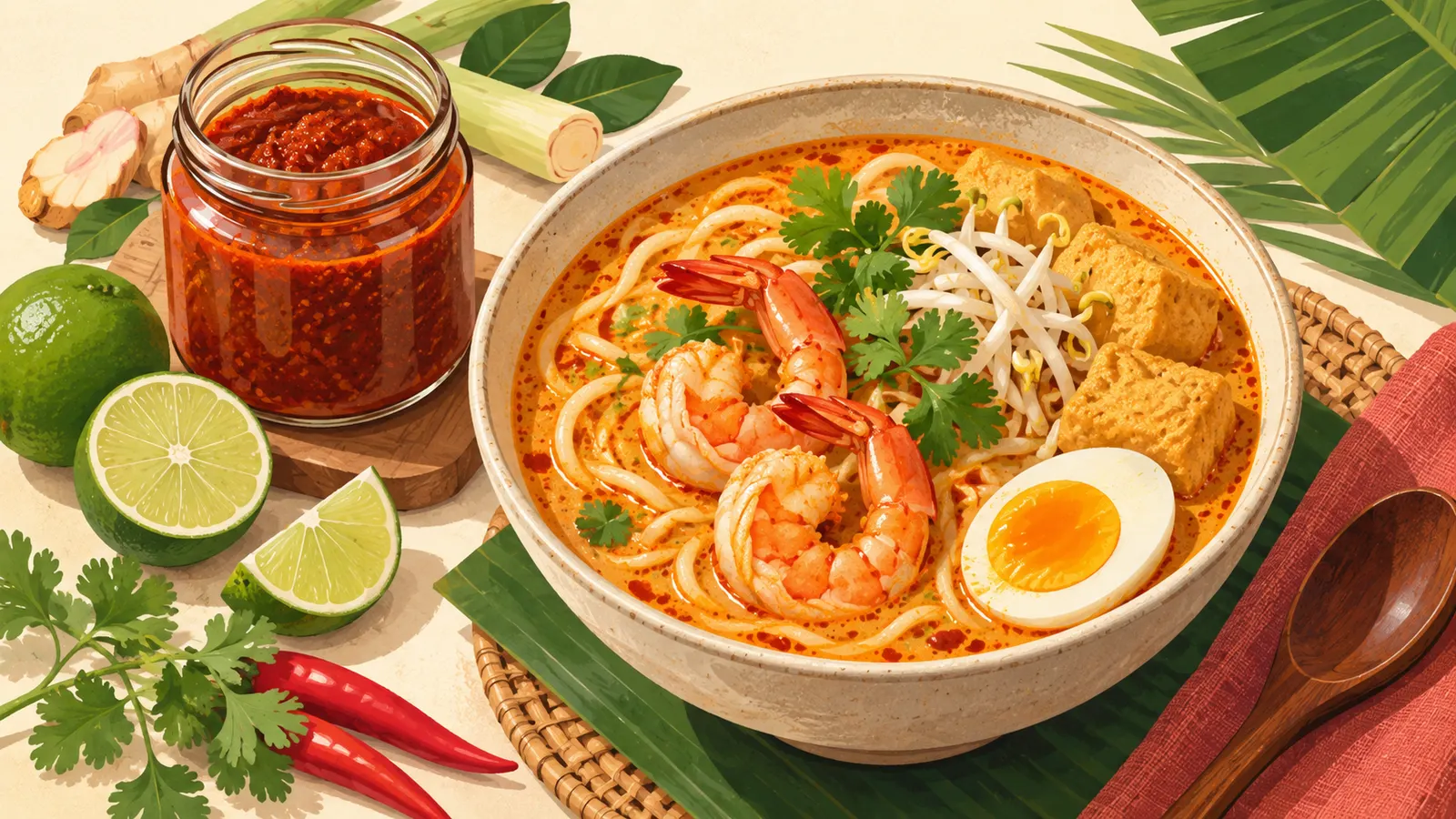
To make laksa, fry a spicy laksa paste in oil until it darkens and the oil separates, simmer it with stock and coconut milk to make a rich, orange broth, then pour it over a mix of egg noodles and rice vermicelli and top it with prawns, tofu puffs, beansprouts, boiled egg and herbs. With a good shop-bought paste and a few upgrades, a properly deep bowl takes about 45 minutes.
Laksa is a family of spicy noodle soups from Malaysia and Singapore, and the version most people in the UK mean is curry laksa: creamy, spicy and fragrant with lemongrass and shrimp paste. This guide explains how it differs from sour assam laksa, what goes into the paste, how to make a jar taste homemade, and which noodles and toppings to buy.
Curry laksa vs assam laksa: what's the difference?
They share a name and little else. Curry laksa (also called laksa lemak or curry mee) is built on coconut milk and a chilli-and-spice paste, and is eaten across Malaysia and Singapore. Assam laksa comes from Penang and has no coconut at all: it is a sour, tamarind-based broth made with flaked mackerel, poured over thick round rice noodles and topped with raw pineapple, cucumber, onion, mint and a drizzle of sticky black prawn paste. Assam means tamarind, which gives the soup its sourness.
| Laksa | Broth | Noodles | Typical toppings |
|---|---|---|---|
| Curry laksa (laksa lemak) | Coconut milk and spicy paste; rich and creamy | Yellow egg noodles and rice vermicelli | Prawns, tofu puffs, beansprouts, boiled egg, chicken, fish cakes |
| Singapore (Katong) laksa | Coconut-rich, with plenty of dried shrimp | Thick rice noodles cut short, eaten with a spoon | Prawns, cockles, fish cake, laksa leaf, sambal |
| Assam laksa (Penang) | Sour tamarind and mackerel; no coconut | Thick round rice noodles | Pineapple, cucumber, onion, mint, torch ginger flower, prawn paste |
| Sarawak laksa | Spiced paste with a little coconut milk; lighter | Rice vermicelli | Prawns, shredded chicken, omelette strips, lime, sambal |
The rest of this guide is about curry laksa, the easiest to make well at home and the one most shop-bought pastes are made for. Check the jar before you buy: assam laksa paste is a different product and won't give you a coconut curry broth.
What is in laksa paste?
Laksa paste is a rempah, the Malay name for a pounded wet spice paste. A typical curry laksa rempah contains:
- Dried red chillies, soaked, for heat and colour.
- Shallots and garlic as the sweet, savoury base.
- Lemongrass and galangal for the citrusy, peppery fragrance.
- Candlenuts, which thicken the broth and give body. Macadamias are the usual substitute.
- Belacan (fermented shrimp paste) and often dried shrimp, for deep savouriness.
- Ground spices such as coriander seed and turmeric, sometimes with a little curry powder.
Making it from scratch means soaking, pounding or blending and then frying for a long time. Shop-bought pastes vary a lot: some are concentrated and oily, some are padded out with sugar, and some come as kits with coconut milk powder. Because of the shrimp paste, most are not vegetarian, so check the label.
How to make shop-bought laksa paste taste better
1. Fry the paste until the oil splits
This matters more than anything else. Fry the paste in 2 tbsp oil over a medium heat for 5–8 minutes, stirring often so it doesn't catch. At first it looks wet and smells sharp; it is ready when it has darkened a shade, smells sweet and toasty rather than raw, and red oil has separated out around the edges. Malaysian cooks call this pecah minyak, the oil breaking. Undercooked paste makes a broth that tastes harsh and flat however long it simmers.
2. Add fresh aromatics and dried shrimp
Fry a bruised stalk of lemongrass with the paste, and if you have them, a tablespoon of dried shrimp, soaked for ten minutes and pounded or finely chopped. Dried shrimp is what gives a restaurant laksa its rounded, almost sweet savoury depth. Our guide to storing Asian herbs covers keeping lemongrass fresh, or freezing it.
3. Use a proper stock
Buy shell-on prawns and make a quick stock from the heads and shells: fry them in a little oil until pink, add chicken stock and simmer for ten minutes. It turns a good laksa into a great one for very little effort. If you use stock cubes, go for a low-salt one so you control the seasoning.
4. Season at the end
Once the coconut milk is in, taste and adjust with salt or fish sauce, and a little sugar to round off the heat. It should taste rich, spicy and savoury, with sweetness in the background. Keep the broth at a gentle simmer after adding coconut milk; boiling hard can make it split and look grainy.
What are the best noodles for laksa?
Curry laksa is traditionally served with two kinds of noodle in the same bowl: springy yellow egg noodles and fine rice vermicelli. The mix gives you chew and slurp in each mouthful. Allow about 75g fresh egg noodles and 25g dried vermicelli per person.
- Fresh yellow egg noodles (Hokkien mee): thick, round and springy, from the chiller cabinet. Blanch them in boiling water for a minute and rinse, which removes the slightly alkaline taste.
- Rice vermicelli (bee hoon): dried thin rice noodles. Soak in just-boiled water for 5–8 minutes, then drain.
- Thick round rice noodles (laksa noodles): the choice for Singapore and assam laksa, sold fresh or dried at Asian grocers.
- If you can only get one: thin dried egg noodles or rice vermicelli on their own are fine.
Laksa toppings
- Tofu puffs (tau pok): deep-fried, airy tofu squares that soak up the broth like a sponge. Halve them and simmer them in the soup for a few minutes.
- Prawns: poached in the broth for the last couple of minutes.
- Beansprouts: blanched for 30 seconds or added raw for crunch.
- Boiled egg: halved; cook for 7–8 minutes for a jammy yolk.
- Fish cakes or fish balls, sliced, and shredded poached chicken.
- Laksa leaf (Vietnamese coriander, daun kesom), finely shredded. It is hard to find, and a mix of mint and coriander is the usual substitute.
- Sambal and lime: a spoonful of sambal for extra heat, and lime or calamansi to cut the richness.
Curry laksa with prawns and tofu puffs
This recipe takes a jar of curry laksa paste and upgrades it with a prawn-shell stock, dried shrimp and lemongrass. Laksa pastes vary in strength, so start with the lower amount and add more, fried in a little oil first, if the broth needs it.
Recipe
Curry laksa with prawns and tofu puffs
A rich, spicy coconut curry laksa made with shop-bought paste upgraded with prawn-shell stock, dried shrimp and lemongrass, served over egg noodles and rice vermicelli.
- Serves
- 4 people
- Prep
- 20 min
- Cook
- 35 min
- Total
- 55 min
Ingredients
- 400g raw shell-on king prawns
- 3 tbsp neutral oil
- 800ml chicken stock (low salt)
- 4–6 tbsp curry laksa paste
- 1 lemongrass stalk, bashed
- 1 tbsp dried shrimp, soaked for 10 minutes and finely chopped (optional)
- 400ml tin full-fat coconut milk
- 100g tofu puffs, halved
- 1–2 tsp fish sauce or salt, to taste
- 1–2 tsp sugar, to taste
- 300g fresh yellow egg noodles
- 100g dried rice vermicelli
- 150g beansprouts
- 2 eggs, boiled for 7–8 minutes, peeled and halved
- Small handful mint and coriander leaves (or laksa leaf)
- 1 lime, cut into wedges, and sambal, to serve
Method
- 1Peel the prawns, leaving the tails on if you like, and keep the heads and shells. Fry the shells in 1 tbsp oil in a saucepan for 2–3 minutes until bright pink, add the stock, simmer for 10 minutes, then strain and discard the shells.
- 2Meanwhile, soak the vermicelli in just-boiled water for 5–8 minutes and drain. Blanch the egg noodles in boiling water for 1 minute and the beansprouts for 30 seconds, drain, and divide the noodles and beansprouts between four deep bowls.
- 3Heat 2 tbsp oil in a large pan or wok over a medium heat. Add the laksa paste, lemongrass and dried shrimp and fry for 5–8 minutes, stirring often, until the paste darkens, smells toasty and the oil separates.
- 4Pour in the prawn stock, stir to loosen the paste and simmer for 5 minutes.
- 5Add the coconut milk and tofu puffs and simmer gently for 5 minutes without letting it boil hard.
- 6Add the prawns and poach for 2–3 minutes, until pink and opaque all the way through.
- 7Remove the lemongrass, then season with fish sauce or salt and sugar until the broth tastes rich, spicy and savoury with a gentle sweetness.
- 8Ladle the broth, prawns and tofu puffs over the noodles. Top with the egg halves and herbs and serve with lime wedges and sambal.
Stock your pantry
The cupboard ingredients behind a good bowl of laksa.
- Laksa pasteUpgrade it with fresh lemongrass and shallots as the guide shows.See options on Amazon (affiliate link, opens in a new tab)
- Coconut milkFull-fat tins give curries and laksa their body; check the coconut percentage on the label.See options on Amazon (affiliate link, opens in a new tab)
- Rice vermicelliThin rice noodles that soak up the broth.See options on Amazon (affiliate link, opens in a new tab)
- Fish sauceLook for a short ingredient list: anchovies, salt and maybe sugar.See options on Amazon (affiliate link, opens in a new tab)
Some links on this page are affiliate links: if you buy through them we may earn a small commission, at no extra cost to you. It never affects which shops we list. How we make money.
Where to buy laksa paste in the UK
Supermarkets sometimes stock a laksa paste, but an Asian grocer will have a choice of Malaysian and Singaporean pastes, plus tofu puffs, fresh yellow noodles, dried shrimp, belacan and sambal. Our directory lists 39 stores that stock Malaysian groceries.
In London, New Loon Moon carries Malaysian, Singaporean and Indonesian groceries, and Loon Fung Chinatown imports from Malaysia among many other countries. In Glasgow, Isan Thai Food Market lists Thai and Malaysian ingredients and Lims stocks Malaysian foods. Fresh Asia in Beeston, near Nottingham, sells Malaysian sauces alongside South East Asian fresh and frozen foods.
London has the most choice, with 7 stores stocking Malaysian products. Thai grocers often carry laksa paste and tofu puffs too, so it is worth checking Thai grocers near you.