
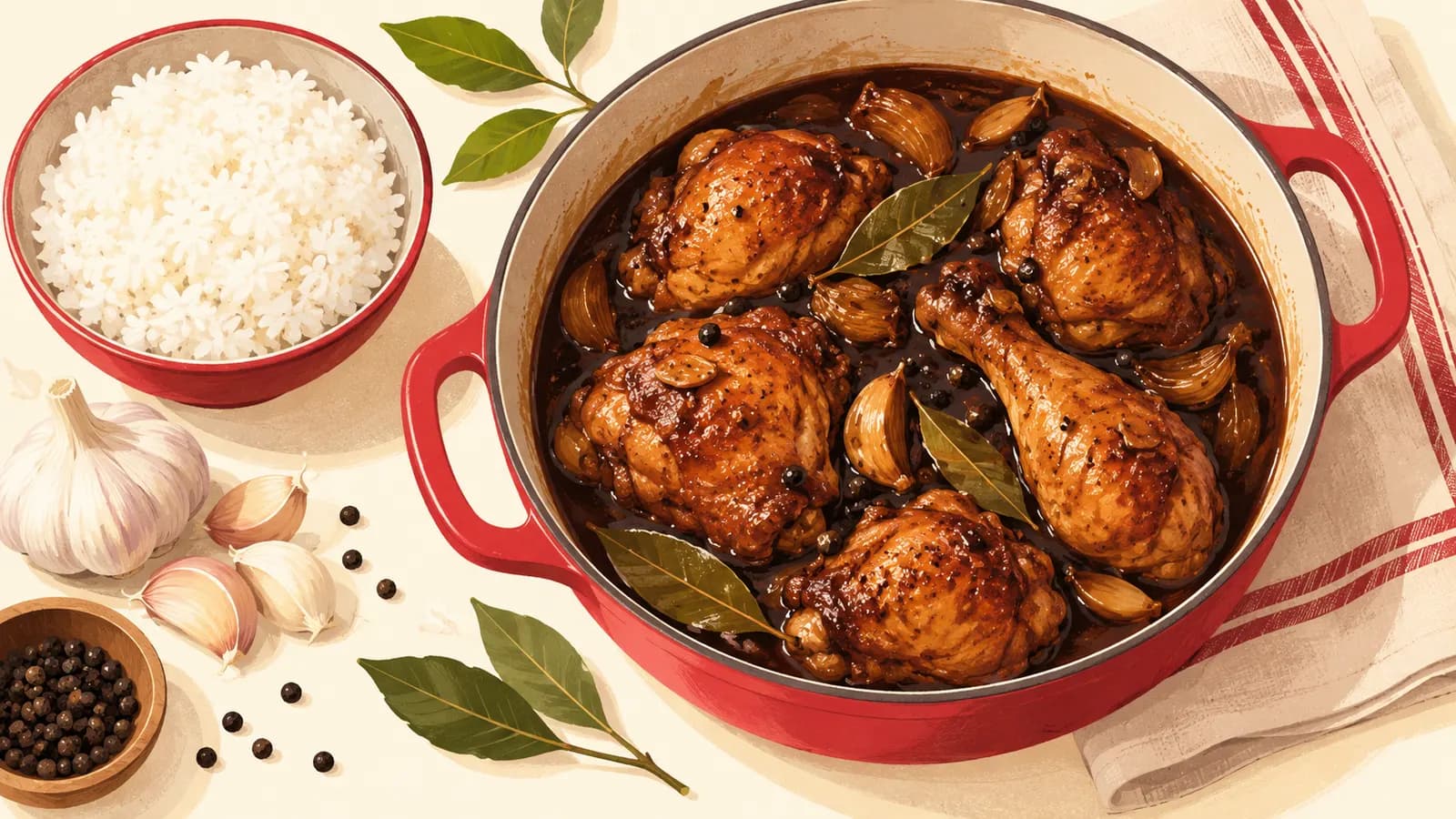
Chicken adobo is chicken braised in vinegar, soy sauce, plenty of garlic, bay leaves and whole black peppercorns until tender, then reduced to a glossy, tangy and savoury sauce. For about 1.2kg of bone-in chicken, use roughly 120ml of vinegar to 80ml of soy sauce and a whole head of garlic, simmer for 40 to 45 minutes and serve it over steamed rice.
It is one of the best-loved dishes in the Philippines and one of the easiest to make well: a handful of cupboard ingredients, one pan, and a result that tastes even better the next day. This guide explains which vinegar and soy sauce to use, how to get a rich sauce and browned chicken, the coconut milk version, and the Filipino pantry staples worth picking up while you shop.
What is adobo?
In Filipino cooking, adobo is a method as much as a dish: meat or vegetables simmered in vinegar with garlic, pepper and bay. Vinegar-braising was used to keep food in a hot climate long before refrigeration, which is why adobo keeps so well. The name comes from the Spanish word for a marinade, but the cooking is Filipino. Every family has its own version, and they vary widely in how sour, salty, sweet or saucy they are.
- Chicken adobo (adobong manok): the most common everyday version, and the one in the recipe below.
- Pork adobo (adobong baboy): usually pork belly or shoulder, richer and fattier. Chicken and pork are often cooked together.
- Adobong puti: "white" adobo made without soy sauce, seasoned with salt instead, so the vinegar and garlic come through more clearly.
- Adobong dilaw: "yellow" adobo coloured with turmeric.
- Adobo sa gata: finished with coconut milk; more on that below.
- Adobong kangkong and adobong sitaw: vegetable versions with water spinach or long beans.
What vinegar do you use for adobo?
Filipino vinegars are milder and rounder than British malt or distilled vinegar, and they make the biggest difference to how adobo tastes. Look for these at an Asian grocer:
| Vinegar | What it is | Flavour | Use in adobo |
|---|---|---|---|
| Cane vinegar (sukang Iloko or sukang maasim) | Made from sugar cane | Clean, mild, slightly sweet | The everyday choice; use as written |
| Coconut vinegar (sukang tuba) | Made from coconut sap | Soft, slightly yeasty and funky | Excellent; especially good in adobo sa gata |
| Palm vinegar (sukang paombong) | Made from nipa palm sap | Mellow and rounded | Use as written |
| Spiced vinegar (sinamak, pinakurat) | Cane or coconut vinegar steeped with chilli, garlic and ginger | Hot and aromatic | Better as a table dip than in the pot |
| Rice vinegar | Japanese or Chinese rice vinegar | Mild and gentle | Best substitute; use the same amount |
| Cider or white wine vinegar | Supermarket vinegars | Fruity, a little sharper | Good substitute; add a pinch more sugar |
| Distilled white or malt vinegar | Supermarket vinegars | Harsh; malt is strongly flavoured | Last resort; use two-thirds the amount, topped up with water |
Which soy sauce is best for adobo?
Filipino soy sauce (toyo) is thin and quite salty, much closer to Chinese light soy sauce than to dark or sweet soy. If you don't have a Filipino bottle, use light soy sauce in the same quantity. A teaspoon of dark soy sauce is optional for a deeper colour, but too much makes the sauce heavy and bitter. Our guide to light vs dark soy sauce explains the difference. If you use a Japanese soy sauce, which can be saltier, start with a little less and taste at the end.
How to make the best chicken adobo
- Use bone-in, skin-on thighs and drumsticks. They stay moist through the braise and give the sauce body. Breast dries out; if you must use it, cut the simmering time to 20 minutes.
- Marinate if you have time. Thirty minutes in the soy, garlic and pepper seasons the meat; a night in the fridge is better still.
- Brown the chicken. Some families skip this, but colouring the skin first adds flavour and stops it being flabby.
- Reduce the sauce. Adobo should be saucy, not soupy. Simmer uncovered at the end until the liquid has reduced by about half and coats a spoon.
- Crisp it at the end (optional). Lifting the cooked chicken out and grilling or frying it skin-side up for a few minutes gives crisp, sticky skin to spoon the sauce over.
- Make it ahead. Like most braises, adobo is better the next day. Cool it quickly, refrigerate within two hours and eat within three days, reheating until piping hot.
Classic chicken adobo recipe
This is a straightforward, balanced adobo: tangy but not sharp, savoury but not too salty, with lots of soft, sweet garlic. Taste the sauce at the end and adjust it to your liking; there is no single right balance.
Recipe
Classic Filipino chicken adobo
Bone-in chicken braised in cane vinegar, soy sauce, garlic, bay leaves and black peppercorns until tender, then reduced to a glossy sauce. Serve with steamed rice.
- Serves
- 4 people
- Prep
- 45 min
- Cook
- 55 min
- Total
- 100 min
Ingredients
- 1.2kg bone-in, skin-on chicken thighs and drumsticks (about 8 pieces)
- 80ml Filipino soy sauce or light soy sauce
- 120ml cane or coconut vinegar (or rice vinegar)
- 1 whole head of garlic (10 to 12 cloves), peeled and lightly crushed, divided
- 1 tsp whole black peppercorns, lightly cracked
- 4 dried bay leaves
- 1 tbsp neutral oil
- 250ml water
- 1 tbsp light brown sugar (optional)
- 2 spring onions, sliced, and steamed jasmine rice, to serve
Method
- 1Put the chicken in a bowl with the soy sauce, half the garlic, the peppercorns and bay leaves. Turn to coat, cover and marinate in the fridge for at least 30 minutes, or up to overnight.
- 2Lift the chicken out of the marinade, keeping the marinade, and pat the skin dry. Heat the oil in a wide, heavy pan or casserole over a medium-high heat and brown the chicken skin-side down for 5 to 6 minutes until golden. Turn, colour the other side for 2 minutes, then set aside. Pour off all but 1 tablespoon of fat.
- 3Add the rest of the garlic and fry for 1 minute until pale golden. Return the chicken, skin-side up, with the marinade, vinegar and water. Bring to the boil and let it bubble for 2 to 3 minutes without stirring.
- 4Cover, turn the heat down and simmer gently for 30 minutes, turning the chicken once halfway through.
- 5Uncover and simmer for 10 to 15 minutes more, until the sauce has reduced by about half and the chicken is tender and cooked through, with clear juices and no pink meat near the bone.
- 6Taste the sauce. Stir in the sugar if it is too sharp, or a splash of water if it is too salty. For crisp skin, grill the chicken skin-side up under a hot grill for 3 to 5 minutes while the sauce finishes reducing.
- 7Serve the chicken over steamed rice with plenty of sauce and the softened garlic spooned over, scattered with spring onions.
Adobo sa gata: adobo with coconut milk
Adobo sa gata adds coconut milk, which softens the vinegar and turns the sauce creamy, rich and slightly sweet. It is a popular variation in coconut-growing parts of the Philippines and is often made with chilli for a gentle heat. Follow the recipe above to the end of step 4, then stir in 200ml of full-fat coconut milk and 1 or 2 sliced bird's eye chillies with the lid off. Simmer gently for 10 to 15 minutes until the sauce thickens and turns glossy, without letting it boil hard, or the coconut milk can split. Coconut vinegar suits this version best.
What to serve with chicken adobo
Adobo is made to be eaten with plain white rice, which soaks up the sauce; see our guide to how to cook perfect rice for fluffy jasmine rice every time. Leftover rice fried with plenty of garlic makes sinangag, and adobo with garlic rice and a fried egg is a classic Filipino breakfast. For something fresh alongside, serve sliced tomatoes and cucumber or a jar of atchara, sweet pickled green papaya. Shredded leftover adobo also makes very good fried rice and sandwich fillings.
Filipino pantry essentials
While you are buying vinegar and soy sauce, these are the staples that open up the rest of Filipino home cooking:
- Calamansi: a small, fragrant citrus, sour with a hint of mandarin, squeezed over pancit noodles and into dipping sauces. Fresh fruit is rare in the UK, but frozen fruit and bottled juice are common. Lime with a splash of orange juice is a decent substitute.
- Banana ketchup: sweet, tangy and bright red, made from bananas rather than tomatoes. It is used on fried chicken, eggs, hot dogs and in Filipino spaghetti.
- Bagoong: fermented seafood paste. Bagoong alamang is made from tiny shrimp and is eaten with green mango and in kare-kare; bagoong isda is made from fish. Buy it plain or ready-sautéed.
- Patis: Filipino fish sauce, lighter than Thai and Vietnamese styles. Our guide to how to use fish sauce covers all three.
- Pancit noodles: canton (wheat egg noodles) and bihon (thin rice vermicelli) for Filipino stir-fried noodles.
- Sinigang mix: tamarind soup base for sinigang, the sour Filipino soup.
- Ube: purple yam, sold as halaya (jam), powder and extract for cakes, ice cream and desserts.
- Frozen longganisa and tocino: sweet cured sausages and pork for silog breakfasts with garlic rice and egg.
Stock your pantry
Adobo needs only a few ingredients, so these are worth getting right.
- Filipino cane vinegarMilder than malt vinegar; the traditional adobo vinegar.See options on Amazon (affiliate link, opens in a new tab)
- Filipino soy sauceThinner and saltier than Japanese soy, as adobo expects.See options on Amazon (affiliate link, opens in a new tab)
- Dried bay leavesEssential for adobo's aroma.See options on Amazon (affiliate link, opens in a new tab)
- Jasmine rice (5 kg)Adobo is always served with plenty of rice.See options on Amazon (affiliate link, opens in a new tab)
Some links on this page are affiliate links: if you buy through them we may earn a small commission, at no extra cost to you. It never affects which shops we list. How we make money.
Where to buy Filipino groceries in the UK
Cane and coconut vinegar, Filipino soy sauce, banana ketchup and bagoong are easier to find in UK Asian supermarkets than many people expect. In our directory, 34 stores stock Filipino groceries, mostly large pan-Asian and Chinese supermarkets with a Filipino shelf or aisle. For a wider range, including frozen longganisa and tocino, snacks and calamansi, 4 shops describe themselves as Filipino specialists. Filipino groceries are easiest to find in the cities below; elsewhere, check your nearest large pan-Asian supermarket.
Filipino specialist shops
- Asia SHOP (GLOBAL FC LTD)Bournemouth · EnglandFilipinoBournemouth
- Miah's Oriental Foods,pinoy and thai food specialistEpsom · EnglandChineseThaiFilipinoEpsom
- Pabili Po Filipino & Oriental StoreWolverhampton · EnglandChineseFilipinoWolverhampton
- Sari Sari StoreBarnstaple · EnglandFilipinoBarnstaple
Filipino groceries by city