
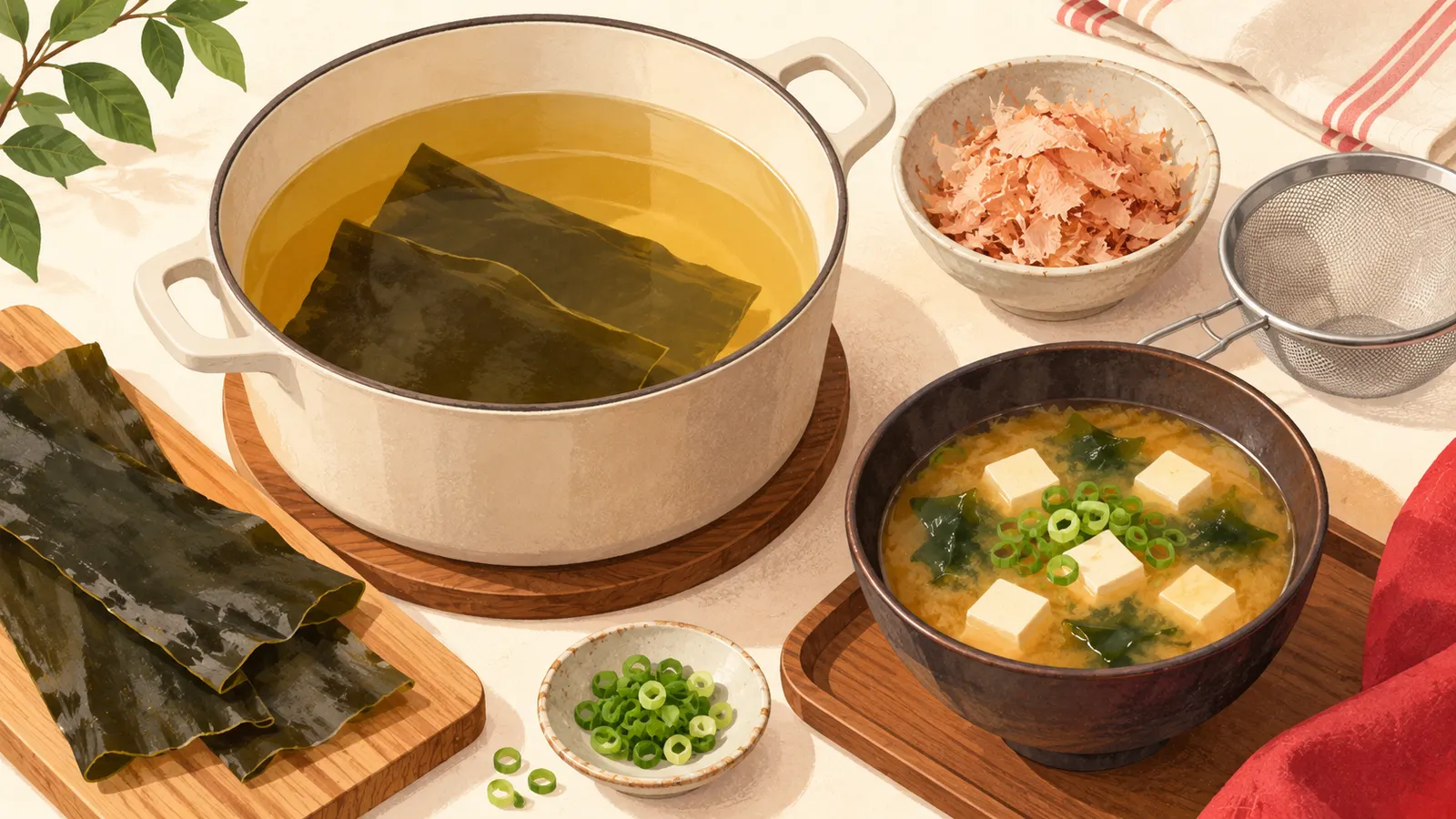
To make dashi, soak 10g of kombu in 1 litre of cold water for at least 30 minutes, heat it slowly and lift the kombu out just before the water boils. Then bring it to the boil, add 20g of katsuobushi (dried bonito flakes), turn off the heat, leave it for 2 to 3 minutes and strain. That gives you awase dashi, the clear, savoury stock behind miso soup and much of Japanese home cooking.
Dashi takes about 15 minutes of actual cooking and tastes far cleaner and more rounded than most instant versions. This guide covers the main types of dashi, including kombu dashi and a vegan dashi made with dried shiitake, when instant granules are good enough, what to use if you have no dashi at all, how to store it, and how to use up the kombu and bonito flakes afterwards.
What is dashi?
Dashi (出汁) is a light stock made by steeping ingredients rich in umami, the savoury taste, in water for a short time. Kombu, a type of dried kelp, is high in glutamate; katsuobushi, smoked and dried skipjack tuna shaved into flakes, is high in inosinate. Together they taste more savoury than either alone, which is why awase (combined) dashi is the everyday standard. Unlike a Western stock, dashi is never boiled for hours: long cooking makes kombu slimy and bonito bitter.
Types of dashi
| Type | Made from | Flavour | Best for |
|---|---|---|---|
| Awase dashi | Kombu and katsuobushi | Rounded, savoury, lightly smoky | Miso soup, noodle broths, simmered dishes: the all-rounder |
| Kombu dashi | Kombu only | Subtle, clean, gently sweet | Hot pot, tofu dishes, vegetarian cooking, rice |
| Shiitake dashi | Dried shiitake mushrooms | Earthy and deep | Vegan cooking, often mixed with kombu dashi |
| Katsuo dashi | Katsuobushi only | Smoky and fishy | Quick soups and sauces |
| Niboshi (iriko) dashi | Small dried sardines or anchovies | Strong and fishy | Robust miso soup, ramen, udon |
| Instant dashi | Granules, powder, liquid concentrate or tea-bag style packs | Convenient; often saltier | Everyday cooking when time is short |
Japanese cooks also talk about ichiban dashi (first dashi), the delicate stock from fresh kombu and bonito used for clear soups, and niban dashi (second dashi), a stronger, cloudier stock from simmering the same ingredients again. More on that below.
Recipe: awase dashi with kombu and katsuobushi
This is the dashi to make if you only learn one. It makes about 1 litre, enough for four to five bowls of miso soup or two bowls of noodle broth with some left over. Soaking the kombu overnight in the fridge gives the fullest flavour, but 30 minutes works.
Recipe
Awase dashi (kombu and bonito stock)
Classic Japanese stock made by steeping kombu and katsuobushi in hot water. The base for miso soup, noodle broths and simmered dishes, and ready in about 15 minutes after soaking.
- Serves
- About 1 litre
- Prep
- 35 min
- Cook
- 15 min
- Total
- 50 min
Ingredients
- 1.1 litres cold water
- 10g kombu (a piece about 10 x 10cm)
- 20g katsuobushi (dried bonito flakes)
Method
- 1Wipe the kombu lightly with a damp cloth to remove any grit. Don't wash off the white powder on the surface: it is natural and adds flavour.
- 2Put the kombu in a saucepan with the cold water and leave to soak for at least 30 minutes, or overnight in the fridge.
- 3Set the pan over a medium-low heat and warm it slowly for about 10 minutes. When small bubbles start to rise around the edges, just before it boils, lift out the kombu and set it aside.
- 4Bring the water up to the boil, then turn off the heat and scatter in the katsuobushi. Don't stir.
- 5Leave to steep for 2 to 3 minutes, until the flakes have sunk to the bottom.
- 6Strain through a sieve lined with kitchen paper or muslin. Let it drip through without pressing or squeezing the flakes, which makes the dashi cloudy and bitter.
- 7Use straight away, or cool quickly and keep in the fridge for up to 3 days. Save the kombu and flakes for a second batch.
Good dashi is clear and pale gold, smells gently of the sea and smoke, and tastes savoury rather than fishy. If it tastes of very little, the next batch needs a longer kombu soak or a few more bonito flakes; if it is bitter, the kombu was boiled or the flakes were squeezed.
How to make kombu dashi and vegan dashi
Kombu dashi is the simplest stock there is, and it is vegan. The easiest method is a cold brew: put 10g kombu in 1 litre of cold water in a jug or jar and leave it in the fridge overnight, or for at least 3 hours. Remove the kombu and the dashi is ready. You can also use the hot method from the recipe above and simply skip the bonito.
For a more savoury vegan dashi, add 3 or 4 dried shiitake mushrooms to the cold soak with the kombu and leave both overnight in the fridge. Shiitake release their flavour best when soaked slowly in cold water. Lift them out, squeeze them gently back into the dashi, and slice the softened mushrooms into the soup or a stir-fry. A combined kombu and shiitake dashi is the base of shojin ryori, Japanese Buddhist temple cooking.
Are instant dashi granules any good?
Yes, for everyday cooking. Instant dashi comes in a few forms, and most Japanese households keep one in the cupboard:
- Granules or powder (dashi no moto): dissolve straight into hot water. Usually about 1 tsp per 400 to 500ml, but follow the packet. They often contain salt, sugar and flavour enhancers, so add them before seasoning anything else.
- Dashi packs: tea-bag style sachets of ground kombu, bonito and sometimes shiitake. Simmer one in water for 3 to 5 minutes. Closest in flavour to homemade.
- Liquid concentrates: handy for noodle broths. Some, labelled tsuyu or mentsuyu, are already seasoned with soy sauce and mirin, so they are not plain dashi.
- Check the label: most instant dashi is made from fish and is not vegetarian. Kombu-only or shiitake versions are available for vegan cooking.
What can I use as a dashi substitute?
- Kombu water: even a 1-hour cold soak of kombu adds noticeable depth.
- Dried shiitake soaking liquid: strain it well; it is earthier and darker than dashi.
- Light chicken stock: made up weaker than usual. Not the same flavour, but works in noodle broths and simmered dishes.
- Vegetable stock with a splash of soy sauce: a last resort for miso soup. Keep it mild, as strong stock overpowers the miso.
- Fish sauce: a few drops in water add savoury depth for simmered dishes, though it is saltier and more pungent.
- Water and good miso: for miso soup, a dashi-iri (dashi-added) miso and plain water gets you most of the way.
What to do with used kombu and katsuobushi
After making dashi, the kombu and bonito flakes still have plenty of flavour left. Don't throw them out:
- Make niban dashi: put the used kombu and flakes back in a pan with 500ml water, simmer gently for 10 minutes, then strain. It is stronger and cloudier than the first dashi and perfect for miso soup, stews and simmered vegetables.
- Kombu tsukudani: slice the used kombu into thin strips and simmer it with 2 tbsp soy sauce, 2 tbsp mirin, 1 tbsp sugar and 100ml water until the liquid has almost gone. A sweet-savoury relish for rice that keeps in the fridge for about a week.
- Homemade furikake: dry the used katsuobushi in a frying pan over a low heat, then add a splash of soy sauce, a pinch of sugar and toasted sesame seeds and stir until dry and crumbly. Sprinkle over rice.
- Cook rice with it: lay a piece of used kombu on top of rice in the pan or rice cooker (affiliate link, opens in a new tab) for gentle extra flavour.
- Freeze it: collect used kombu in a bag in the freezer until you have enough for tsukudani.
How to use dashi
- Miso soup: warm 500ml dashi, take it off the heat and whisk in 2 to 3 tbsp miso. Our miso guide explains which miso to use.
- Noodle broths: for hot udon or soba, simmer roughly 8 parts dashi to 1 part soy sauce and 1 part mirin. For a dipping sauce for cold noodles, go stronger, at about 4 : 1 : 1.
- Ramen: replace a quarter of the chicken stock with dashi for a deeper broth, as in our homemade ramen guide.
- Eggs: dashi rolled omelette (dashimaki tamago) and silky steamed egg custard (chawanmushi).
- Simmered dishes: nimono of vegetables, tofu or fish, and the sweet-savoury sauce for oyakodon and gyudon.
- Agedashi tofu: fried tofu in a light dashi broth; see our guide to cooking tofu.
How to store dashi
Cool fresh dashi quickly, cover and keep it in the fridge for up to 3 days. It loses its aroma day by day, so it is at its best within 24 hours. To freeze, pour it into ice cube trays or small tubs and use within a month; a few cubes are handy for a single bowl of miso soup or a quick sauce. Keep dried kombu and katsuobushi in airtight packs in a cool, dry cupboard and use bonito flakes within a few weeks of opening, as they go stale.
Stock your pantry
The two ingredients for proper dashi, plus a shortcut.
- Kombu (dried kelp)Thick, dark sheets; a white bloom on the surface is flavour, so don't wash it off.See options on Amazon (affiliate link, opens in a new tab)
- Katsuobushi (bonito flakes)Smoky dried tuna flakes for awase dashi.See options on Amazon (affiliate link, opens in a new tab)
- Instant dashi stockGranules or tea-bag style packets for miso soup in minutes on busy nights.See options on Amazon (affiliate link, opens in a new tab)
- Fine mesh strainerStrains broths, oils and sauces cleanly.See options on Amazon (affiliate link, opens in a new tab)
Some links on this page are affiliate links: if you buy through them we may earn a small commission, at no extra cost to you. It never affects which shops we list. How we make money.
Where to buy kombu and katsuobushi in the UK
Some supermarkets and health food shops sell kombu, but katsuobushi, dried shiitake, niboshi, dashi packs and instant granules are easiest to find at Japanese grocers and larger Asian supermarkets. Our directory lists 111 stores that stock Japanese groceries, and the cities with the most are London, Glasgow and Edinburgh.
Japanese specialists such as Japan Centre in central London and Kantenya in Brighton stock several grades of kombu and katsuobushi alongside instant dashi. Korean grocers sell dried kelp and dried anchovies for their own soup stocks, which work in much the same way. For everything else on a Japanese shopping list, see our Japanese grocery shopping guide.
Japanese groceries by city
- Japanese groceries in London19 stores
- Japanese groceries in Glasgow8 stores
- Japanese groceries in Edinburgh7 stores
- Japanese groceries in Cambridge5 stores
- Japanese groceries in Canterbury4 stores
- Japanese groceries in Leeds4 stores
- Japanese groceries in Nottingham4 stores
- Japanese groceries in Brighton & Hove3 stores
- Japanese groceries in Bristol3 stores
- Japanese groceries in Oxford3 stores
- Japanese groceries in Reading3 stores
- Japanese groceries in Southampton3 stores