
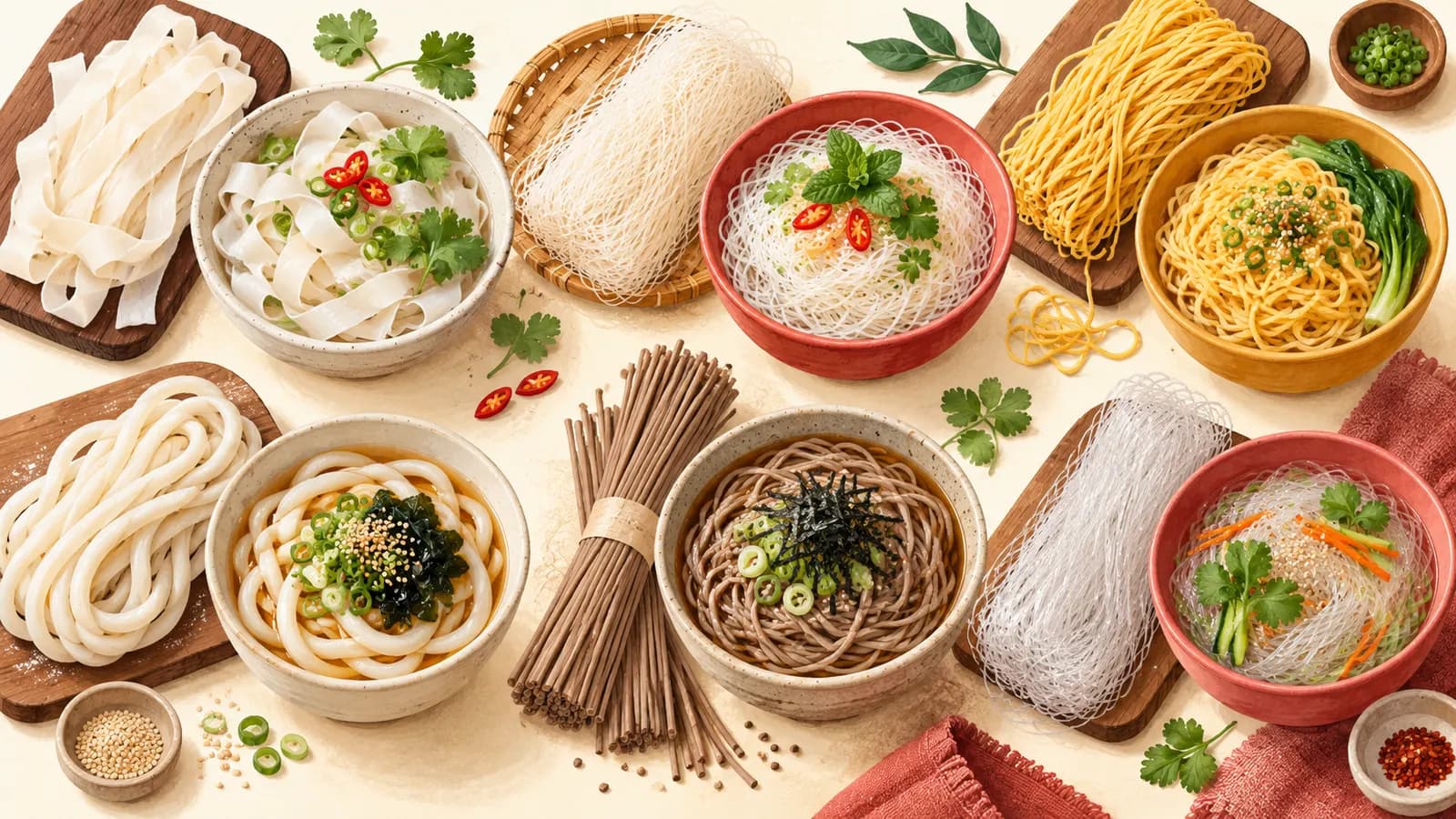
The main types of Asian noodles are rice noodles (vermicelli and flat rice sticks), wheat and egg noodles (including ramen and chow mein noodles), thick Japanese udon, buckwheat soba and translucent glass noodles made from mung bean or sweet potato starch. Each is cooked differently: rice and glass noodles are often soaked rather than boiled, while wheat noodles are boiled briefly and rinsed or sauced straight away.
The noodle aisle of an Asian supermarket can run to hundreds of packets, many labelled only in Chinese, Japanese, Korean, Thai or Vietnamese. This guide sorts them by what they are made from, explains how to cook each one so it stays springy rather than sticky, and matches them to the dishes they belong in. It finishes with 15-minute garlic-sesame noodles you can make from the store cupboard.
Types of Asian noodles at a glance
| Noodle | Made from | How to cook | Best for |
|---|---|---|---|
| Rice vermicelli (米粉, bún, sen mee) | Rice flour, water | Soak in just-boiled water 3–5 min, drain, rinse | Vietnamese bún bowls, summer rolls, Singapore noodles |
| Flat rice sticks (河粉, bánh phở, sen lek) | Rice flour, water | Soak in warm water 20–30 min, then finish in the wok or broth | Pad thai, pho, pad see ew |
| Fresh ho fun (沙河粉) | Rice flour, water, oil | Separate by hand; warm briefly, never boil | Beef ho fun, Malaysian char kway teow |
| Thin egg noodles (蛋面, wonton noodles) | Wheat flour, egg, alkaline water | Fresh: boil 30–60 sec. Dried: 3–4 min | Wonton noodle soup, crispy pan-fried noodles |
| Medium egg noodles (chow mein, lo mein) | Wheat flour, egg | Boil 3–5 min (dried) or 1–2 min (fresh), rinse | Chow mein, lo mein, stir-fries |
| Ramen (ラーメン) | Wheat flour, kansui (alkaline salts) | Fresh: 1–2 min. Dried: 3–5 min. Drain hard | Ramen soups, tsukemen, mazemen |
| Udon (うどん) | Wheat flour, water, salt | Frozen: 1–2 min from frozen. Dried: 8–12 min | Hot udon soups, yaki udon, curry udon |
| Soba (蕎麦) | Buckwheat flour, usually with wheat | Boil 4–6 min, rinse well in cold water | Cold zaru soba, hot soba soup, salads |
| Somen (素麺) | Wheat flour, very thin | Boil 1½–2 min, rinse in iced water | Chilled somen with dipping sauce |
| Mung bean glass noodles (粉丝) | Mung bean starch | Soak in warm water 10–15 min or boil 2–3 min | Spring roll fillings, hot pot, glass noodle salads |
| Sweet potato noodles (당면, dangmyeon) | Sweet potato starch | Boil 6–8 min until chewy, rinse | Japchae, Korean stews, hot pot |
| Shanghai thick noodles (上海粗炒面) | Wheat flour, water | Boil 2–3 min (fresh), drain | Shanghai fried noodles with pork and cabbage |
| Hokkien noodles | Wheat flour, egg, alkaline water | Loosen in hot water 1 min | Hokkien mee, Malaysian stir-fries |
| Pancit canton and bihon | Wheat-egg (canton) or rice (bihon) | Soften in the pan with stock | Filipino pancit |
Rice noodles vs egg noodles: what's the difference?
Rice noodles are made from rice flour and water, so they are naturally wheat-free (always check the label if that matters to you, as some brands add other starches). They are softer, more slippery and more delicate than wheat noodles and they absorb sauce readily, which is why pad thai and pho are built on them. Egg noodles are wheat noodles enriched with egg and usually an alkaline salt, which makes them yellow, firm and springy. They stand up to vigorous tossing in a wok (affiliate link, opens in a new tab) and keep their bite in soup.
As a rule: Southeast Asian dishes (Thai, Vietnamese, Malaysian) lean on rice noodles; northern Chinese, Cantonese and Japanese dishes lean on wheat. If a recipe calls for one and you have the other, the dish will still work, but the texture will be noticeably different.
How to cook rice noodles without them going sticky
Rice noodles turn into a gluey clump when they are overcooked or left to sit. The fix is to soak rather than boil, and to stop them just before they are done.
- Soak, don't boil, flat rice sticks for stir-frying. Cover them with warm (not boiling) tap water for 20–30 minutes until they bend easily but are still slightly firm and white in the centre. They finish cooking in the wok.
- Use just-boiled water for thin vermicelli and pho noodles you are serving in a bowl: 3–5 minutes for vermicelli, or follow the packet for pho noodles, which some brands want boiled for a few minutes.
- Drain and rinse in cold water to wash off surface starch and stop the cooking. Shake them very dry.
- Toss with a teaspoon of oil if they will wait more than a few minutes.
- Add sauce early and keep them moving in the wok. Rice noodles stick to a dry pan, so pour sauce in as soon as they go in.
Our pad thai guide covers soaking and wok timing for flat rice sticks in detail, and the pho guide shows how to blanch bánh phở so it stays silky in the broth.
Udon vs soba vs ramen
These are the three Japanese noodles you will see most often, and they are not interchangeable.
- Udon is thick, white and chewy, made from wheat flour, water and salt. Frozen udon is the best quality you can buy in the UK: it goes from freezer to boiling water and is ready in a minute or two. Vacuum-packed "fresh" udon is softer; dried udon is the most economical but takes longest.
- Soba is thin, greyish-brown and nutty, made with buckwheat flour. Most packs also contain wheat; 100% buckwheat (juwari) soba is wheat-free but more fragile. Boil it in plenty of water, then rinse it vigorously under cold water to remove starch, even if you plan to serve it hot.
- Ramen noodles are wheat noodles made with kansui, alkaline salts that give them their yellow colour, firm bite and springiness. Fresh or frozen ramen from a Japanese or Chinese grocer is much better than the noodle block in an instant pack. Cook them in a separate pan, not in the soup, and drain them hard. Our ramen at home guide covers broths, tare and toppings.
What are glass noodles?
Glass noodles, also called cellophane noodles or bean thread, are made from starch rather than flour, so they turn clear when cooked. Chinese fen si and Thai woon sen are usually made from mung bean starch: thin, slippery and quick to soften. Korean dangmyeon is made from sweet potato starch: thicker, greyish when dry and much chewier, and it is the noodle for japchae.
Cut glass noodles with scissors after soaking; they are very long and tangle easily. They soak up liquid as they sit, so add them to soups and hot pot at the end, and expect leftovers to be drier the next day.
Fresh vs dried vs frozen noodles
- Fresh (chilled): best texture for egg noodles, ramen, ho fun and Shanghai noodles. Cook within the use-by date; most keep only a few days in the fridge.
- Frozen: often the best choice for udon and ramen. Cook from frozen; there is no need to thaw.
- Dried: keeps for months in the cupboard and is the norm for rice vermicelli, rice sticks, soba, somen and glass noodles. Dried egg noodles are fine for chow mein but less springy than fresh.
- Instant: pre-fried or air-dried blocks with a seasoning sachet. Handy, but the noodles are softer and the seasoning varies widely in salt, so check the label.
Which noodle for which dish?
| Dish | Noodle to buy | Good swap |
|---|---|---|
| Pad thai | 3–5mm flat rice sticks | Medium rice noodles |
| Pho | Flat rice noodles (bánh phở) | Rice vermicelli |
| Chow mein | Thin or medium egg noodles | Dried wheat noodles |
| Singapore noodles | Thin rice vermicelli | None; the texture matters |
| Ramen | Fresh or frozen ramen noodles | Thin egg noodles |
| Yaki udon | Frozen udon | Shanghai thick noodles |
| Japchae | Sweet potato glass noodles | Mung bean glass noodles (softer) |
| Laksa | Rice vermicelli and yellow egg noodles | Either on its own |
| Cold sesame noodles | Medium wheat or egg noodles | Soba |
For stir-fried noodle dishes, dry the cooked noodles well and cook in batches over a high heat. Our stir-fry guide explains how to get the pan hot enough.
Recipe: 15-minute garlic-sesame noodles
This is a store-cupboard dish inspired by Sichuan-style cold sesame noodles: chewy wheat noodles in a nutty sesame, soy and black vinegar sauce, finished with sizzling oil poured over garlic and spring onion. Eat it warm or at room temperature. It is vegan as written; check that your noodles are egg-free if that matters to you.
Recipe
15-minute garlic-sesame noodles
Chewy wheat noodles tossed in Chinese sesame paste, soy, black vinegar and chilli oil, finished with hot oil sizzled over garlic and spring onion. A quick lunch from the store cupboard.
- Serves
- 2 people
- Prep
- 5 min
- Cook
- 10 min
- Total
- 15 min
Ingredients
- 200g dried medium wheat noodles (or 2 nests of egg noodles, or 400g fresh noodles)
- 3 tbsp Chinese sesame paste or tahini, stirred well
- 2 tbsp light soy sauce
- 1 tbsp Chinkiang black vinegar (or rice vinegar)
- 1 tsp caster sugar
- 1–2 tbsp chilli oil, to taste
- 3 garlic cloves, finely grated
- 3 spring onions, thinly sliced, whites and greens separated
- 3 tbsp vegetable or groundnut oil
- ½ cucumber, cut into matchsticks
- 1 tsp toasted sesame seeds
Method
- 1Bring a large pan of water to the boil and cook the noodles according to the packet, usually 3–5 minutes for dried, until just tender with a little bite.
- 2Meanwhile, whisk the sesame paste, soy sauce, black vinegar and sugar in a large bowl, adding 2–3 tbsp hot water from the noodle pan to loosen it to the consistency of double cream.
- 3Put the garlic and spring onion whites in a small heatproof bowl. Heat the oil in a small pan until shimmering, about 2 minutes, then carefully pour it over the garlic; it will sizzle. Stir.
- 4Drain the noodles, rinse briefly under warm water to remove surface starch, and shake well.
- 5Add the noodles to the sesame sauce with the garlic oil and chilli oil and toss with tongs until every strand is coated. Add another splash of hot water if the sauce is too thick.
- 6Divide between bowls and top with the cucumber, spring onion greens and sesame seeds.
What you'll need
A noodle basket and a few dried noodles cover most recipes.
- Noodle strainer basketCook and drain one portion of noodles at a time in the same pan of water.See options on Amazon (affiliate link, opens in a new tab)
- Flat rice noodlesFor pad thai, pho and stir-fries; soak before cooking.See options on Amazon (affiliate link, opens in a new tab)
- Dried udonThick wheat noodles that keep in the cupboard.See options on Amazon (affiliate link, opens in a new tab)
- Sweet potato glass noodlesChewy, clear noodles for japchae.See options on Amazon (affiliate link, opens in a new tab)
Some links on this page are affiliate links: if you buy through them we may earn a small commission, at no extra cost to you. It never affects which shops we list. How we make money.
Where to buy Asian noodles in the UK
Supermarkets carry a handful of dried egg and rice noodles, but an Asian grocer gives you the full range, including fresh and frozen noodles. Our directory lists 259 stores stocking Chinese groceries, with the most in London, Edinburgh and Birmingham. Head to Japanese grocers for frozen udon, soba and fresh ramen, Vietnamese and Thai shops for rice noodles of every width, and Korean grocers for dangmyeon and instant ramyeon.
Hing Long Hong Hull in Hull lists a wide variety of noodles among its specialities, and iMart Oriental in Glasgow sells fresh noodles alongside fresh vegetables.
Wah Hing Chinese Supermarket in Poole stocks Chinese, Japanese, Korean and Thai groceries and has a soba noodle shop on site.
Noodles by city
- Chinese groceries in London45 stores
- Chinese groceries in Edinburgh11 stores
- Chinese groceries in Birmingham9 stores
- Chinese groceries in Manchester9 stores
- Japanese groceries in London19 stores
- Japanese groceries in Glasgow8 stores
- Vietnamese groceries in London16 stores
- Vietnamese groceries in Nottingham3 stores