
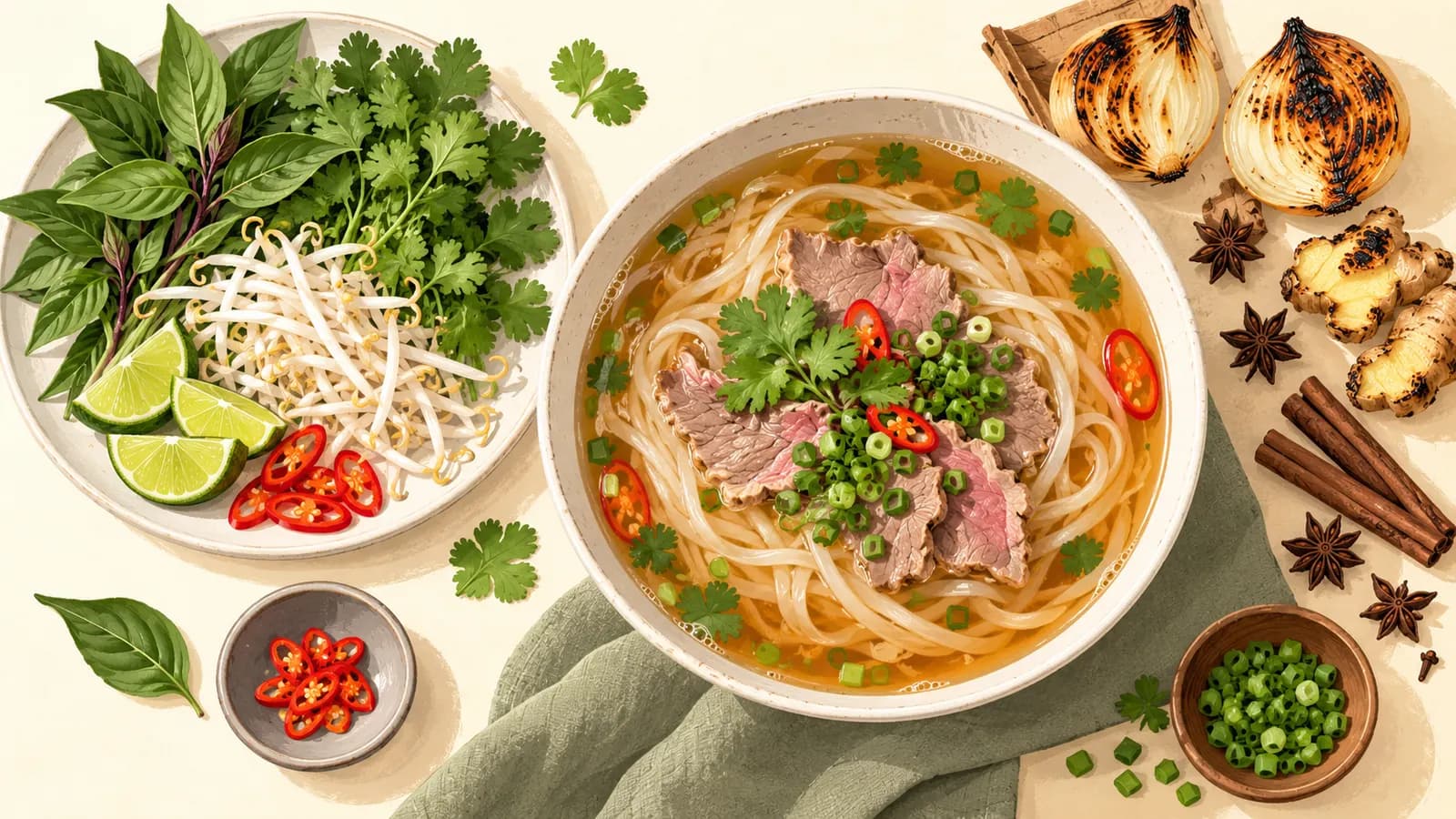
To make pho at home, simmer good beef stock with charred onion and ginger and toasted star anise, cinnamon, cloves and coriander seed for about 45 minutes, then season it with fish sauce and a little sugar. Pour the broth, at a rolling boil, over cooked flat rice noodles and paper-thin slices of raw beef so the meat cooks in the bowl, and finish with herbs, lime and chilli at the table.
Phở bò, Vietnam's beef noodle soup, is traditionally built on a bone broth that simmers for six hours or more. But the flavour that makes pho taste like pho comes mostly from the charred aromatics and spices, and those work just as well on a ready-made stock. This guide explains each part, then gives a weeknight recipe.
What gives pho broth its flavour?
A good pho broth is clear, light brown and smells of sweet spice. Three things get it there: a rich beef base, charred aromatics, and a little warm spice that perfumes the broth without making it taste like mulled wine. Fish sauce and rock sugar season it at the end.
How to char onion and ginger for pho
Halve an onion and a large piece of ginger without peeling them. Char them directly over a gas flame with tongs, under a very hot grill, or cut-side down in a dry cast-iron pan, for 10 to 15 minutes, turning until they are blackened in patches and starting to soften. The burnt skin gives the broth its smoky sweetness and deeper colour. Rinse or rub off the loosest black flakes before they go in, or the broth turns grey and bitter.
Which spices go in pho?
| Spice | Amount | What it adds |
|---|---|---|
| Star anise | 3 to 4 whole stars | The signature sweet, aniseed aroma |
| Cinnamon or cassia stick | One piece, about 8cm | Warmth and sweetness |
| Cloves | 3 to 4 | Depth; more than this tastes medicinal |
| Coriander seeds | 1 tbsp | A light, citrusy lift |
| Black cardamom (thảo quả) | 1 pod, cracked | Smoky, camphor-like note; optional but authentic |
| Fennel seeds | 1 tsp | Optional; softens the anise |
Toast the whole spices in a dry pan over a medium heat for two to three minutes, shaking often, until fragrant but not smoking. Tie them in a square of muslin or put them in a large tea infuser so they are easy to lift out. Asian grocers also sell ready-made pho spice bags, which are a sensible shortcut. Take the spices out after 30 to 45 minutes; left in for hours, cloves and cardamom turn the broth bitter.
Shortcut broth vs traditional bone broth
Traditional broth starts with beef marrow and knuckle bones, often with oxtail and a piece of brisket. The bones are blanched in boiling water for 10 minutes and rinsed to remove scum, then simmered very gently for six to eight hours with the charred aromatics. That slow simmer is what gives restaurant pho its body.
For a weeknight version, use fresh beef stock from the chiller cabinet or your own frozen stock, which have a body that cubes lack. Choose low-salt stock where you can, because you will be seasoning with fish sauce. If you only have cubes, use one for 2 litres of water and simmer a piece of brisket in it for longer.
Phở bò vs phở gà
Phở bò is beef pho, the version most people know: a spiced beef broth topped with rare beef, well-done brisket, beef balls, or a mix. Phở gà is chicken pho, made by simmering a whole chicken or chicken carcasses with the same charred onion and ginger but usually fewer spices, often just star anise, coriander seed and a little cinnamon. The result is lighter and more delicate, topped with shredded poached chicken and, in Hanoi, finely shredded lime leaves. A chicken version takes about an hour and a half from raw bones, which makes it a good first attempt at a from-scratch broth.
Hanoi-style pho tends to be clearer and less sweet, with plenty of spring onion and few extras. Saigon-style pho is slightly sweeter and comes with a big plate of herbs, bean sprouts, lime and chilli, plus hoisin and sriracha. The recipe below sits closer to the southern style.
Which rice noodles should you use for pho?
Pho uses flat rice noodles called bánh phở. Dried packs are labelled bánh phở or rice sticks and come in several widths; about 3mm, sometimes sold as small or medium, is the classic choice. Thai rice sticks (sen lek) are the same thing under a different name. Vietnamese grocers also sell fresh bánh phở in the chiller, which are softer and silkier and need only a few seconds in boiling water. Our guide to Asian noodles covers the other rice noodles and what to use them for.
- Dried noodles: soak in warm water for 20 to 30 minutes until pliable, then blanch in boiling water for 30 to 60 seconds until just tender. Or follow the pack, which may say to boil for 4 to 6 minutes from dry.
- Fresh noodles: separate the strands, then dip in boiling water for 10 to 20 seconds to warm through.
- Cook them separately, never in the broth: their starch clouds it.
- Rinse briefly under hot water and divide between bowls straight away, so they don't clump.
How to slice beef thin for pho
Use a tender steak: sirloin, rump or fillet, or topside for a leaner, cheaper option. The trick is to freeze it for 30 to 40 minutes until firm but not solid, then slice it as thinly as you can, about 2mm, across the grain with your sharpest knife. Lay the slices between cling film and press them thinner with the flat of the knife or a rolling pin. Thin slices are what let boiling broth cook the beef in the bowl; thick ones stay raw in the middle and turn chewy.
The broth must be at a full, rolling boil when you ladle it over, and the beef will turn pale pink and tender within a minute. If you are serving anyone who is pregnant, very young, elderly or has a weakened immune system, or you simply prefer it cooked through, dip the slices into the simmering broth in a sieve for 30 to 60 seconds before adding them to the bowl. Frozen Vietnamese beef balls (bò viên) are another easy topping: simmer them in the broth for 5 minutes until hot all the way through.
Pho herbs and toppings
The herb plate is half the point of pho: each person adds what they like as they eat.
- Thai basil (húng quế): purple stems and a sweet anise flavour that echoes the star anise.
- Coriander and sawtooth coriander (ngò gai): sawtooth, also sold as culantro, has long serrated leaves and a stronger coriander taste.
- Bean sprouts: UK food safety advice is to cook them thoroughly unless the pack says ready to eat, so blanch them in boiling water for 30 seconds or drop them into the hot broth.
- Lime wedges, sliced bird's eye chilli and very thinly sliced onion for sharpness and heat.
- Spring onion and chopped coriander, scattered over each bowl before serving.
- Hoisin and sriracha at the table. Many people prefer them in a small dish for dipping the beef rather than squeezed into the broth.
Buy herbs on the day if you can. If not, our guide to storing Asian herbs and vegetables explains how to keep Thai basil and coriander fresh for several days.
Weeknight beef pho recipe
This version won't have the full body of a six-hour broth, but it tastes clearly of pho and is ready in about an hour and a half.
Recipe
Weeknight beef pho (phở bò) with a shortcut broth
Vietnamese beef noodle soup made with shop-bought beef stock, charred onion and ginger and toasted spices, topped with rare sliced steak and fresh herbs.
- Serves
- 4 people
- Prep
- 30 min
- Cook
- 60 min
- Total
- 90 min
Ingredients
- 1.5 litres fresh beef stock, ideally low-salt, plus 500ml water
- 1 large onion, halved, skin on
- 60g fresh ginger (about two thumbs), halved lengthways
- 4 star anise
- 1 cinnamon stick (about 8cm)
- 4 cloves
- 1 tbsp coriander seeds
- 1 black cardamom pod, cracked (optional)
- 3 tbsp fish sauce, plus extra to taste
- 1 tbsp rock sugar or 2 tsp caster sugar
- 400g sirloin or rump steak, trimmed of fat
- 300g dried flat rice noodles (bánh phở, about 3mm) or 600g fresh
- 200g bean sprouts
- 4 spring onions, thinly sliced, and ½ small onion, sliced paper-thin
- A handful each of Thai basil, coriander and sawtooth coriander (if you can find it)
- 2 limes, cut into wedges, and 2 red bird's eye chillies, sliced
- Hoisin sauce and sriracha, to serve
Method
- 1Put the steak in the freezer for 30 to 40 minutes. Meanwhile, char the onion and ginger over a gas flame, under a very hot grill or in a dry heavy pan for 10 to 15 minutes, turning, until blackened in patches. Rub off the loosest char.
- 2Toast the star anise, cinnamon, cloves, coriander seeds and cardamom in a dry pan over a medium heat for 2 to 3 minutes until fragrant, then tie them in muslin or put them in a large tea infuser.
- 3Put the stock, water, charred onion and ginger, spice bag and sugar in a large pan. Bring to a gentle simmer, partly cover and cook for 45 minutes, skimming any foam. Do not let it boil hard. Lift out the spices after 40 minutes at most.
- 4While the broth simmers, soak the dried noodles in warm water for 20 to 30 minutes. Slice the firm steak across the grain as thinly as possible, about 2mm, and keep it chilled. Blanch the bean sprouts for 30 seconds and set out the herbs, lime, chilli and sauces.
- 5Strain the broth through a fine sieve into a clean pan and bring it back to the boil. Season with the fish sauce, then taste and add more fish sauce, sugar or salt until it tastes rich and slightly too salty on its own. You should have about 1.6 litres.
- 6Warm four deep bowls with hot water. Cook the noodles in a separate pan of boiling water for 30 to 60 seconds (10 to 20 seconds if fresh), drain and divide between the bowls.
- 7Lay the raw beef over the noodles, then ladle about 400ml of broth at a rolling boil into each bowl so it covers the meat. Top with spring onion, sliced onion and coriander, and serve straight away with the bean sprouts, herbs, lime, chilli, hoisin and sriracha on the side.
Common pho mistakes
- Under-seasoning: a broth that tastes just right in the pan tastes flat once it meets noodles. Season boldly with fish sauce; see our guide to how to use fish sauce for how to balance it.
- Lukewarm broth: the beef only cooks if the broth is at a full boil and the bowls are warm.
- Overcooked noodles: they keep softening in the hot broth, so take them out while they still have a little bite.
Leftover broth keeps in the fridge for up to three days or in the freezer for three months, so it is worth making a double batch and freezing it in portions, without noodles or beef.
What you'll need
Pho needs a big pot and deep bowls.
- Large stockpot (8 litre)Room for bones, charred aromatics and plenty of broth.See options on Amazon (affiliate link, opens in a new tab)
- Noodle strainer basketCook and drain one portion of noodles at a time in the same pan of water.See options on Amazon (affiliate link, opens in a new tab)
- Large soup bowlsDeep enough for broth, noodles and herbs.See options on Amazon (affiliate link, opens in a new tab)
- Flat rice noodles (bánh phở)Dried pho noodles; soak before a quick blanch.See options on Amazon (affiliate link, opens in a new tab)
- Whole star aniseOne of the key pho spices with cinnamon, cloves and cardamom.See options on Amazon (affiliate link, opens in a new tab)
Some links on this page are affiliate links: if you buy through them we may earn a small commission, at no extra cost to you. It never affects which shops we list. How we make money.
Where to buy pho ingredients in the UK
Most supermarkets sell star anise, cinnamon, fresh stock and limes, but for bánh phở, black cardamom, rock sugar, pho spice bags, sawtooth coriander, Thai basil and good fish sauce, a Vietnamese or pan-Asian grocer is much easier. In our directory, 46 stores stock Vietnamese groceries, and most will have everything on the list above.
In London, Huy Minh Supermarket lists pho ingredients among its specialities, and Ha-Noi Supermarket sells fresh vegetables alongside Vietnamese groceries. The Longdan Hoxton branch is one of several Longdan shops across London and the South East. Further north, try NamKhang Supermarket in Leicester or Vinh supermarket in Leeds, which has a Vietnamese restaurant on site.
Vietnamese groceries by city