
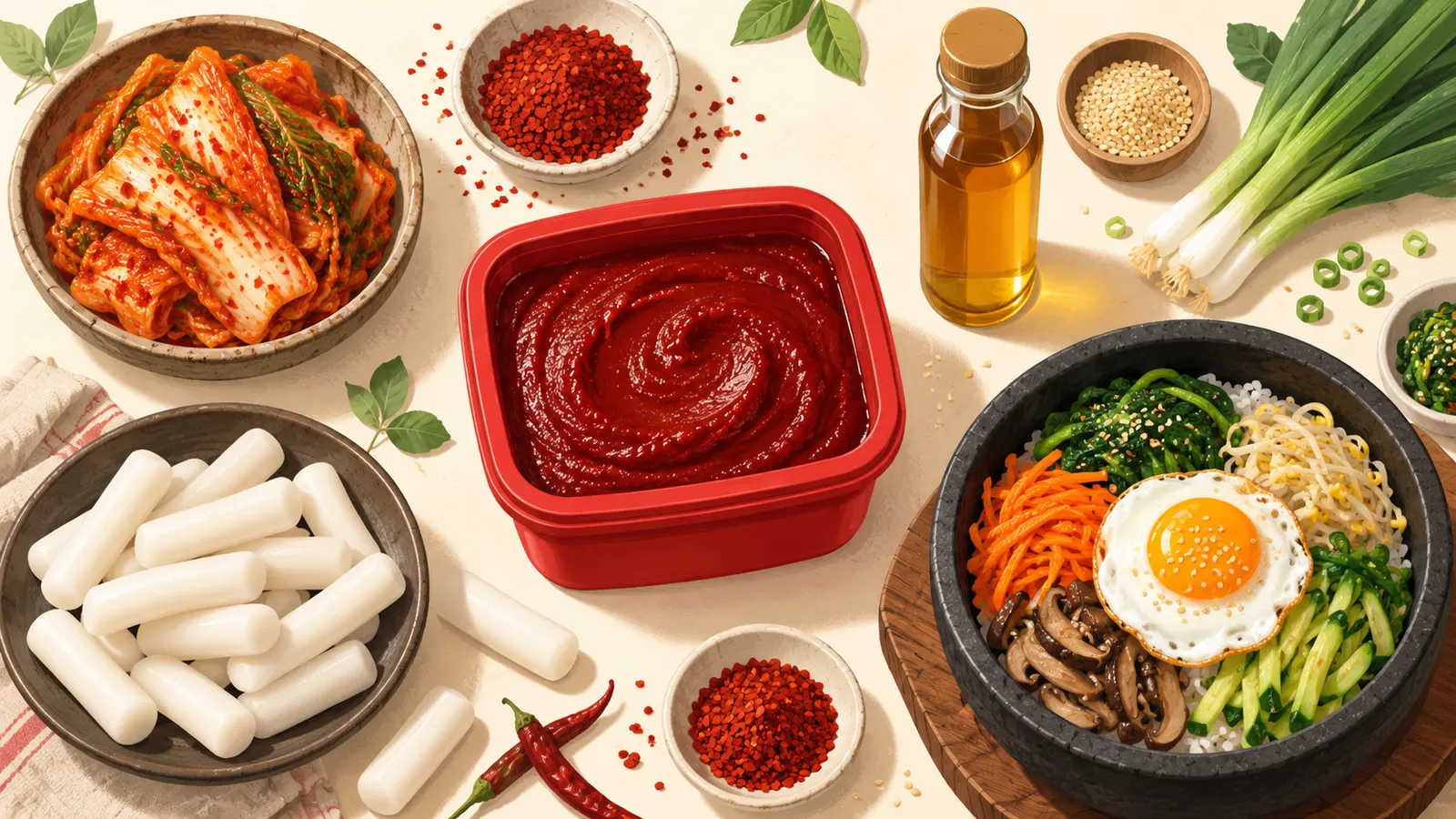
A tub of gochujang is the gateway to Korean home cooking. The fermented paste of chilli, glutinous rice, soybeans and salt brings heat, sweetness and deep savoury flavour to stews, marinades and dipping sauces. Most big UK supermarkets now sell a squeezy bottle of it, but for the full range (tubs in different heat levels, coarse and fine chilli flakes, fresh rice cakes, banchan and proper ramyeon) you need a Korean grocer or a well-stocked Asian supermarket.
Our directory lists 125 stores that stock Korean groceries, 30 of them Korean specialists. Here is what to put in your basket and where to find it. You can also browse every one of them on the Korean groceries page.
What to put in your basket
- Gochujang (고추장): fermented chilli paste sold in red plastic tubs. Most brands print a heat scale on the lid; a mild or medium paste suits most cooking. Keep it in the fridge once opened.
- Gochugaru (고춧가루): Korean chilli flakes. Coarse flakes are for kimchi, fine powder for soups and sauces. It is fruitier and milder than most chilli powders, so it isn't a like-for-like swap.
- Doenjang and ssamjang: fermented soybean paste for stews such as doenjang jjigae, and the ready-mixed dip served with grilled meat and lettuce wraps.
- Guk-ganjang: soup soy sauce, lighter in colour but saltier than everyday soy, used to season broths.
- Tteok (rice cakes): cylinders for tteokbokki and thin ovals for tteokguk soup. Look in the chiller or freezer, and soak frozen ones before cooking.
- Kimchi: sold in jars and tubs in the chiller. Young kimchi is crisp and fresh; older, sourer kimchi is better for stews and fried rice.
- Dangmyeon: sweet potato glass noodles for japchae.
- Ramyeon, frozen mandu and snacks: usually the biggest aisle in any Korean shop.
- Toasted sesame oil, roasted seaweed (gim) and short-grain rice: the everyday basics.
Korean specialists
New Malden in south-west London is home to one of the largest Korean communities in Europe and the densest cluster of Korean shops in the UK. Korea Foods is the biggest store in the area, with fresh meat in Korean cuts for bulgogi and galbi and an onsite bakery.
Seoul Plaza has its New Malden shop on the high street and branches in Birmingham, Coventry and Cambridge, plus two in Oxford including Cornmarket. Each stocks Chinese, Japanese and Thai products alongside the Korean range.
The Oseyo chain's Arndale Centre store in Manchester is listed at around 13,000 sq ft and billed as the largest Korean supermarket in the UK, with kimchi, chilli seasoning, mochi, fermented drinks and K-beauty. There are smaller Oseyo shops on Oxford Road, Manchester, in Cambridge, Guildford and Kingston upon Thames.
Further afield, Itaewon Korean Supermarket in Norwich sells kimchi, tteokbokki and Korean snacks and has a small seating area, Korea Super 韩品超市 in Leicester mixes Korean, Chinese and Japanese stock, and Happy Rooster Oriental Food and BUBBLE TEA in Scarborough pairs Korean noodles and mochi with a bubble tea counter.
Every Korean specialist in the directory
- Oseyo BirminghamBirmingham · EnglandKorean
- Seoul PlazaBirmingham · EnglandKoreanChineseJapaneseThai
- Oseyo CambridgeCambridge · EnglandKoreanJapanese
- Seoul PlazaCambridge · EnglandKoreanChineseJapaneseThai
- Seoul PlazaCoventry · EnglandKoreanChineseJapaneseThai
- Oseyo GuildfordGuildford · EnglandKorean
- Korea Super 韩品超市Leicester · EnglandKoreanChineseJapanese
- Korea FoodsNew Malden · EnglandKorean
- Oseyo AngelLondon · EnglandKorean
- Oseyo Battersea Power StationLondon · EnglandKorean
- Oseyo Camden TownLondon · EnglandKorean
- Oseyo HammersmithLondon · EnglandKorean
- Oseyo KingstonKingston upon Thames · EnglandKorean
- Oseyo Liverpool StreetLondon · EnglandKorean
- Oseyo London BridgeLondon · EnglandKorean
- Oseyo Notting HillLondon · EnglandKorean
- Oseyo Paddington SquareLondon · EnglandKorean
- Oseyo SohoLondon · EnglandKorean
- Oseyo Tottenham Court RoadLondon · EnglandKorean
- Oseyo VictoriaLondon · EnglandKorean
- Oseyo WimbledonLondon · EnglandKorean
- Seoul PlazaNew Malden · EnglandKoreanChineseJapaneseThai
- Oseyo Arndale CentreManchester · EnglandKorean
- Oseyo Oxford Rd.Manchester · EnglandKorean
- Oseyo NewcastleNewcastle upon Tyne · EnglandKorean
- Itaewon Korean SupermarketNorwich · EnglandKorean
- Seoul Plaza CornmarketOxford · EnglandKoreanChineseJapaneseThai
- Seoul Plaza OxfordOxford · EnglandKoreanChineseJapaneseThai
- Happy Rooster Oriental Food and BUBBLE TEAScarborough · EnglandKoreanChinese
- Oseyo SheffieldSheffield · EnglandKorean
Pan-Asian supermarkets with a Korean aisle
You don't need a specialist for the basics. Another 95 stores in the directory stock Korean products alongside Chinese, Japanese or South-East Asian ranges, including big Chinese supermarkets such as Loon Fung in London, W.H. Lung in Manchester and Sida Chinese Supermarket in Liverpool. These pages list the best-served cities:
Korean groceries by city
- Korean groceries in London35 stores
- Korean groceries in Manchester3 stores
- Korean groceries in Edinburgh5 stores
- Korean groceries in Birmingham3 stores
- Korean groceries in Glasgow7 stores
- Korean groceries in Bristol3 stores
- Korean groceries in Cambridge4 stores
- Korean groceries in Leeds3 stores
- Korean groceries in Nottingham4 stores
- Korean groceries in Brighton & Hove3 stores
- Korean groceries in Canterbury4 stores
- All Korean grocers125 stores
Shopping tips
- Check the date on kimchi. It keeps fermenting in the fridge, so a jar near its date will be sourer: great for kimchi jjigae, less so as a side dish.
- Buy rice cakes, mandu and meat last and bring a cool bag, especially if you have a long trip home.
- Large tubs of gochujang and doenjang cost much less per gram than small ones and keep for months in the fridge.
- For thinly sliced pork belly or beef for Korean barbecue, look for stores with a meat counter or a well-stocked freezer, and check opening hours on each listing before you travel.
Stock your pantry
Can't get to a Korean shop? These keep well and post safely.
- GochujangFermented chilli paste; tubs keep for months in the fridge.See options on Amazon (affiliate link, opens in a new tab)
- Gochugaru (Korean chilli flakes)Fruity, medium-hot flakes for kimchi, stews and dipping sauces.See options on Amazon (affiliate link, opens in a new tab)
- Doenjang (soybean paste)For doenjang jjigae and dipping sauces.See options on Amazon (affiliate link, opens in a new tab)
Some links on this page are affiliate links: if you buy through them we may earn a small commission, at no extra cost to you. It never affects which shops we list. How we make money.
Three easy dishes to start with
- Tteokbokki: rice cakes simmered in stock with gochujang, gochugaru and a little sugar until the sauce turns glossy. Add fish cakes and a boiled egg.
- Kimchi fried rice: fry chopped sour kimchi in butter or oil, add day-old rice and a spoon of gochujang, and top with a fried egg and sesame seeds.
- Bibimbap sauce: mix gochujang, sesame oil, sugar, a splash of rice vinegar and garlic, then spoon over rice, vegetables and a fried egg.