
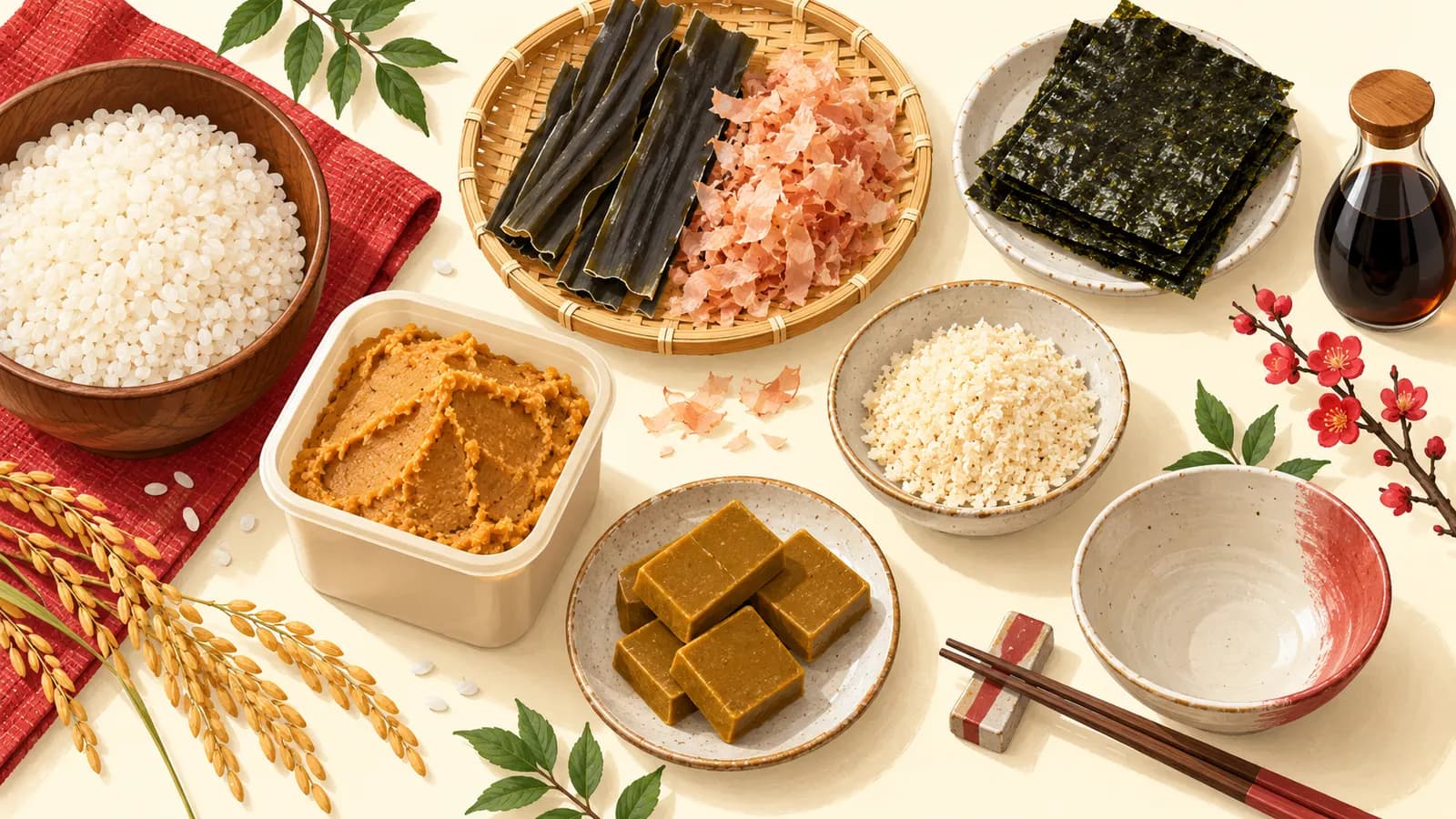
Japanese cooking relies on a short list of pantry staples (good rice, soy sauce, mirin, miso and dashi), and once you have those, most weeknight dishes are within reach. Dedicated Japanese food shops are rare outside London, but you seldom need one: 111 of the 438 stores in our directory carry Japanese groceries, from Chinese supermarkets with a Japanese aisle to Korean chains that stock both.
The pantry basics
- Short-grain rice. For sushi and everyday steamed rice, look for Japanese short-grain or Californian medium-grain rice, often sold as sushi rice. Koshihikari is the premium variety. Rinse it until the water runs nearly clear.
- Soy sauce. Koikuchi (dark) soy is the all-rounder; usukuchi is lighter in colour but saltier. Tamari is richer and often wheat-free, but check the label.
- Mirin and sake. Hon-mirin is true sweet rice wine; mirin-style seasoning is cheaper and sweeter. A splash of cooking sake adds depth to simmered dishes and marinades.
- Rice vinegar. Milder than Western vinegars, for sushi rice, dressings and quick pickles.
- Miso. White (shiro) miso is mild and sweet, red (aka) miso is aged longer and saltier, and mixed (awase) sits in between. Keep it in the fridge.
- Dashi. Make it from kombu and katsuobushi (bonito flakes), or keep instant dashi granules for speed.
- Nori, furikake and sesame seeds for rice balls, toppings and garnishes.
- Panko, Japanese curry roux and Kewpie mayonnaise, the comfort-food trio behind katsu curry.
Fresh and frozen
Udon freezes brilliantly: frozen sanuki-style udon has a far better bite than shelf-stable packs. The freezer is also where you'll find gyoza, edamame, natto and thinly sliced meat for shabu-shabu or sukiyaki. In the produce section, look for firm and silken tofu, shiitake and enoki mushrooms, mooli (daikon) and Japanese-style cucumbers.
Three dishes from a basic pantry
- Miso soup: warm dashi, whisk in miso off the boil, and add cubes of silken tofu, wakame and spring onion.
- Teriyaki salmon or chicken: equal parts soy sauce, mirin and sake with a little sugar, reduced in the pan until sticky.
- Katsu curry: breadcrumb pork or chicken in panko, fry, and serve with rice and a sauce made from a block of curry roux.
Japanese specialists
Kantenya in Brighton is a small Japanese grocery with onigiri, bento and sushi, sushi-grade fish, frozen sashimi and fish cakes, plus sake, shochu and Japanese beer.
Edinburgh Trading Ltd in Edinburgh focuses on Japanese packaged food, snacks, sauces, curries and condiments, and Bao An Oriental Supermarket in Birmingham pairs Japanese and Vietnamese stock with brands such as Nissin, Meiji and Glico.
The Secret Grocery and Bubble Tea Cafe in Aylesbury combines a Japanese grocery with a bubble tea café.
Japanese specialists in the directory
- Bao An Oriental SupermarketBirmingham · EnglandJapaneseVietnamese
- Edinburgh Trading LtdEdinburgh · ScotlandJapanese
- Japan CentreLondon · EnglandJapanese
- KantenyaBrighton and Hove · EnglandJapanese
- The Secret Grocery and Bubble Tea CafeAylesbury · EnglandJapanese
Where else to look
Many Korean shops double as Japanese grocers: every Seoul Plaza branch in our listings carries Japanese products, and Oseyo Cambridge stocks both. In Glasgow, 100 Supermarket and O-Mart focus on Korean and Japanese cooking essentials and snacks, and around Bristol the two Konbini stores sell Japanese and Korean groceries, mochi and ramen alongside bubble tea.
Large Chinese and pan-Asian supermarkets are the other good bet, especially for rice, soy sauce, noodles and frozen gyoza. These cities have the most stores stocking Japanese food:
Japanese groceries by city
- Japanese groceries in London19 stores
- Japanese groceries in Edinburgh7 stores
- Japanese groceries in Glasgow8 stores
- Japanese groceries in Bristol3 stores
- Japanese groceries in Cambridge5 stores
- Japanese groceries in Southampton3 stores
- Japanese groceries in Leeds4 stores
- Japanese groceries in Nottingham4 stores
- Japanese groceries in Oxford3 stores
- Japanese groceries in Brighton & Hove3 stores
- Japanese groceries in Canterbury4 stores
- Japanese groceries in Reading3 stores
- All Japanese grocers111 stores
Stock your pantry
Japanese pantry staples that keep well and post safely.
- Japanese short-grain riceThe base of every Japanese meal.See options on Amazon (affiliate link, opens in a new tab)
- White (shiro) misoFor soup, glazes and dressings.See options on Amazon (affiliate link, opens in a new tab)
- MirinSweet rice seasoning for teriyaki and simmered dishes.See options on Amazon (affiliate link, opens in a new tab)
- Japanese curry rouxBlocks for an easy Japanese curry.See options on Amazon (affiliate link, opens in a new tab)
Some links on this page are affiliate links: if you buy through them we may earn a small commission, at no extra cost to you. It never affects which shops we list. How we make money.
Shopping tips
- If you cook rice most days, a 5kg or 10kg bag is much cheaper per kilo. Store it in an airtight container.
- Imported packs carry an English label, usually a sticker added by the importer, with ingredients and allergens. Check it if you avoid wheat, fish or sesame.
- Hon-mirin and sake are alcoholic, so you may be asked for ID, and not every shop is licensed to sell them.
- Natto, fresh fish and seasonal snacks sell out fast. Ring ahead if you're travelling for something specific; phone numbers are on each store page.