
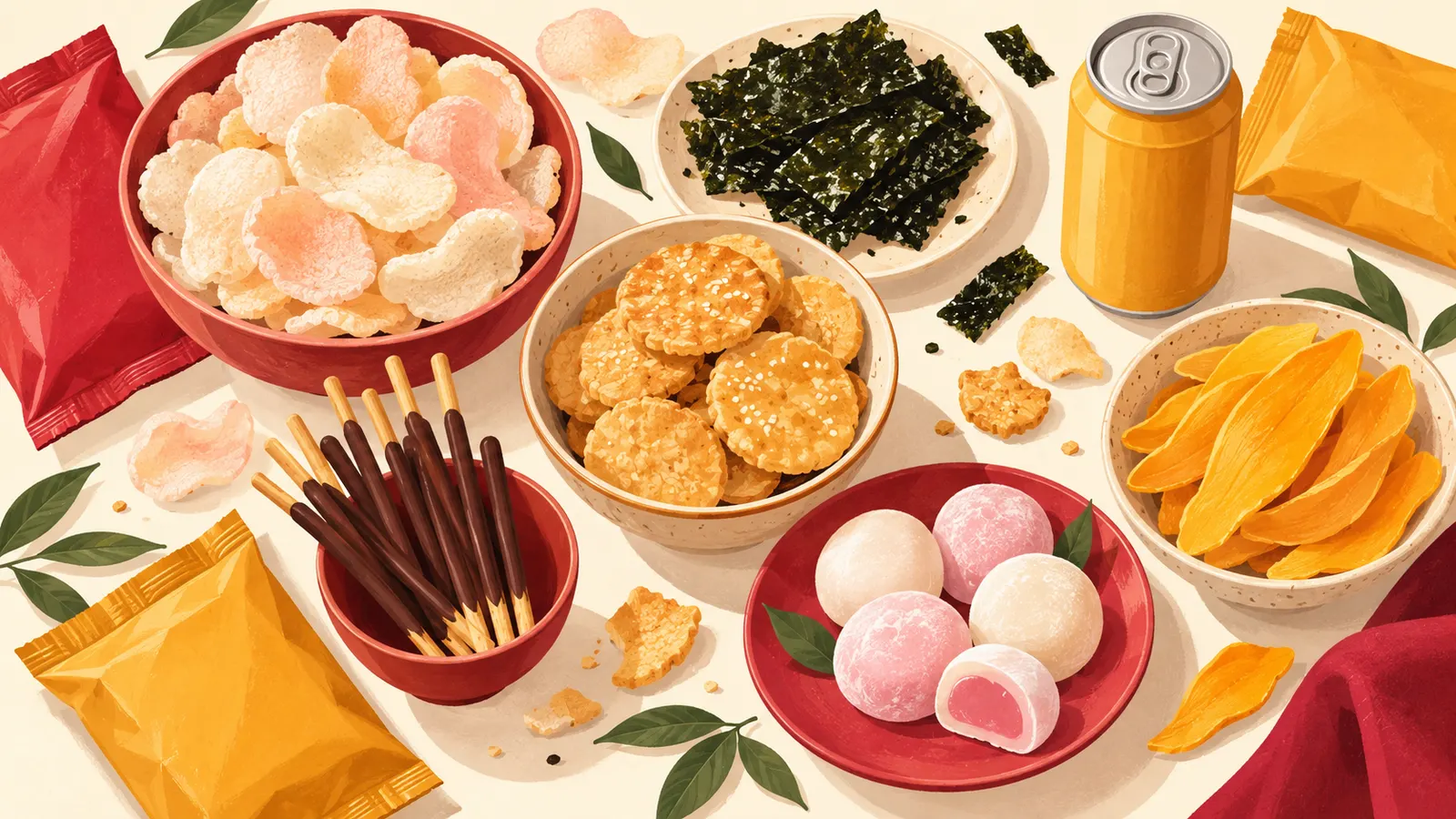
The best Asian snacks to try first are shrimp crackers, roasted seaweed snacks, chocolate-coated biscuit sticks, rice crackers, mochi and milk candy, with a bottle of milk tea or a melon or lychee soda to wash them down. Pick a mix of sweet and savoury from a few different countries: each has its own specialities.
The snack aisle is the easiest place to start in an Asian supermarket. Packets are cheap, there's no cooking involved, and a basket of six or seven things makes a good tasting night or a stack of stocking fillers. In our directory, 78 listings specifically mention snacks, sweets or mochi, and 34 mention bubble tea or milk tea, but almost every Asian supermarket has a snack aisle. This guide goes country by country, then covers drinks, gifting and how to read the labels.
Japanese snacks to try
- Rice crackers (senbei). Crunchy, toasted crackers glazed with soy sauce, sometimes wrapped in a strip of nori. Small bite-sized ones are often mixed with peanuts.
- Chocolate-coated biscuit sticks. Thin, crisp biscuit sticks dipped in chocolate, strawberry or matcha coating. A good first buy if you're unsure.
- Matcha-flavoured sweets. Matcha biscuits, chocolates and wafers are slightly bitter and less sweet than you might expect. Our matcha guide explains the grades if you want to make your own.
- Gummies and soft chews in fruit flavours such as grape, peach and Japanese melon, often with a more intense fruit taste than British sweets.
- Dorayaki, two small pancakes sandwiching sweet red bean paste, sold individually wrapped.
- Puffed corn and potato snacks in flavours such as seaweed, soy and butter, and teriyaki.
Korean snacks to try
- Seaweed snacks (gim). Thin sheets of roasted laver, brushed with sesame oil and salt. Eat them as they are or wrap them around a spoonful of rice.
- Shrimp-flavoured crackers. Light, curled corn or wheat crackers with a sweet-savoury prawn flavour. They contain crustaceans, so check the allergens.
- Chocolate-coated marshmallow cakes: soft cake rounds sandwiching marshmallow, often sold in boxes of individually wrapped cakes.
- Honey butter and sweet potato crisps, sweeter than British crisps.
- Banana-flavoured milk in small bottles, alongside strawberry and melon versions.
- Yakgwa, chewy honey-and-ginger fried biscuits that are softer than they look.
Chinese snacks to try
- Milk candy. Chewy, creamy sweets wrapped in a thin layer of edible rice paper: leave the inner paper on and eat it with the sweet.
- Haw flakes. Thin, sweet-sour discs made from hawthorn fruit, sold in paper rolls.
- Preserved and dried fruit, such as salted plum, dried mango, candied ginger and sweet-sour dried lemon.
- Roasted seeds. Sunflower and melon seeds in flavours such as five-spice, caramel and green tea, for cracking with your teeth.
- Spicy gluten strips (latiao). Chewy wheat-gluten strips in chilli oil, very spicy and very savoury.
- Crispy egg rolls, thin rolled wafer biscuits, often sold in tins around Lunar New Year, and sachima, soft fried-dough squares bound with syrup.
Taiwanese snacks to try
- Pineapple cakes. Small squares of buttery shortbread pastry around a sticky pineapple filling. A popular gift, usually sold in boxes.
- Milk nougat, soft and chewy with peanuts or dried fruit, and sometimes made with milk powder biscuits.
- Sweet rice crackers, lighter and sweeter than Japanese senbei, often individually wrapped in twos.
- Sun cakes, flaky pastries with a malt-sugar filling.
- Bubble tea kits, with dried tapioca pearls and powdered or bottled milk tea. Our guide to making bubble tea at home shows how to cook the pearls.
Thai snacks to try
- Crispy seaweed sheets, fried or baked, in flavours such as original, spicy and barbecue.
- Dried mango, soft and chewy, and durian chips, freeze-dried or fried, which taste much milder than fresh durian.
- Coconut rolls and coconut crisps, light and sweet.
- Tamarind sweets, sweet, sour and sometimes rolled in chilli sugar.
- Flavoured cashews and peanuts, coated in chilli, garlic or tom yum seasoning.
- Prawn crackers, sold ready to eat or as dried discs to fry at home, where they puff up in seconds.
Filipino snacks to try
- Dried mango is perhaps the best-known Filipino snack in the UK: thick, soft slices.
- Ube (purple yam) treats, including ube biscuits, wafers and jam, sweet with a vanilla-nutty flavour.
- Polvoron, crumbly shortbread made with toasted flour, powdered milk and sugar, wrapped individually.
- Toasted corn kernels in garlic, barbecue or chilli flavours, very crunchy.
- Pork crackling (chicharrón), puffed and crunchy, often with a spiced vinegar dip.
- Banana chips, sweet and crisp.
Malaysian, Indonesian and Vietnamese snacks
Shops with Malaysian, Indonesian and Vietnamese ranges are worth a look too. Look for prawn and fish crackers to fry at home, which puff up to several times their size in hot oil; spicy anchovy and peanut snacks; kaya, a sweet coconut and egg jam flavoured with pandan, to spread on toast; pandan-flavoured wafers and layer cakes; tempeh chips; and Vietnamese sesame rice crackers, coconut candy and dried jackfruit. Many of these are less common than Japanese or Korean snacks, so if you see one, buy it.
Which Asian snacks are vegetarian or vegan?
Plenty are, but you have to read the sticker. Many rice crackers, roasted seeds, dried mango, banana chips, coconut rolls, haw flakes and plain seaweed snacks contain no animal products. Watch for less obvious ones: shrimp and prawn crackers contain crustaceans, some seaweed snacks and savoury crackers use fish sauce, anchovy or shrimp powder for flavour, gummies and marshmallow cakes often contain gelatine, and milk candy, biscuit sticks, polvoron and most chocolate contain milk. Savoury crisps labelled with a meat flavour can contain meat extracts. If a packet has no English ingredients list at all, don't buy it for someone with an allergy or strict diet.
How to put together an Asian snack tasting box
A tasting night with friends is a good excuse to try ten things at once. For four to six people, buy around eight to ten different packets: three savoury, three sweet, one or two unusual ones and a couple of drinks to share. Choose small or multipack bags so nothing goes to waste, and include at least one snack from each of three or four countries. Lay them out from mild to strong (seaweed and rice crackers first, spicy gluten strips and tamarind sweets last) and keep a note of the favourites so you know what to buy next time.
Asian drinks to try
- Bottled milk tea, from Hong Kong-style strong tea to sweet jasmine and oolong milk tea.
- Flavoured milks in banana, strawberry, melon and coffee.
- Fruit sodas and marble soda, the glass-stoppered bottle you open by pushing a marble down into the neck.
- Aloe vera drinks with soft pieces of aloe, and grass jelly drinks with herbal jelly.
- Cultured milk drinks, sweet and tangy, sold in small bottles.
- Barley tea and unsweetened green tea, if you'd like something less sweet.
- Canned coffee, from black to very sweet and milky.
Sweet or savoury? A quick guide
| Snack | Where it's from | Sweet or savoury | Good to know |
|---|---|---|---|
| Shrimp crackers | Korea, China, Thailand | Savoury | Contains crustaceans |
| Seaweed snacks | Korea, Thailand | Savoury | Light; good with rice too |
| Rice crackers (senbei) | Japan, Taiwan | Savoury or sweet | Often contain soya and wheat |
| Biscuit sticks | Japan | Sweet | Easy first buy |
| Milk candy | China | Sweet | Leave the rice paper on |
| Mochi | Japan, China, Taiwan | Sweet | Short shelf life; chewy |
| Pineapple cakes | Taiwan | Sweet | Popular gift boxes |
| Dried mango | Philippines, Thailand | Sweet | Long shelf life |
| Roasted seeds | China | Savoury or sweet | Crack open with your teeth |
| Spicy gluten strips | China | Savoury | Very spicy; contains wheat |
| Polvoron | Philippines | Sweet | Crumbly; contains milk |
How to buy and store mochi
Mochi are soft, chewy rice cakes, often filled with red bean paste, peanut, sesame or fruit and dusted with starch. Packaged mochi from the snack aisle are best within a few days of opening and harden in the fridge, so keep them at room temperature unless the label says otherwise. Mochi ice cream lives in the freezer section: let it sit for a few minutes before eating so the outside softens. Mochi are very sticky, so cut them into small pieces for young children and older people and chew well. To make your own, see our guide to making mochi.
Asian snacks for Christmas stockings and gifts
Asian snacks make good stocking fillers: individually wrapped, colourful and a bit different. Build a mix of one savoury packet, one sweet, one drink and one thing they've never seen before, such as haw flakes, marble soda or a box of pineapple cakes. In December, many shops stock gift boxes of biscuits, pineapple cakes and sweets, and Lunar New Year boxes appear soon after Christmas.
Before you wrap them
- Check the best-before date on the packet, especially for mochi, cakes and anything soft.
- Check allergens on the English sticker if the snacks are for someone else. Peanuts, sesame, soya, wheat, milk, egg, fish and crustaceans are all common.
- Keep a list of what you bought and where, so they can find their favourite again.
Tips for buying snacks at an Asian supermarket
- Read the English sticker on the back. It gives the ingredients and allergens, with allergens emphasised, usually in bold. The front of the packet may be entirely in another language.
- Look for gelatine in gummies and marshmallow snacks if you don't eat it, and for pork or beef extracts in savoury flavours.
- Buy single packets first, then the multipack once you've found something you like.
- Check the spice level. A chilli on the packet usually means it, and Korean and Chinese spicy snacks can be very hot.
- Look near the till for single sweets, small drinks and seasonal items.
Our Asian supermarket shopping tips explain how to read imported date labels and where things usually are in the shop.
Stock your pantry
Can't get to a shop? A mixed box is a good way to try lots at once.
- Japanese snack boxRice crackers, chocolate biscuits and candy from Japan.See options on Amazon (affiliate link, opens in a new tab)
Some links on this page are affiliate links: if you buy through them we may earn a small commission, at no extra cost to you. It never affects which shops we list. How we make money.
Where to buy Asian snacks in the UK
Pan-Asian supermarkets have the widest snack aisles, with products from several countries side by side. For a particular country, try Japanese shops, Korean grocers, Chinese supermarkets, Thai grocers or Filipino stores. Search by town or postcode on our store finder, or start with London, Manchester, Edinburgh and Birmingham, which have the most listings.
Stores whose listings mention snacks, sweets or bubble tea
- Hai Bao Supermarket 海宝超市Southampton · EnglandChineseJapaneseListing mentions snacks, sweets and drinks
- KonbiniPatchway · EnglandKoreanJapaneseListing mentions mochi, desserts and bubble tea
- Asian Grocery ShopPaisley · ScotlandChineseKoreanJapaneseThaiListing mentions snacks and drinks
- Bao An Oriental SupermarketBirmingham · EnglandJapaneseVietnameseListing mentions snacks and drinks
- GG Oriental Snack ShackOxford · EnglandChineseListing mentions snacks and desserts
- Go EastIpswich · EnglandChineseKoreanJapaneseThaiVietnamese+2 moreListing mentions mochi and desserts
- Hang Won HongManchester · EnglandChineseListing mentions snacks and drinks
- Happy Rooster Oriental Food and BUBBLE TEAScarborough · EnglandKoreanChineseListing mentions mochi and bubble tea