
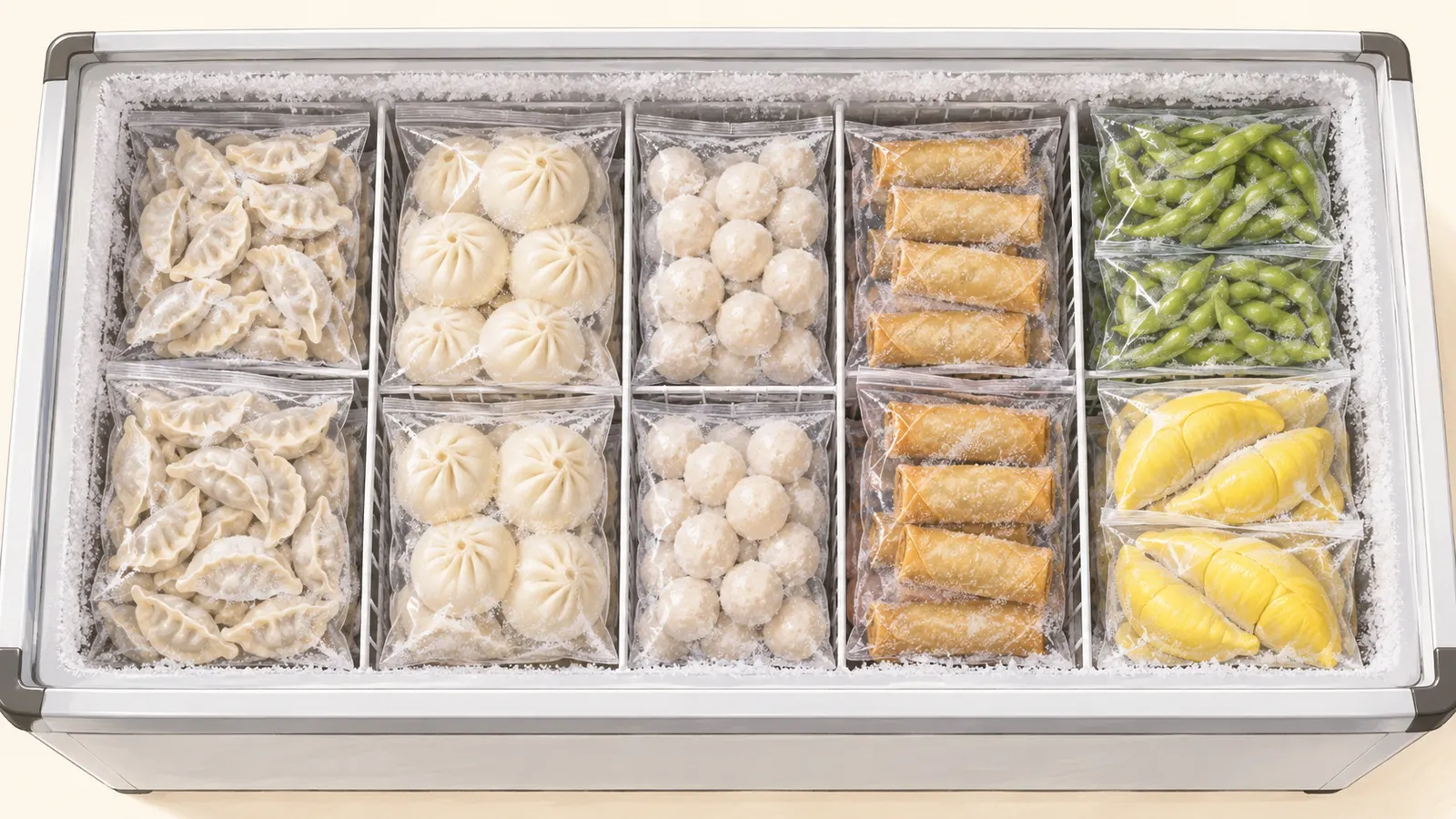
The best things to buy in the frozen section of an Asian supermarket are dumplings and gyoza, steamed bao buns, dim sum, fish balls for hot pot, edamame, thinly sliced meat and seafood, plus ingredients that are hard to find fresh, such as pandan leaves, banana leaves and durian. Most of them cook straight from frozen in under 15 minutes.
The freezers are often the best-value part of the shop: a large bag of dumplings costs about the same as a takeaway portion and makes several meals. They can also be the most confusing, with packets labelled mainly in Chinese, Korean, Japanese or Thai. In our directory, 152 listings specifically mention frozen food, dim sum or dumplings, and most Asian supermarkets have at least a few freezers even when the listing doesn't say so. Here is what to look for, how to cook it and how to get it home safely.
Frozen dumplings, gyoza and wontons
Dumplings usually take up the most freezer space. The English sticker on the back gives the filling and allergens, and the shape tells you how they are meant to be cooked:
- Chinese boiled dumplings (jiaozi) are plump half-moons with thicker wrappers, sold in big bags with fillings such as pork and cabbage, pork and chive, or vegetable. Boil them, or pan-fry them as potstickers.
- Gyoza and potstickers have thinner wrappers and a flat base, made for frying and steaming in one pan until the bottoms are crisp.
- Wontons have very thin, square wrappers and small fillings. They cook in a few minutes in simmering broth.
- Soup dumplings (xiao long bao) hold a little jellied stock that melts as they steam. Steam them on baking paper or cabbage leaves so they don't stick and tear.
- Korean mandu are often larger, with fillings that can include glass noodles, tofu and kimchi. They can be steamed, pan-fried or added to soup.
How to cook frozen dumplings
Cook them straight from frozen. Thawed wrappers turn soggy, stick together and tear. Give them room in the pan, and check one: the filling should be piping hot in the centre with no pink meat.
To boil
- Bring a large pan of water to a rolling boil and add the dumplings, stirring gently so they don't stick to the bottom.
- When the water returns to the boil, add a cup of cold water. Repeat once more when it boils again; this cooks the filling through without bursting the wrappers.
- Once they float and the wrappers look slightly translucent, cook for another 2–3 minutes, about 6–8 minutes in all, then lift out with a slotted spoon.
To pan-fry (potsticker style)
- Heat 1 tbsp oil in a non-stick frying pan with a lid over a medium-high heat and add the dumplings flat side down.
- Fry for about 2 minutes until the bases are golden, then pour in about 100 ml water and cover straight away.
- Steam for 8–10 minutes until the water has evaporated, then uncover and fry for 1–2 minutes more until the bases re-crisp.
Our dumpling night guide covers dipping sauces and making your own, and our bamboo steamer guide explains how to steam them.
Frozen bao buns and dim sum
Steamed buns come filled (char siu pork, red bean, custard, lotus seed paste) or as plain folded buns for filling yourself with slow-cooked pork or crispy tofu. Dim sum such as har gow (prawn dumplings), siu mai and sticky rice in lotus leaf are sold in trays or bags. Steam all of them from frozen, on baking paper with a few holes poked in it, over a pan of steadily boiling water. Don't let the steamer boil dry, and don't lift the lid too often. If you'd rather make your own, our guide to making bao buns shows how, and homemade buns freeze just as well as shop-bought ones.
Fish balls, beef balls and hot pot extras
The hot pot section of the freezer has fish balls, beef balls, cuttlefish balls, fish tofu, crab sticks and thinly sliced beef, pork and lamb rolled up in trays. Fish balls are already cooked and only need heating through; they puff up and float when they're hot. The sliced meat is cut thin enough to cook in seconds in simmering broth. Thaw it slightly in the fridge if you need to separate the slices. These are the base of a hot pot at home and also make a quick noodle soup. In our directory, Super Tiger and Thais R Us list fish balls among their specialities.
Frozen udon, ramen noodles and rice cakes
Frozen noodles are often better than the dried or vacuum-packed versions. Frozen udon comes in individual blocks that go straight into boiling water or broth and are ready in 1–2 minutes, with a springier texture than shelf-stable udon. Frozen ramen noodles are sold in portion packs, sometimes with a sachet of soup base: cook them for the time on the packet, usually a minute or two, in plenty of water, and drain well before adding them to the bowl. Our guide to ramen at home covers broths and toppings. Korean rice cakes (tteok), both cylinders and sliced ovals, are sold frozen as well as chilled. Soak frozen ones in cold water for 10–20 minutes so they soften evenly, then simmer them in sauce or soup until soft and chewy all the way through.
Frozen seafood and sliced meat
Asian supermarkets usually have a wider frozen seafood range than mainstream shops: whole prawns with heads on, peeled raw prawns in several sizes, squid tubes and rings, cleaned whole fish, mussels and seafood mixes for stir fries and fried rice. Thinly sliced pork belly, beef brisket and marinated meats for Korean barbecue are also sold frozen in trays. Our guide to Korean BBQ at home shows how to cook them. Thaw raw seafood and meat in the fridge overnight on a plate, or for prawns, in a sealed bag in a bowl of cold water, and cook within 24 hours of thawing. Small prawns and squid rings can go straight into a stir fry or soup from frozen, as long as they're cooked through.
Edamame and frozen vegetables
Edamame (young soya beans) are sold in their pods, sometimes already salted, and shelled. Boil the pods for 3–5 minutes, drain and toss with flaky salt, or add shelled beans to stir fries, rice bowls and salads. Look out too for frozen sweetcorn, peas and mixed vegetables in Asian-style cuts, frozen taro and cassava, grated cassava for Filipino cassava cake, and purple yam (ube) for Filipino desserts.
Frozen pandan leaves and banana leaves
Pandan and banana leaves are often easier to find frozen than fresh. Pandan leaves give a sweet, grassy, vanilla-like aroma: tie two or three in a knot and drop them into rice as it cooks, or simmer them in coconut milk or sugar syrup for desserts and drinks. They work straight from frozen. Banana leaves are used to wrap food for steaming or grilling. Thaw the pack for about 30 minutes, wipe the leaves clean, then pass them briefly over a gas flame or dip them in hot water so they turn glossy and fold without splitting.
Frozen durian and tropical fruit
Durian is sold frozen whole in a net, as segments in trays or as frozen pulp. Thaw it in the fridge in a sealed box, because the smell travels, and many people like it still slightly frozen, when it tastes like a rich custard ice cream. You'll also find frozen jackfruit, grated coconut, mango and other tropical fruit, which are handy for smoothies and desserts. Durian is less common: in our directory, Yun Feng Foods mentions it, so call ahead before travelling for it.
Cooking times from frozen
| Item | How to cook | From frozen |
|---|---|---|
| Jiaozi (boiled dumplings) | Boil, adding cold water twice | 6–8 min |
| Gyoza / potstickers | Fry, add water, cover and steam, then re-crisp | 11–14 min |
| Wontons | Simmer in broth or boiling water | 4–6 min |
| Soup dumplings | Steam on lined steamer | 8–10 min |
| Bao buns | Steam on baking paper | 10–15 min |
| Har gow / siu mai | Steam on baking paper | 8–10 min |
| Spring rolls | Oven at 200°C, or deep-fry at 170–180°C | 20–25 min oven / 5–6 min fried |
| Fish balls | Simmer in broth until puffed and floating | 5–8 min |
| Edamame in pods | Boil in salted water | 3–5 min |
| Sliced hot pot meat | Dip in simmering broth | Until no pink remains, under 1 min |
| Raw prawns | Thaw in the fridge or in a sealed bag under cold running water, then cook | 2–3 min, until pink all through |
| Pandan leaves | Knot and add to rice, syrup or coconut milk | Use from frozen |
| Banana leaves | Thaw, wipe, soften over a flame or in hot water | Thaw about 30 min |
| Durian | Thaw in the fridge in a sealed box | Several hours |
Times are a guide for typical sizes. Always follow the packet, which can vary by brand and size, and check that anything containing meat or seafood is piping hot all the way through before eating.
Freezer food safety: can you refreeze thawed food?
- Don't refreeze raw food that has thawed, including raw dumplings, prawns and sliced meat. Cook it and eat it, or cook it thoroughly and freeze the cooked dish.
- Get frozen food home quickly. Pick it up last, pack it together in a cool bag with an ice pack, and put it in the freezer as soon as you're home.
- Keep your freezer at −18°C or colder. At that temperature frozen food stays safe; quality slowly declines over time.
- Defrost in the fridge, not on the side, and use defrosted food within 24 hours.
- Check packets in the shop. Avoid bags with large ice crystals or dumplings fused into one lump: they may have thawed and refrozen.
- Label your own freezer bags with the contents and date. Homemade dumplings and buns keep their best quality for about three months.
Our Asian supermarket shopping tips cover cool bags, reading imported date labels and what to buy in bulk.
Where to buy Asian frozen food in the UK
Chinese and pan-Asian supermarkets have the biggest freezer sections, with Korean grocers strong on mandu, rice cakes and sliced meat for barbecue, Japanese shops on gyoza and edamame, and Thai and Filipino grocers on banana leaves, pandan, cassava and ube. Search by town or postcode on our store finder, or start with London, Manchester, Edinburgh and Birmingham, which have the most listings.
Stores whose listings mention frozen dim sum, dumplings and more
- Thais R UsCanterbury · EnglandThaiListing mentions dim sum, dumplings, fish balls and frozen seafood
- Chung Wah SupermarketLiverpool · EnglandChineseListing mentions dumplings, spring rolls and frozen seafood
- Super TigerLeicester · EnglandChineseKoreanThaiIndonesianListing mentions dim sum, dumplings and fish balls
- Chinese Supermarket Cmart Oriental Food StoreEarley · EnglandChineseKoreanJapaneseListing mentions dumplings and gyoza
- Chung YingGlasgow · ScotlandChineseKoreanJapaneseThaiListing mentions dim sum and bao buns
- Cmart Oriental Store 新玲特东方超市. Chinese Supermarket Store. Cmart ReadingReading · EnglandChineseKoreanJapaneseListing mentions dumplings and gyoza
- Ding Sing Oriental SupermarketBristol · EnglandListing mentions dim sum and bao buns
- Hoo HingMitcham · EnglandChineseListing mentions dim sum and dumplings