
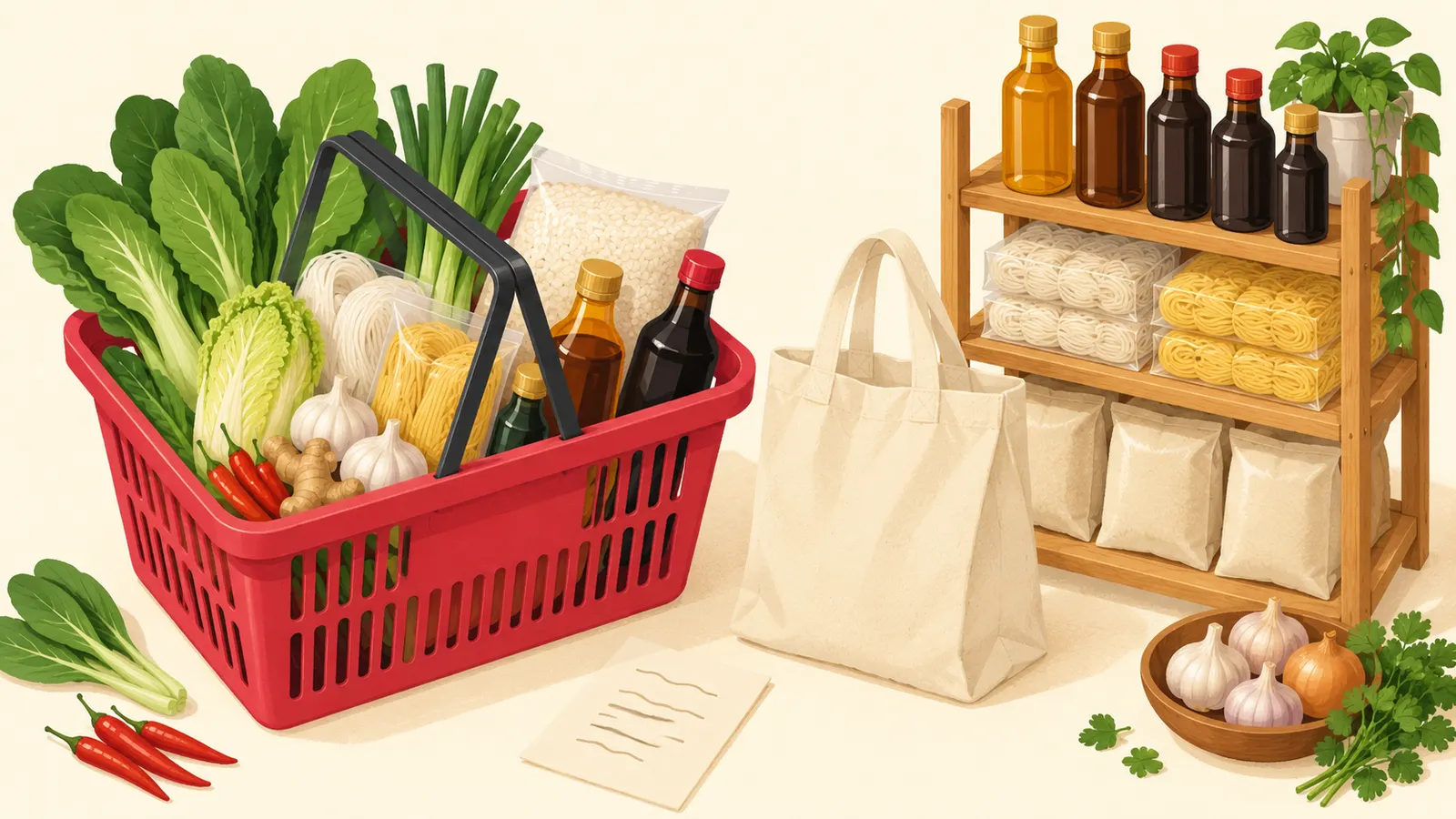
The best tips for a first trip to an Asian supermarket are simple: go with a short list for one or two dishes, bring a cool bag and a little cash, check the English sticker on imported packets for the date and allergens, and ask staff for help. Rice, sauces and noodles are cheaper here than in the big chains, so that is where the savings are.
If you have only ever bought soy sauce from a mainstream supermarket, the first visit can feel like a lot: whole aisles of noodles, sauces labelled mainly in Chinese, Korean, Japanese or Thai, and a freezer section with dozens of kinds of dumplings. It gets easy quickly. Our directory lists 438 Asian supermarkets across the UK; 245 say they sell fresh produce and 234 have an online shop as well as a counter. This guide covers how the shop is usually laid out, how to read the labels, how to pay, and what is worth buying in bulk.
What to know before your first visit
- Shop for a dish, not the whole shop. Pick one or two recipes and buy what they need. A pantry builds up naturally over a few trips.
- Bring a cool bag or insulated bag if you plan to buy anything chilled or frozen, which you almost certainly will.
- Carry a bit of cash. Most shops take cards, but some small ones are cash only or have a card minimum.
- Take a photo of what you need. A picture of the bottle from a recipe, or the name written in the original script, makes it much easier to match a label or show a member of staff.
- Ask. Staff are usually happy to point you to the right shelf or tell you which of three similar sauces they use at home.
- Go at a quiet time. Weekday mornings and early afternoons are calmer than Saturday, when the aisles in busy city shops can be tight.
- Check the hours. Many shops open later in the morning than mainstream supermarkets, and Sunday hours vary. Every store page in our directory shows its opening times.
Where things are in an Asian supermarket
No two shops are identical, but most follow a similar pattern, and once you know it you can find things in any of them.
- Rice is usually stacked in sacks near the door or at the end of an aisle, in 1 kg, 5 kg and 10 kg bags, sorted by type: jasmine, sushi (short grain), glutinous and basmati.
- Fresh produce is often near the entrance or along one wall: pak choi, choi sum, gai lan, mooli, Thai basil, lemongrass, ginger and bean sprouts. Herbs and tofu are often in a chiller next to it.
- Sauces and condiments take up one or more aisles and are often grouped by country, so Chinese soy and oyster sauces sit apart from Thai fish sauce and Korean pastes.
- Dried noodles have their own aisle: wheat, egg, rice, glass and buckwheat noodles, with the instant noodles (often sold in five-packs) nearby.
- Dried goods such as mushrooms, shrimp, seaweed, beans, spices and flours are usually in one block.
- Frozen is often at the back: dumplings, buns, fish balls, seafood, meat and some fresh herbs and leaves sold frozen.
- Snacks, sweets and drinks often fill an aisle, with a drinks fridge by the till.
- Kitchenware and household goods (rice cookers, woks, bamboo steamers, bowls and chopsticks) are usually at the far end.
How to read best-before dates on imported food
Food sold in the UK must give its key information in English, so imported packets usually carry a white English sticker added by the importer. It gives the product name, ingredients, allergens (emphasised in the ingredients list, usually in bold), net weight, storage instructions, the importer's UK address and the date mark. Read the sticker before the printed packaging: the original packaging may not mention an allergen in English at all.
The date itself is often printed on the packet rather than the sticker, and it is commonly written year first: 2026.11.13, 26/11/13 or 20261113 all mean 13 November 2026. If a packet shows two dates, one is usually the production date. These are the words to look for:
| Language | Look for | What it means |
|---|---|---|
| Japanese | 賞味期限 / 消費期限 | Best before / use by (short-life foods) |
| Chinese | 生产日期 / 保质期 | Production date / shelf life, e.g. 12 months from production |
| Korean | 소비기한 / 유통기한 / 제조일자 | Use-by date / older 'sell-by' date / production date |
| Thai | ควรบริโภคก่อน / วันหมดอายุ (EXP) | Best before / expiry date; MFG is the production date |
| Vietnamese | HSD / NSX | Expiry or best before / production date |
UK food safety guidance applies as normal. A best-before date is about quality: dried noodles, rice, sauces and snacks are usually fine for a while after it if the packet is intact and stored properly, though the flavour fades. A use-by date is about safety and applies to chilled foods such as tofu, fresh noodles and bean sprouts: don't eat them after it, even if they look fine. Check dates on slow-moving items in small shops, and skip dented, swollen or leaking tins and jars.
Do Asian supermarkets take cards?
Of the 90 listings in our directory that record how you can pay, 10 say cash only, 5 mention a minimum spend for cards and 4 mention a card surcharge. On the other hand, 41 specifically mention contactless or phone payments. Most shops take cards, but it is the small independents that tend not to, and those are exactly the places a first-timer wanders into.
Listings in our directory that say cash only
- Hung Cheong StoresSwansea · WalesChineseKoreanJapaneseThaiListing says cash only
- J&S Oriental Supermarket 福宝超市Loughborough · EnglandChineseListing says cash only
- Jiajia China SupermarketBournemouth · EnglandChineseListing says cash only
- Oriental Express Asian Food StoreSwansea · WalesChineseListing says cash only
- Walk in Chinese SupermarketTelford · EnglandChineseListing says cash only
- 晨阳超市 Morning SunMiddlesbrough · EnglandChineseKoreanListing says cash only
- 阳光超市 E&J Oriental SupermarketSouthampton · EnglandChineseJapaneseListing says cash only
- Bao An Oriental SupermarketBirmingham · EnglandJapaneseVietnameseListing says cash only
- Sun Wah Mini-Mart ltdStirling · ScotlandChineseKoreanJapaneseThaiFilipino+2 moreListing says cash only
- Sun YipBirmingham · EnglandChineseListing says cash only
Is there a best day to buy fresh produce?
Most shops take one or two produce deliveries a week, and the day after a delivery is when the herbs and greens look their best and the most popular items are back in stock. The day varies by shop, so ask at the till which day the vegetables come in. If you are buying for the weekend, a Thursday or Friday visit often catches fresh stock without the Saturday crowds, but the shop's own answer always beats a rule of thumb.
- Check leaves and stems. Pak choi and choi sum should be crisp with no yellowing; Thai basil should have no black patches.
- Smell the herbs. Lemongrass, galangal and lime leaves should smell strongly when you scratch them.
- Buy what you'll use this week, then freeze the extras that freeze well, such as lemongrass, lime leaves, galangal and ginger. Our guide to storing Asian herbs and vegetables has the details.
- Look in the freezer for herbs that are out of stock fresh: lime leaves, pandan and banana leaves are often sold frozen.
What to buy in bulk at an Asian supermarket
Buy in bulk what you use every week and what keeps; buy small what you use occasionally or what goes stale or rancid once opened.
Worth buying big
- Rice in 5 kg or 10 kg sacks, if you eat it several times a week. Decant it into an airtight container once opened.
- Light soy sauce in the large bottle, if you cook Chinese food often. Unopened, it keeps for a long time.
- Dried noodles and instant noodles in multipacks.
- Frozen dumplings in large bags, which cook from frozen in minutes.
- Dried shiitake mushrooms, which keep for months in a sealed jar.
- Cooking oil, cornflour and sugar in catering sizes, if you have the space.
Buy small
- Sesame oil, which loses its aroma and can turn rancid once opened.
- Ground spices and chilli flakes, which fade within months.
- Pastes you're trying for the first time, such as a new curry paste or gochujang, until you know you like them.
- Fresh herbs and greens, unless you plan to freeze them that day.
For the biggest sizes, look for a cash and carry or wholesaler that also sells to the public. 50 listings in our directory mention wholesale, catering or bulk buying. A few of them:
- Chi Yip Group LtdMiddleton · EnglandChinese
- China Cash & Carry 中国超市Belfast · Northern IrelandChinese
- Chinastar WholesaleManchester · EnglandChinese
- Dales Cash & CarryLiverpool · EnglandChinese
- Hing SingEdinburgh · ScotlandChineseJapaneseThai
- Hong Hu Limited t/a Chung WahBlackpool · EnglandChineseThai
How to compare prices
- Work out the price per 100 g or 100 ml. Small shops don't always show unit prices, and the same sauce can come in four sizes.
- Compare the same product, not just the same type. Two light soy sauces can differ a lot in quality; price per bottle tells you little on its own.
- Look for multibuy offers on instant noodles, frozen dumplings and drinks, which are common.
- Check the big chain's world food aisle too. For a few basics it can be competitive, but for rice, sauces and noodles the specialist shop usually wins on range and size.
- Ask about loyalty schemes and student discounts. 26 listings mention a loyalty card, stamp card or points scheme, so ask at the till if you'll be a regular.
Bring a cool bag for chilled and frozen food
Many Asian supermarket trips are longer than a run to the local shop, often by bus or train, and the frozen aisle is half the fun. Pack chilled and frozen food together in a cool bag or insulated bag, ideally with an ice pack, and get it into the fridge or freezer as soon as you're home. Frozen food should go back into a freezer at −18°C before it starts to thaw. Never refreeze raw food that has thawed: cook it and eat it, or cook it and then freeze the cooked dish. Our guide to the Asian supermarket frozen aisle explains what is worth buying.
Can you get Asian groceries delivered?
Yes. 124 listings in our directory mention some form of delivery: 31 through food delivery apps for nearby addresses and 19 describing UK-wide delivery. Of the 83 listings with parking notes, 11 describe parking as limited or awkward, which is typical of shops on busy high streets and in Chinatowns. If parking near your nearest shop is difficult, delivery or click and collect can be worth it for heavy items such as sacks of rice and large bottles of oil.
What to buy for popular dishes
A short list per dish keeps a first trip manageable. Each guide below has the full ingredients and method.
- Egg fried rice: jasmine rice, light soy sauce, spring onions and white pepper.
- Stir fries: light and dark soy sauce, oyster sauce, Shaoxing wine, cornflour and a pack of fresh noodles.
- Pad Thai: flat rice noodles, tamarind, fish sauce, palm sugar and dried shrimp.
- Ramen at home: fresh or frozen ramen noodles, miso or soy tare, nori and menma.
- Dumplings: frozen dumpling wrappers, garlic chives, black vinegar and chilli oil.
- Pho: flat rice noodles, star anise, cinnamon, fish sauce and fresh herbs.
- Korean BBQ: thinly sliced meat from the freezer, gochujang, ssamjang, lettuce and kimchi.
- Hot pot: a soup base, sliced meat, fish balls, tofu and greens.
- Laksa: laksa paste, coconut milk, rice vermicelli and tofu puffs.
- Thai curry: curry paste, coconut milk, fish sauce, lime leaves and Thai basil.
- Chilli oil: chilli flakes, Sichuan peppercorns, star anise and a neutral oil.
For the sauce aisle itself, start with our guide to Chinese sauces and condiments and light vs dark soy sauce.
What you'll need
Two things that make a big Asian supermarket shop easier.
- Insulated cool bagKeeps chilled and frozen shopping cold on the way home from an Asian supermarket.See options on Amazon (affiliate link, opens in a new tab)
- Foldable shopping trolleyFor carrying 10 kg rice bags and big tins home on foot or by bus.See options on Amazon (affiliate link, opens in a new tab)
Some links on this page are affiliate links: if you buy through them we may earn a small commission, at no extra cost to you. It never affects which shops we list. How we make money.
Where to find an Asian supermarket near you
Search by town or postcode on our store finder, or browse by cuisine: Chinese, Korean, Japanese, Thai, Vietnamese and Filipino grocers each have their own page. The cities with the most listings are London, Manchester, Edinburgh, Birmingham, Glasgow and Bristol. Ranges, hours and payment options change, so call ahead if you're travelling for something specific.