
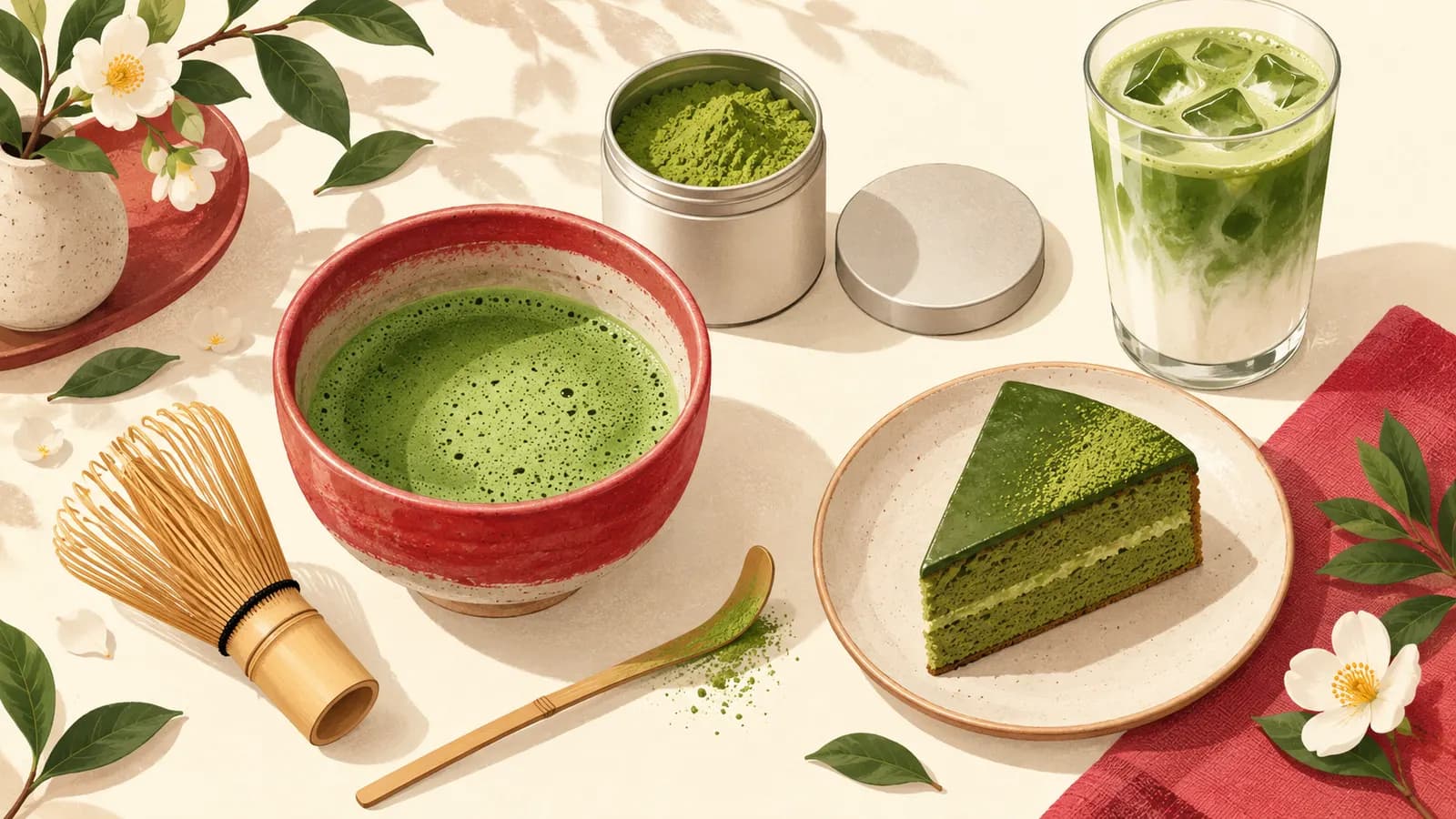
To make matcha, sift about 2 g (1 level teaspoon) of matcha powder into a bowl, add 70–80 ml of water at around 75–80°C, not boiling, and whisk briskly in a zigzag for 15–20 seconds until the surface is covered in fine foam. Use bright green, drinking-quality matcha for this, and save cheaper culinary matcha for lattes and baking.
Matcha is Japanese green tea ground into a fine powder. Unlike a tea bag, you whisk the powder into water and drink the whole leaf, which is why quality, water temperature and technique make such a difference to the taste. This guide explains what the grades on the tin mean, how to whisk matcha without lumps, how to make a matcha latte, how to bake with it, how to store it and why yours might taste bitter.
What is matcha?
Matcha (抹茶) is made from tea plants that are shaded for several weeks before harvest. The shading deepens the green colour and develops a sweet, savoury flavour. The leaves are steamed, dried, stripped of stems and veins, then stone-ground into a powder as fine as talc. Uji near Kyoto, Nishio in Aichi and Kagoshima in the south are well-known growing areas, and you will often see the origin on the tin.
Not every green powder is matcha. Powdered sencha and other green tea powders are made from unshaded leaves, taste grassier and more astringent, and don't foam the same way. Sweetened matcha latte mixes contain sugar and often milk powder, so check that the ingredients list says 100% matcha or green tea if you want the pure product. Matcha contains caffeine, so bear that in mind if you are sensitive to it or drinking it late in the day.
Ceremonial vs culinary grade matcha
Ceremonial and culinary are marketing terms rather than official Japanese grades, so one brand's ceremonial can be another's premium. As a rule, though, ceremonial matcha is made from younger, earlier-harvest leaves for drinking with water, and culinary matcha from later harvests for mixing with milk, sugar and flour.
| Ceremonial (drinking) grade | Culinary (cooking) grade | |
|---|---|---|
| Colour | Vivid, bright jade green | Duller, olive or yellowish green |
| Flavour | Sweet, rounded, savoury; little bitterness | Stronger, more astringent and bitter |
| Texture | Very fine and silky | Slightly coarser |
| Price | Higher; usually sold in small 20–40 g tins | Lower; often sold in larger bags |
| Best for | Whisking with water (usucha and koicha) | Lattes, smoothies, baking, ice cream |
Some brands sell a middle grade labelled latte or premium, which is a good compromise if you mostly drink matcha with milk. Judge a matcha by its colour and price per gram as much as by the word on the label: very cheap ceremonial matcha is rarely the real thing.
How to make matcha without lumps
Matcha clumps because the powder is so fine and slightly static. Lumps don't dissolve once they are wet, so the fix is to break them up before the water goes in.
- Warm the bowl and whisk. Pour hot water into the bowl and stand the bamboo whisk (chasen) in it for a minute to soften the tines. Tip the water out and dry the bowl.
- Sift the matcha. Push 2 g (1 level teaspoon, or two scoops of a bamboo chashaku) through a small tea strainer into the bowl, pressing it through with the back of a spoon.
- Cool the water. Boil the kettle, then let it stand for a few minutes, or pour it between cups, until it is about 75–80°C.
- Make a paste (optional). Add a splash of the water and mix to a smooth paste first. This is the most reliable trick if you don't have a bamboo whisk.
- Whisk. Add the rest of the water (70–80 ml in total) and whisk fast from the wrist in an M or W shape, not in circles, for 15–20 seconds until a layer of fine foam forms. Finish by lifting the whisk gently from the centre.
Usucha and koicha
Everyday matcha is usucha, or thin tea, whisked to a light foam as above. Koicha, or thick tea, uses about twice the powder in roughly half the water and is kneaded slowly with the whisk into a glossy, syrupy liquid with no foam. Koicha shows up every flaw, so it is only made with top-grade matcha.
Why is my matcha bitter?
- The water is too hot. Boiling water scorches matcha and brings out bitterness. Aim for 75–80°C.
- Too much powder. More is not better when drinking it straight. Start with 2 g and adjust.
- A culinary grade used for drinking. It is meant to stand up to milk and sugar, so it can taste harsh on its own.
- It is old or stale. Matcha that has turned dull, brownish-green or smells of hay has oxidised and will taste flat and bitter.
- It wasn't whisked enough. Proper foam softens the flavour and makes the texture smoother.
Recipe: matcha latte, hot or iced
A good matcha latte is mostly about whisking the matcha smooth before it meets the milk. Use a culinary or latte-grade matcha. Whole milk froths the best, and oat milk is the most popular dairy-free choice because its natural sweetness balances matcha's bitterness.
Recipe
Matcha latte (hot or iced)
Smooth, lump-free matcha whisked with a little hot water and topped with steamed or cold milk. A café-style Japanese green tea latte made at home in five minutes.
- Serves
- 1 large mug or glass
- Prep
- 3 min
- Cook
- 2 min
- Total
- 5 min
Ingredients
- 1½–2 tsp matcha (3–4 g), culinary or latte grade
- 60 ml hot water, about 75–80°C (or cold water for iced)
- 250 ml whole milk or oat milk
- 1–2 tsp honey, maple syrup or sugar syrup, to taste (optional)
- Ice cubes, for the iced version
Method
- 1Sift the matcha into a wide mug or bowl, pressing it through a small strainer with the back of a spoon.
- 2Add a splash of the water and mix to a smooth paste, then add the rest of the water and whisk in a zigzag with a bamboo whisk or milk frother for 15–20 seconds until frothy.
- 3Stir in the sweetener now, if using, so it dissolves evenly.
- 4For a hot latte, heat the milk until steaming but not boiling, about 65°C, and froth it with the frother or by whisking in the pan. Pour it over the matcha.
- 5For an iced latte, whisk the matcha with cold water instead, fill a glass with ice and the cold milk, then pour the matcha over the top so it settles in a green layer. Stir before drinking.
Variations: add a spoonful of brown sugar syrup and some chewy tapioca pearls for matcha bubble tea (see how to make bubble tea), blend with frozen banana for a smoothie, or swap half the milk for a little strawberry purée in the bottom of the glass for an iced strawberry matcha.
Baking with matcha
Culinary matcha is the one to bake with: its stronger flavour survives sugar and butter, and the colour of expensive drinking matcha would be lost in the oven anyway. Sift it together with the flour so it is evenly spread and doesn't leave dark green specks.
- How much to use. About 1 tbsp (5–6 g) per 200 g flour gives a clear matcha flavour in cakes, cookies and shortbread. Increase it for a stronger taste, but too much turns bitter.
- Keep the colour green. Heat and long baking turn matcha olive-brown. Bake at the lower end of the temperature range, cover cakes loosely with foil once set, and favour light-coloured recipes with little browning.
- Good partners. White chocolate, red bean paste, strawberries, citrus, black sesame and coconut all balance matcha's bitterness.
- No-bake is easiest. Matcha keeps its best colour and flavour in ice cream, panna cotta, cheesecake, frosting, whipped cream and the dough for homemade mochi.
How to store matcha
Light, heat, air and moisture all dull matcha's colour and flavour, so treat an opened tin like fresh coffee. Keep it tightly sealed in its tin or an opaque airtight container, away from the hob, kettle and sunny windowsills.
- Use it within a month or two of opening for the best flavour. Buy small tins of drinking-grade matcha rather than a big bag that will go stale.
- The fridge is fine for opened matcha, as long as the container is airtight and kept away from strong smells. Let it come to room temperature before opening, or condensation will make the powder clump.
- Unopened tins and pouches keep until the best-before date in a cool, dark cupboard.
- Don't scoop with a wet spoon. Moisture causes lumps and spoils the powder faster.
Matcha equipment: what you actually need
To start, all you need is a small tea strainer, a wide bowl or mug and a whisk or frother. A bamboo whisk (chasen) with around 80–100 fine tines makes the best foam and is inexpensive; a bamboo scoop (chashaku) and a proper matcha bowl (chawan) are nice to have but optional. Rinse the whisk in warm water after use, without soap, and let it dry standing upright on its tines or on a whisk holder so it keeps its shape and doesn't go mouldy.
What you'll need
The traditional tools make smooth, lump-free matcha much easier.
- Bamboo matcha whisk (chasen)Its fine tines whisk matcha into a smooth froth that a spoon can't.See options on Amazon (affiliate link, opens in a new tab)
- Matcha bowl (chawan)A wide bowl gives the whisk room to move.See options on Amazon (affiliate link, opens in a new tab)
- Fine mesh tea sieveSift the powder first to stop lumps.See options on Amazon (affiliate link, opens in a new tab)
- Bamboo scoop (chashaku)Measures roughly 1 g per scoop.See options on Amazon (affiliate link, opens in a new tab)
- Ceremonial-grade matchaFor drinking straight; look for a bright green colour and a Japanese origin on the tin.See options on Amazon (affiliate link, opens in a new tab)
- Culinary-grade matchaCheaper and stronger, for lattes and baking.See options on Amazon (affiliate link, opens in a new tab)
Some links on this page are affiliate links: if you buy through them we may earn a small commission, at no extra cost to you. It never affects which shops we list. How we make money.
Where to buy matcha in the UK
Supermarkets and health food shops sell some matcha, but often in a single grade at a high price per gram. Japanese grocers usually stock a wider range of drinking and culinary grades, plus bamboo whisks, scoops and bowls. Our directory lists 111 stores stocking Japanese groceries, and the best-served cities are London, Glasgow and Edinburgh. The 125 stores selling Korean groceries are worth checking too, as some carry green tea powders and matcha snacks.
Specialists such as Japan Centre in London and Kantenya in Brighton are good places to compare Japanese teas, but ranges change, so call ahead if you want a specific grade or origin. For the rest of a Japanese shopping list, see our Japanese grocery shopping guide.