
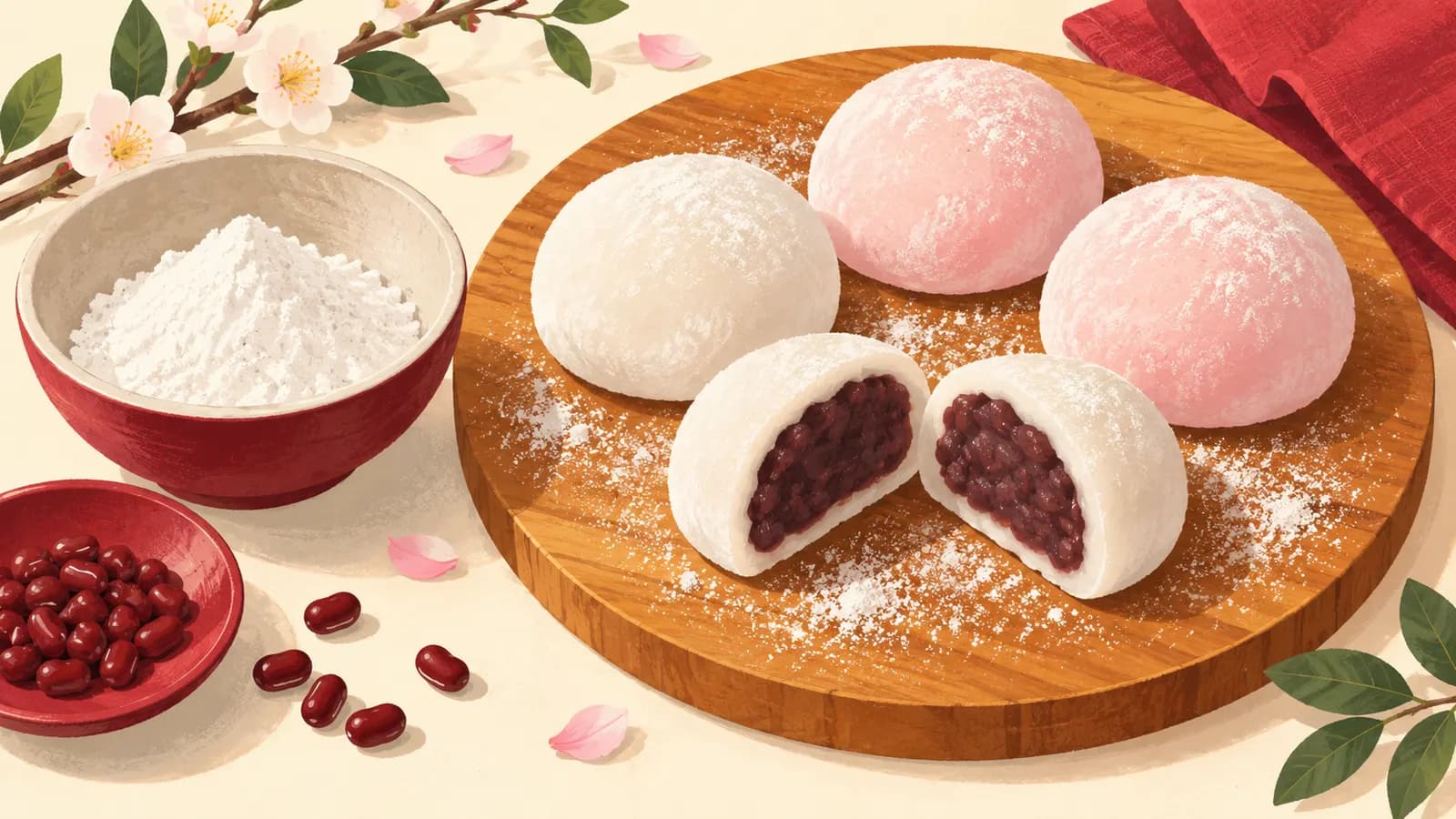
To make mochi at home, mix 100 g glutinous rice flour with 40 g sugar and about 150 ml water, microwave it in short bursts, stirring between each, for 2–3 minutes until it turns glossy, translucent and stretchy, then dust it with potato starch and shape it while warm. Wrap the dough around a ball of sweet red bean paste and you have daifuku, the classic stuffed mochi.
Traditional mochi is made by steaming glutinous rice and pounding it with a heavy mallet, but the microwave gives a soft, smooth result from rice flour in under 10 minutes with no special kit. This guide covers which flour to buy (and the one that won't work), the microwave method, fillings from red bean to strawberry, how to keep mochi soft, and how to eat it safely.
Glutinous rice flour vs rice flour
This is the mistake that ruins most first batches. Mochi needs glutinous rice flour, also sold as sweet rice flour, made from short-grain sticky rice. Ordinary rice flour is made from non-sticky rice and gives a crumbly, pasty dough that never stretches. The packets often sit side by side and look alike, so check the label carefully. Despite the name, glutinous rice contains no gluten; the word refers to its glue-like stickiness.
| Flour | What it is | Mochi result |
|---|---|---|
| Glutinous rice flour (Thai or Chinese) | Finely milled sticky rice; widely sold in UK Asian supermarkets | Soft and stretchy; the cheapest and easiest to find |
| Mochiko | Japanese-style glutinous rice flour, finely milled | Soft and slightly denser; very reliable |
| Shiratamako | Japanese glutinous rice flour in coarse, granular lumps | The smoothest, most elastic mochi; dissolve the lumps in the water first |
| Rice flour (non-glutinous) | Flour from ordinary long- or medium-grain rice | Does not work: crumbly and won't stretch |
| Tapioca or potato starch | Pure starch, not rice | Not a substitute, but potato starch is ideal for dusting |
How to make mochi in the microwave
Use a large microwave-safe glass or ceramic bowl, because the dough puffs up as it cooks, and a sturdy silicone spatula or wooden spoon dipped in water. Times below are for a microwave of around 800–900 W; check yours and adjust.
- Mix. Whisk the flour and sugar, then pour in the water gradually, stirring until completely smooth with no dry lumps, like thick pouring cream.
- Cover loosely with a plate or cling film with a gap at one side, so steam can escape.
- Microwave for 1 minute, then stir. The edges will have started to set. Stir hard to mix the cooked and uncooked parts together.
- Repeat with another minute, stir, then 30-second bursts until the whole mass is glossy and slightly translucent, with no chalky white patches. It should stretch in long strands from the spatula.
- Turn it out onto a tray thickly dusted with potato starch (katakuri-ko) or cornflour. Dust the top and your hands too, then shape while it is still warm and soft.
What done looks like
Undercooked mochi is opaque, gritty and tears instead of stretching; give it another 20–30 seconds. Overcooked mochi forms a tough skin and hard, dry edges, which is why short bursts and lots of stirring matter. If the dough feels stiff and dry rather than soft and sticky, stir in a teaspoon or two of water and microwave for 15 seconds more. Flours absorb water differently, so a little adjustment is normal.
Daifuku fillings: red bean, strawberry and more
- Red bean paste (anko). The classic. Tsubuan is chunky, with whole beans; koshian is smooth and sieved. Both are sold ready-made in tins and pouches.
- Strawberry (ichigo daifuku). Wrap a hulled strawberry in a thin layer of red bean or white bean paste, leaving the tip showing if you like, then wrap in mochi. Best on the day.
- White bean paste (shiroan). Milder and sweeter than red bean; mix in a little sifted matcha for a green tea filling.
- Peanut or black sesame. Ground roasted peanuts or sesame with sugar and a little butter or oil, a filling also used in Chinese tang yuan.
- Chocolate or custard. Chill a ganache or thick custard until firm enough to roll into balls before wrapping.
- Plain mochi with kinako. Skip the filling, cut the dough into small pieces and toss in roasted soybean flour mixed with sugar.
Mochi ice cream is a different job: the ice cream has to be scooped and frozen hard first, and the mochi rolled very thin, so it is worth mastering daifuku before you try it.
Recipe: microwave daifuku with red bean paste
This makes six daifuku, each about the size of a golf ball. Shaping the red bean paste into balls and chilling them before you cook the mochi makes wrapping far easier, because cold, firm paste doesn't smear.
Recipe
Microwave daifuku with red bean paste
Soft, stretchy mochi made from glutinous rice flour in the microwave and wrapped around sweet red bean paste. A classic Japanese sweet in about 30 minutes.
- Serves
- 6 daifuku
- Prep
- 25 min
- Cook
- 3 min
- Total
- 28 min
Ingredients
- 180 g red bean paste (tsubuan or koshian)
- 100 g glutinous rice flour, mochiko or shiratamako
- 40 g caster sugar
- 150 ml water, plus a little extra if needed
- 3–4 tbsp potato starch (katakuri-ko) or cornflour, for dusting
Method
- 1Divide the red bean paste into 6 portions of 30 g, roll each into a ball and chill on a plate for 15 minutes while you make the mochi.
- 2In a large microwave-safe bowl, mix the flour and sugar, then gradually stir in the water until smooth and lump-free (if using shiratamako, squash the lumps into the water first).
- 3Cover loosely and microwave for 1 minute. Stir well with a wet spatula, cover and microwave for another minute, then stir again.
- 4Microwave in 30-second bursts, stirring between each, until the dough is glossy, slightly translucent and stretchy with no white patches. This usually takes 2½–3 minutes in total.
- 5Scrape the mochi onto a tray dusted generously with potato starch, dust the top, and divide into 6 pieces with a dusted scraper or knife.
- 6Working quickly while warm, flatten each piece into an 8 cm disc, thinner at the edges. Put a ball of red bean paste in the centre, bring the edges up around it and pinch firmly to seal.
- 7Turn each daifuku seam side down, roll gently between your palms to round it off, and brush off excess starch with a dry pastry brush. Eat the same day.
Why does my mochi go hard, and how should I store it?
Mochi starts to firm up within hours of making, and hardens fast in the fridge, because the cooked starch sets as it cools and loses moisture. That is why fresh mochi is best eaten on the day it is made. Keep it covered in a cool place out of direct sunlight, each piece wrapped in cling film or in an airtight box so it doesn't dry out, and eat it within 24 hours. Strawberry daifuku should be eaten the same day, as the fruit starts to weep into the mochi.
- To keep it longer, freeze it. Wrap each piece in cling film, put them in a freezer bag and freeze on the day you make them. Use within a month. Thaw at room temperature for 1–2 hours.
- Avoid the fridge for short-term storage unless your kitchen is warm; it is the fastest way to turn mochi hard.
- Softening plain mochi. A plain piece that has firmed up can be softened with 10–15 seconds in the microwave, but watch it, as it puffs and melts quickly. Filled daifuku don't reheat well.
- Hard blocks are meant to be hard. Dried kirimochi blocks, sold in packets, are made to be toasted, grilled or simmered in soup until they puff up and turn soft inside.
Common mochi mistakes
- Using ordinary rice flour. It won't stretch. Only glutinous (sweet) rice flour works.
- Too little starch for dusting. Warm mochi sticks to everything. Be generous; you can brush the excess off later.
- Letting the dough cool before shaping. Cold mochi cracks instead of sealing. Work quickly, one piece at a time, and keep the rest covered.
- Too much filling. The mochi tears. Keep the filling to about the same weight as the dough in each piece, or a little less.
- Wet fingers. Water makes the dough slimy and stops the seams sealing. Use starch on your hands, not water.
What you'll need
Microwave mochi needs only a couple of basics.
- Microwave-safe glass bowlHeats the dough evenly and is easy to scrape out.See options on Amazon (affiliate link, opens in a new tab)
- Silicone spatulaStirs and folds sticky dough without tearing it.See options on Amazon (affiliate link, opens in a new tab)
- Glutinous rice flourEssential: ordinary rice flour won't turn stretchy.See options on Amazon (affiliate link, opens in a new tab)
- Sweet red bean pasteThe classic daifuku filling.See options on Amazon (affiliate link, opens in a new tab)
Some links on this page are affiliate links: if you buy through them we may earn a small commission, at no extra cost to you. It never affects which shops we list. How we make money.
Where to buy glutinous rice flour and red bean paste in the UK
Glutinous rice flour is cheapest in Chinese and Thai supermarkets, which often sell it in 400–500 g bags; our directory lists 259 stores stocking Chinese groceries and 98 stores with Thai groceries. For mochiko, shiratamako, katakuri-ko, kinako, ready-made anko and kirimochi blocks, try one of the 111 stores with Japanese groceries. If you'd rather taste a shop-bought one first, 11 listings in our directory mention mochi among their specialty products.
Japanese specialists such as Japan Centre in London and Kantenya in Brighton are good places to look for Japanese flours and wagashi ingredients, though ranges change, so call ahead if you are travelling for something specific.
Stores whose listings mention mochi
- KonbiniEmersons Green · EnglandKoreanJapanese
- Konbini - GloucesterGloucester · EnglandKoreanJapanese
- Go EastIpswich · EnglandChineseKoreanJapaneseThaiVietnamese+2 more
- Yong Yu Chinese SupermarketKiln Farm · EnglandChineseKorean
- Hing Yip Oriental SupermarketLondon · EnglandChineseKoreanJapaneseThai
- Sriracha SupermarketLondon · EnglandChineseKoreanJapaneseThaiIndonesian
- Oseyo Arndale CentreManchester · EnglandKorean
- 晨阳超市 Morning SunMiddlesbrough · EnglandChineseKorean
Japanese groceries by city
Serve your daifuku with a bowl of whisked green tea from our matcha guide, or browse more sweet and savoury treats in Asian snacks to try. For the rest of a Japanese shopping list, read our Japanese grocery shopping guide.