
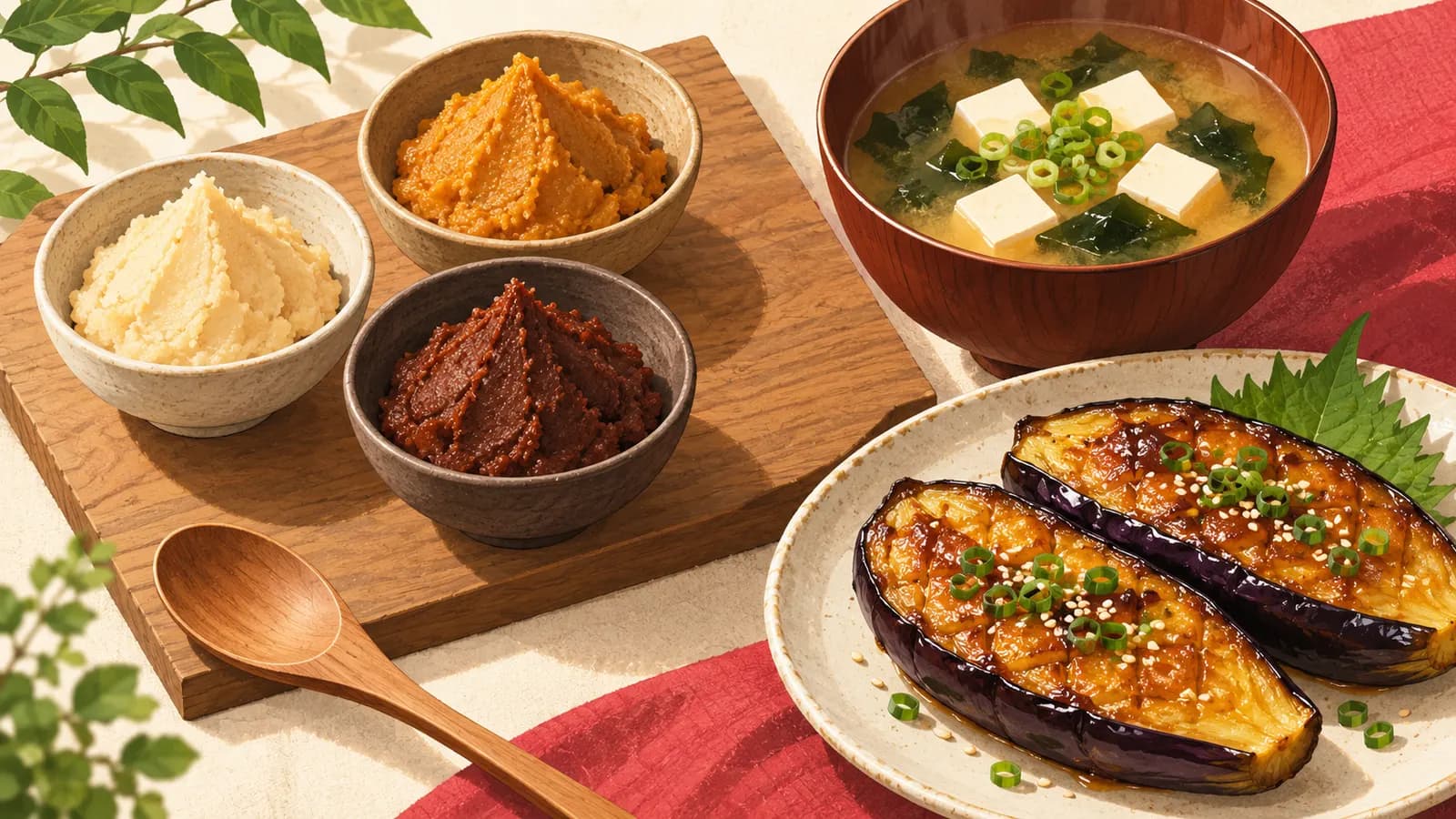
The three types of miso you will see most in UK shops are white (shiro), red (aka) and mixed (awase). White miso is fermented briefly and tastes mild and sweet; red miso is aged longer and is saltier and more intense; mixed miso is a blend of the two and the best all-rounder.
Beyond those three, miso is also named after the grain used to make it, so a label might say barley miso or brown rice miso instead. This guide explains the main types, which one to buy for what, how to cook with miso paste without dulling its flavour, what to use if you run out, how to store it, and a recipe for miso-glazed aubergine.
What is miso?
Miso (味噌) is a Japanese fermented paste made from soybeans, salt and koji, a grain (usually rice or barley) that has been cultured with a mould called Aspergillus oryzae. The koji breaks down the starch and protein in the beans, creating sweetness and deep savoury flavour. The mixture is then left to mature for anything from a few weeks to several years. Three things decide how a miso tastes: how long it ferments, the ratio of koji to soybeans, and how much salt goes in.
White vs red vs mixed miso
| Type | Colour | Fermentation | Flavour | Best for |
|---|---|---|---|---|
| White (shiro miso, 白味噌) | Pale cream to light beige | Short: weeks to a few months | Mild, sweet, gently salty | Dressings, marinades for fish, light soups, sauces, baking |
| Yellow (shinshu miso) | Light golden brown | Medium | Mellow and balanced, slightly tangy | Everyday miso soup, stir-fries, glazes |
| Mixed (awase miso, 合わせ味噌) | Light to mid brown | Blend of short and long | Rounded, savoury, moderately salty | All-purpose: soup, glazes, marinades, ramen |
| Red (aka miso, 赤味噌) | Reddish to dark brown | Long: often a year or more | Salty, rich, deeply savoury | Hearty soups, braises, stews, red meat |
| Barley (mugi miso, 麦味噌) | Light to mid brown | Varies | Earthy, slightly sweet, grainy | Soups and vegetable dishes |
| Soybean (hatcho or mame miso) | Very dark brown | Very long | Intense, slightly bitter, chocolatey | Small amounts in stews and dark sauces |
Which miso should I buy first?
If you only buy one tub, make it mixed (awase) or a yellow shinshu-style miso. It makes a proper miso soup and still works in dressings and glazes. White miso is the one to add next, because its sweetness suits Western cooking too: it is excellent in salad dressings, mashed into butter or stirred into a cheese sauce. Red miso is for people who already cook with miso often and want more depth in winter soups and braises.
Colour is a rough guide rather than a strict rule. Japanese labels often call red miso aka and white miso shiro, but one brand's light miso can be darker than another's, so read the description and taste a little on the tip of a spoon. Some imported tubs contain added dashi (labelled dashi-iri), which is convenient for soup but less useful in dressings or vegetarian cooking.
How to use miso paste
- Miso soup. Warm 500ml dashi, take it off the heat, then whisk in about 2 to 3 tbsp miso through a small sieve or in a ladle of the stock. Add silken tofu, wakame and spring onion. Never let it boil once the miso is in: the aroma fades and the texture turns grainy.
- Marinade. Mix white miso with mirin, sake and a little sugar, and coat cod, salmon or chicken for a few hours or overnight. Wipe off most of the paste before grilling, as it burns easily.
- Dressing. Whisk 1 tbsp white miso with 2 tbsp rice vinegar, 1 tsp sugar, 1 tsp sesame oil and 2 tbsp neutral oil. Good on cucumber, cabbage and grain salads.
- Miso butter. Mash 1 tbsp miso into 50g soft butter for corn, roast potatoes, steak or a bowl of noodles.
- Gravy and stews. A teaspoon of red or mixed miso adds savoury depth to gravy, chilli, bolognese or a mushroom stew. Stir it in near the end.
- Ramen and noodles. Mix miso with a little sesame paste and garlic, then thin with hot stock for a quick miso ramen base.
- Baking. White miso works like salted butter in cookies, caramel and banana bread. Start with 1 tbsp per batch and cut back the salt.
Recipe: miso-glazed aubergine (nasu dengaku)
Nasu dengaku is aubergine cooked until silky and spread with a sweet miso glaze that bubbles and caramelises under the grill. It makes a great side for rice and fish, or a vegetarian main with a salad. White miso gives the classic sweet, mild glaze; for a deeper, saltier version use mixed miso, or half white and half red.
Recipe
Miso-glazed aubergine (nasu dengaku)
Soft roast aubergine halves topped with a sweet miso glaze and grilled until bubbling. A classic Japanese side dish that needs only five main ingredients.
- Serves
- 2 as a main or 4 as a side
- Prep
- 10 min
- Cook
- 30 min
- Total
- 40 min
Ingredients
- 2 medium aubergines (about 600g)
- 2 tbsp neutral oil, such as vegetable or rapeseed
- 3 tbsp white miso (or mixed miso)
- 2 tbsp mirin
- 1 tbsp sake (or 1 more tbsp mirin)
- 1 tbsp caster sugar
- 1 tsp toasted sesame seeds
- 1 spring onion, thinly sliced
Method
- 1Heat the oven to 200°C (180°C fan). Halve the aubergines lengthways, keeping the stalks on, then score the cut sides in a deep criss-cross pattern, cutting almost to the skin but not through it.
- 2Brush the cut sides generously with oil, letting it soak into the cuts. Place cut side up on a lined baking tray.
- 3Roast for 25 to 30 minutes, until the flesh is completely soft when pressed with a spoon and golden at the edges. If the tops look dry halfway through, brush with a little more oil.
- 4Meanwhile, put the miso, mirin, sake and sugar in a small pan over a low heat and stir for 1 to 2 minutes, until the sugar dissolves and the glaze is smooth and glossy, like thick paint. Don't let it boil hard.
- 5Turn the grill to high. Spread the glaze evenly over the cut sides of the aubergines, right to the edges.
- 6Grill for 2 to 4 minutes, watching closely, until the glaze bubbles and catches in a few dark spots. Pull it out as soon as it starts to char, as the sugar burns quickly.
- 7Scatter with sesame seeds and spring onion and serve hot or warm, with rice.
Miso substitutes
Miso's mix of salt, sweetness and savoury depth is hard to copy exactly, but these swaps work well in most dishes. Start with a little less than the recipe asks for and taste as you go.
- Another miso. Swap white for red and use about two thirds of the amount, as red is saltier. Going the other way, use a little more white miso and a pinch less sugar elsewhere.
- Doenjang (Korean soybean paste). The closest substitute for red or mixed miso in soups and stews. It is chunkier and punchier, so use less.
- Chinese yellow soybean paste. Similar savoury depth; good in stir-fries, braises and marinades.
- Soy sauce and tahini. For dressings and sauces, 2 tsp tahini plus 1 tsp soy sauce stands in for 1 tbsp white miso: nutty, salty and creamy.
- Soy sauce alone. In soups and gravies, 1 tsp soy sauce per tbsp of miso adds salt and savoury flavour, though not the body.
How to store miso
Keep opened miso in the fridge in its tub or an airtight container, with cling film or the original film pressed onto the surface. Because it is salty and already fermented it keeps well for months; follow the best-before date and storage advice on the label. Pale, sweet misos are best used within a few months of opening, as they darken and lose their sweetness over time. Darker, saltier misos are more stable.
- Colour changes are normal. Miso slowly darkens, and a little liquid (tamari) can pool on the surface. Stir it back in.
- Use a clean, dry spoon every time to keep mould out. Throw it away if you see fuzzy mould or it smells sour or off.
- You can freeze it. Thanks to the salt, miso doesn't freeze solid, so you can spoon it straight from the freezer. Useful if you buy a large tub.
Stock your pantry
Two misos cover most recipes, plus a strainer for smooth soup.
- White (shiro) misoMild and sweet: dressings, glazes and light soups.See options on Amazon (affiliate link, opens in a new tab)
- Red (aka) misoLonger-aged and saltier: hearty soups and braises.See options on Amazon (affiliate link, opens in a new tab)
- Miso strainerWhisks miso into soup without lumps.See options on Amazon (affiliate link, opens in a new tab)
Some links on this page are affiliate links: if you buy through them we may earn a small commission, at no extra cost to you. It never affects which shops we list. How we make money.
Where to buy miso in the UK
Most large supermarkets sell one or two misos, usually a white or mixed paste in a small tub. For a real choice of white, red, barley and mixed misos, plus mirin, sake, dashi and everything else for a Japanese meal, go to a Japanese grocer or a well-stocked Asian supermarket. Our directory lists 111 stores that stock Japanese groceries on our Japanese groceries page, and the best-served cities are London, Glasgow and Edinburgh.
Specialists such as Japan Centre in central London and Kantenya in Brighton carry the widest range. Korean grocers are worth a look too: they usually sell Japanese miso alongside doenjang. For the rest of a Japanese shopping list, read our Japanese grocery shopping guide.
Japanese groceries by city
- Japanese groceries in London19 stores
- Japanese groceries in Glasgow8 stores
- Japanese groceries in Edinburgh7 stores
- Japanese groceries in Cambridge5 stores
- Japanese groceries in Leeds4 stores
- Japanese groceries in Nottingham4 stores
- Japanese groceries in Canterbury4 stores
- Japanese groceries in Bristol3 stores
- Japanese groceries in Southampton3 stores
- Japanese groceries in Oxford3 stores
- Japanese groceries in Brighton & Hove3 stores
- Japanese groceries in Reading3 stores
Miso makes the perfect partner for a bowl of rice, so try our guide to cooking perfect rice. If you like miso's savoury depth, you'll also enjoy cooking with gochujang and soy sauce.