
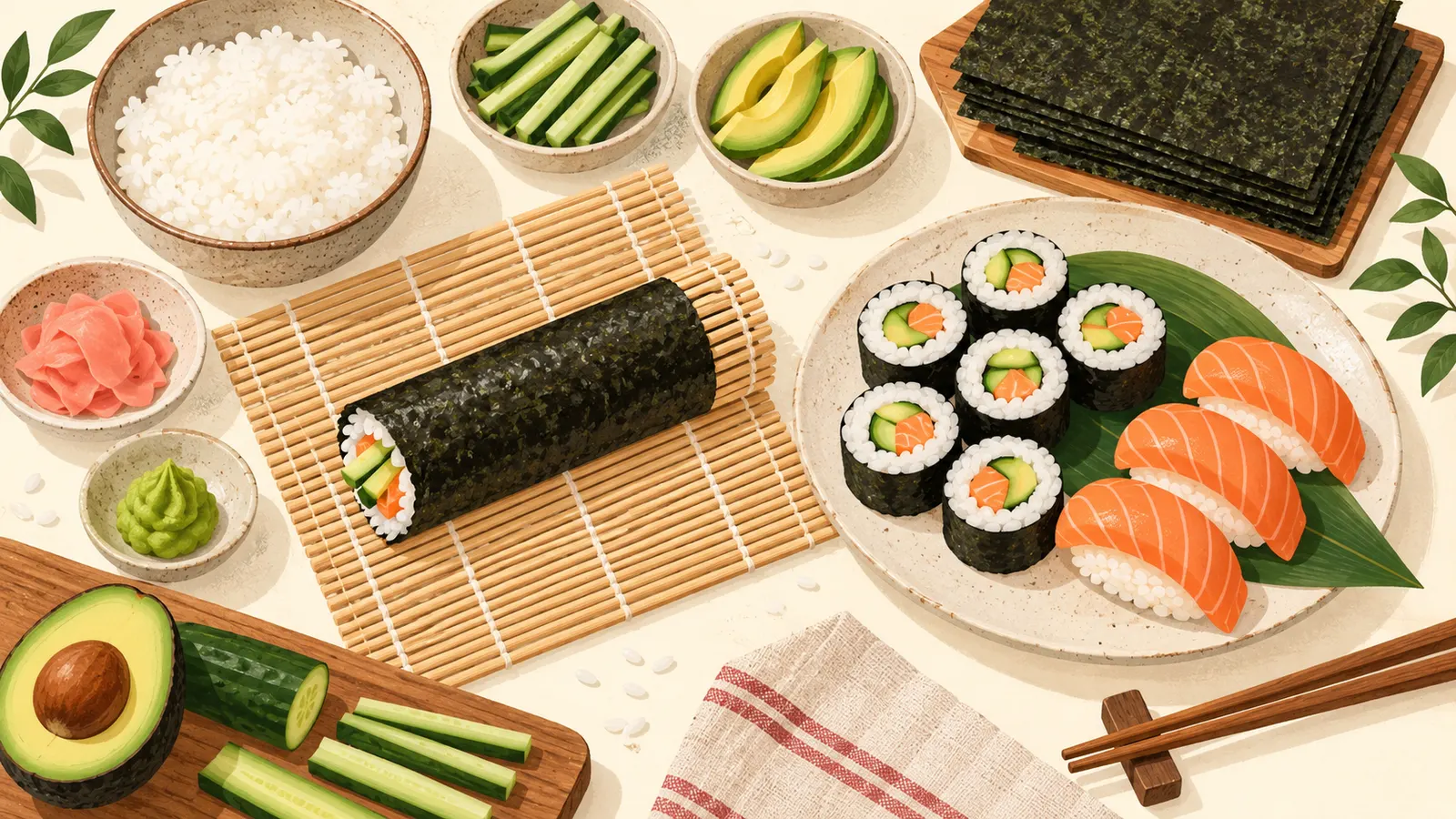
To make sushi at home, cook Japanese short-grain rice, season it while hot with rice vinegar, sugar and salt, and let it cool to body temperature. Then spread it thinly over a sheet of nori on a bamboo mat, lay a line of filling across it, roll it up firmly and slice it with a wet knife. Vegetable rolls such as cucumber and avocado are the easiest place to start.
Good homemade sushi is mostly about the rice: properly seasoned, at the right temperature and handled gently. This guide covers the kit and ingredients you need, how to season sushi rice, step-by-step rolling for thin rolls (hosomaki) and inside-out rolls (uramaki), what UK guidance means for eating raw fish, and a recipe for cucumber, avocado and salmon maki.
What do you need to make sushi at home?
- Sushi rice: Japanese-style short-grain rice. Much of what is sold in the UK is grown in Italy or California, which is fine.
- Rice vinegar, caster sugar and salt for the seasoning, or a bottle of ready-mixed sushi seasoning (sushi-zu).
- Nori: toasted seaweed sheets, about 19 x 21cm. Buy ones labelled for sushi, which are crisp and evenly toasted.
- A bamboo rolling mat (makisu). Cheap and worth having, though a clean tea towel lined with baking paper will do at a push.
- A sharp, long knife and a damp cloth to wipe it between cuts.
- A bowl of hand water (tezu): water with a splash of rice vinegar, to stop the rice sticking to your fingers.
- To serve: soy sauce, wasabi and pickled ginger (gari).
How to make and season sushi rice
Rinse the rice four or five times until the water is only faintly cloudy, soak it for 30 minutes, drain for 10, then cook it with slightly less water than everyday Japanese rice: 300g rice to 360ml water. Our guide to cooking perfect rice covers the hob method and timings in detail, including the sushi rice section.
| Uncooked rice | Water | Rice vinegar | Caster sugar | Fine salt | Makes roughly |
|---|---|---|---|---|---|
| 150g | 180ml | 30ml (2 tbsp) | 2¼ tsp | ½ tsp | 3 thin rolls |
| 300g | 360ml | 60ml (4 tbsp) | 1½ tbsp | 1 tsp | 6 thin rolls or 3 inside-out rolls |
| 450g | 540ml | 90ml (6 tbsp) | 2¼ tbsp | 1½ tsp | 9 thin rolls |
- Warm the seasoning in a small pan or the microwave, stirring until the sugar and salt dissolve. Don't let it boil.
- Season while the rice is hot. Turn the rice into a wide wooden, glass or ceramic dish, not metal, as the vinegar can react with some metals. Pour the seasoning over a rice paddle so it spreads evenly.
- Cut, don't stir. Use sideways slicing strokes and fold the rice over, so the grains stay whole. Stirring or pressing mashes them into paste.
- Fan as you fold until the rice is glossy and about body temperature. Hot rice wilts the nori and warms the fish; cold rice goes hard and won't stick.
- Keep it covered with a damp, clean tea towel and use it the same day. Sushi rice hardens in the fridge.
Is supermarket salmon safe for sushi?
Not automatically. Wild fish can carry parasites, such as anisakis worms, that are killed by thorough cooking or by deep freezing. UK food hygiene law requires businesses that supply fish intended to be eaten raw to freeze it first under set conditions (at least −20°C for at least 24 hours), unless it falls under a specific exemption, which can include some farmed fish raised under controlled conditions. Ordinary fresh fillets sold for cooking may not have been handled or frozen with raw eating in mind.
- Buy fish sold as suitable for eating raw. Look for packs or counters that state the fish is for sushi or sashimi, or is suitable for raw consumption.
- Ask the fishmonger. A good counter can tell you whether a particular fish is suitable to eat raw and whether it has been frozen. If they can't say, cook it instead.
- Don't rely on your home freezer. Domestic freezers typically run at around −18°C, so they are not a guaranteed substitute for the freezing a supplier carries out.
- Keep it cold and fresh. Buy raw fish on the day you plan to make sushi, keep it in the fridge until the moment you slice it, and eat the sushi soon after making it. Don't leave it out at room temperature.
- Vulnerable groups: if you are pregnant, or cooking for young children, older people or anyone with a weakened immune system, check the current NHS and Food Standards Agency advice on raw fish before serving it.
You don't need raw fish to make great sushi. Cucumber, avocado, pickled radish (takuan), cooked prawns, crabsticks, tinned tuna mixed with mayonnaise, teriyaki chicken, omelette (tamagoyaki) and roasted sweet potato all make excellent rolls.
How to roll maki sushi
Thin rolls (hosomaki) use half a sheet of nori and a single filling, which makes them the easiest to roll neatly. Each one uses about 90 to 100g of seasoned rice and cuts into six pieces.
- Cut a nori sheet in half parallel to its lines. Lay one half on the mat, shiny side down, with the long edge nearest you and level with the edge of the mat.
- Wet your hands in the tezu and shake off the excess. Take a ball of rice about the size of a satsuma and spread it gently over the nori, leaving a 1 to 2cm strip bare along the far edge. The layer should be thin enough that you can just see the nori through it.
- Lay the filling in a neat line across the centre of the rice, edge to edge.
- Lift the near edge of the mat with your thumbs while holding the filling in place with your fingertips, then roll forward in one movement so the edge of the rice meets the rice on the far side.
- Squeeze gently along the mat to firm up the roll, then roll it on over the bare strip of nori, which sticks to seal it. Leave it seam side down for a minute.
- Wipe a sharp knife with the damp cloth and cut the roll in half, then each half into three, wiping the blade between cuts. Use long, gentle sawing strokes rather than pressing down.
How to make inside-out rolls (uramaki)
Inside-out rolls such as the California roll have the rice on the outside and the nori inside, so they can hold more filling. Use a whole sheet of nori and about 180g of rice per roll. Spread the rice right to the edges of the nori, scatter it with toasted sesame seeds, then flip the whole sheet over onto a cling-film-wrapped mat so the rice faces down. Lay the fillings across the bare nori, about a third of the way up, and roll as for maki, pressing to shape. Because there is no strip of nori to seal it, the rice holds the roll together, so squeeze it firmly but gently and cut with a wet knife. Uramaki can be cut into six or eight pieces.
Recipe: cucumber, avocado and salmon maki
This makes six thin rolls: two cucumber, two avocado and two salmon, so you can practise on the vegetable rolls before using the fish. For a fully vegetarian batch, swap the salmon for more cucumber and avocado, or for strips of omelette.
Recipe
Cucumber, avocado and salmon maki
Classic thin sushi rolls made at home: seasoned sushi rice and nori wrapped around cucumber, avocado and salmon sold as suitable for eating raw. Makes six rolls, 36 pieces.
- Serves
- 2 to 3 people (36 pieces)
- Prep
- 60 min
- Cook
- 25 min
- Total
- 85 min
Ingredients
- 300g sushi rice
- 360ml cold water
- 60ml rice vinegar
- 1½ tbsp caster sugar
- 1 tsp fine salt
- 3 sheets nori, halved
- ¼ cucumber
- 1 ripe avocado
- 100g skinless salmon fillet sold as suitable for eating raw (sushi or sashimi grade)
- Soy sauce, wasabi and pickled ginger, to serve
Method
- 1Rinse the rice in cold water four or five times until the water is only faintly cloudy, then soak in fresh water for 30 minutes and drain in a sieve for 10 minutes.
- 2Put the rice and 360ml water in a heavy pan with a tight lid. Bring to the boil, cover, turn to the lowest heat and cook for 12 minutes, then leave to rest, covered, for 10 minutes.
- 3Meanwhile, warm the vinegar, sugar and salt until dissolved. Tip the hot rice into a wide non-metal dish, pour over the seasoning and fold it through with slicing strokes, fanning until it is glossy and about body temperature. Cover with a damp tea towel.
- 4Prepare the fillings: quarter the cucumber lengthways, scrape out the seeds and cut into long 1cm batons. Halve, stone and peel the avocado and cut into thin slices. Keep the salmon in the fridge until the last moment, then slice it into 1cm-thick strips.
- 5Lay half a sheet of nori shiny side down on a bamboo mat. With wet hands, spread about 95g of rice evenly over it, leaving a 1 to 2cm strip bare along the far edge.
- 6Lay a line of cucumber, avocado or salmon across the centre. Lift the mat and roll forward so the rice edges meet, press gently to firm it, then finish rolling to seal with the bare nori. Repeat to make six rolls.
- 7Leave each roll seam side down for a minute, then cut into six with a sharp, wet knife, wiping the blade between cuts.
- 8Serve straight away with soy sauce, a little wasabi and pickled ginger. Eat the salmon rolls the same day and keep any leftovers in the fridge.
Why does my sushi fall apart?
- Too much rice: a thick layer leaves no room to seal the roll. Spread it thinly enough to see the nori through it.
- Too much filling: keep to one neat line, about a finger's width, for thin rolls.
- Rice too dry or cold: it won't stick. Use it at body temperature on the day it's made.
- Wet nori: wet hands or hot rice make it chewy and prone to tearing. Shake off excess hand water and work quickly.
- A blunt or dry knife: it squashes the roll. Use your sharpest knife and wipe it with a damp cloth before every cut.
What you'll need
Everything here is inexpensive and makes rolling much easier.
- Bamboo sushi rolling matGives even pressure for tight rolls; wrap it in cling film for inside-out rolls.See options on Amazon (affiliate link, opens in a new tab)
- Rice paddleFluffs and serves rice without crushing the grains.See options on Amazon (affiliate link, opens in a new tab)
- Long, sharp knifeSlices rolls cleanly in long strokes; wipe it with a damp cloth between cuts.See options on Amazon (affiliate link, opens in a new tab)
- Sushi riceShort-grain Japanese rice that holds together once seasoned.See options on Amazon (affiliate link, opens in a new tab)
- Seasoned rice vinegarReady-mixed sushi vinegar saves measuring sugar and salt.See options on Amazon (affiliate link, opens in a new tab)
- Nori sheetsToasted seaweed for rolls; keep opened packs sealed so they stay crisp.See options on Amazon (affiliate link, opens in a new tab)
Some links on this page are affiliate links: if you buy through them we may earn a small commission, at no extra cost to you. It never affects which shops we list. How we make money.
Where to buy sushi ingredients in the UK
Supermarkets sell sushi rice, nori and rice vinegar, but Japanese and Asian grocers usually have bigger bags of rice, better nori, sushi seasoning, bamboo mats, wasabi, pickled ginger, takuan and sesame seeds at lower prices. Our directory lists 111 stores that stock Japanese groceries, and the cities with the most are London, Glasgow and Edinburgh.
Japanese specialists such as Japan Centre in central London and Kantenya in Brighton have the widest range of sushi essentials. For raw fish, buy from a counter or supplier that sells it specifically as suitable for eating raw. Our Japanese grocery shopping guide has the full list of what to pick up, and while you're there, grab some kombu and katsuobushi to make dashi for a bowl of miso soup alongside.
Japanese groceries by city
- Japanese groceries in London19 stores
- Japanese groceries in Glasgow8 stores
- Japanese groceries in Edinburgh7 stores
- Japanese groceries in Cambridge5 stores
- Japanese groceries in Canterbury4 stores
- Japanese groceries in Leeds4 stores
- Japanese groceries in Nottingham4 stores
- Japanese groceries in Brighton & Hove3 stores
- Japanese groceries in Bristol3 stores
- Japanese groceries in Oxford3 stores
- Japanese groceries in Reading3 stores
- Japanese groceries in Southampton3 stores