
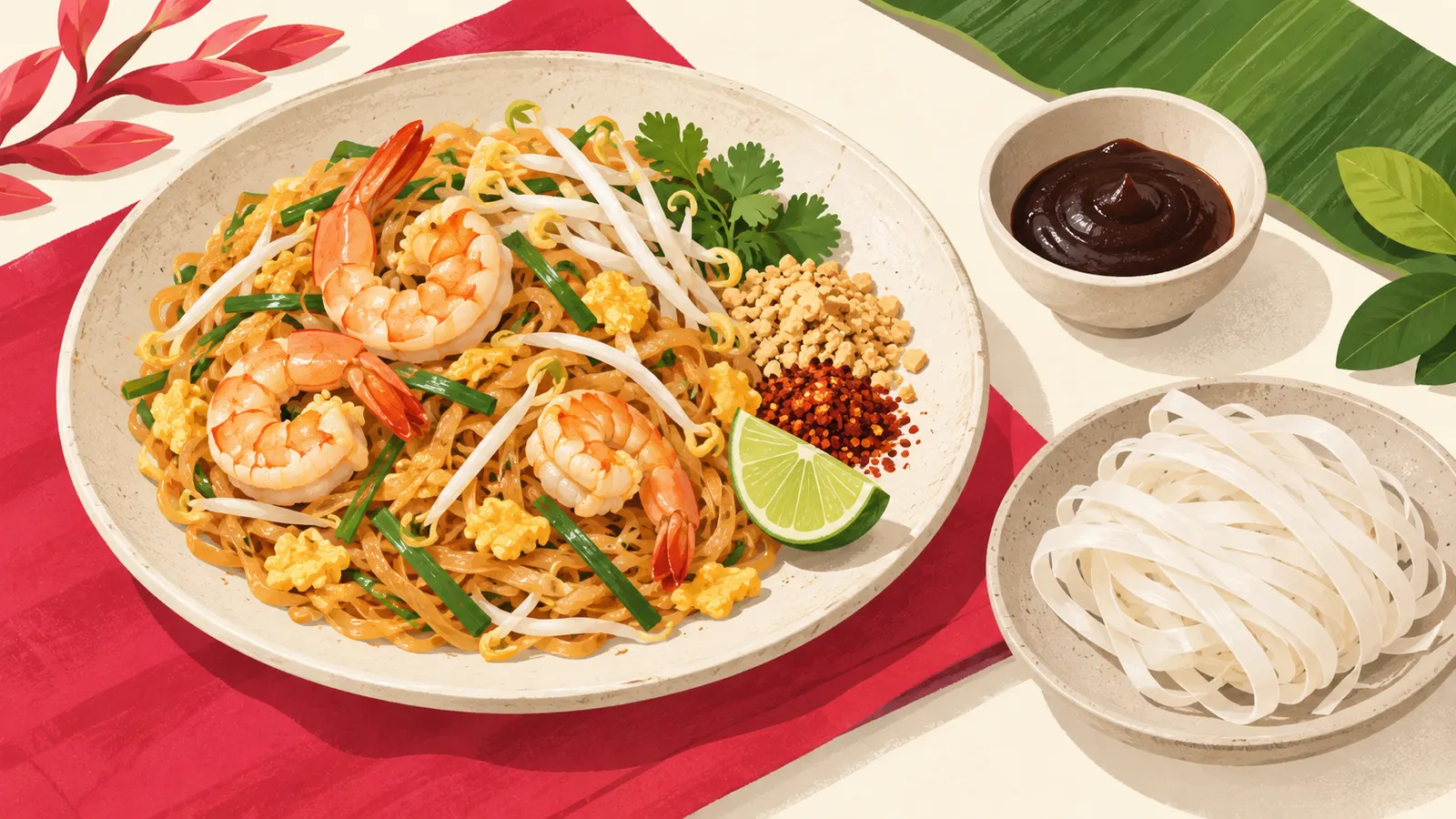
To make pad thai, soak flat dried rice noodles in room-temperature water until they are bendy but still firm, mix a sauce of tamarind, fish sauce and palm sugar, then stir-fry one or two portions at a time in a very hot wok (affiliate link, opens in a new tab): garlic and shallots first, then prawns or tofu, then the noodles with the sauce, then a scrambled egg, beansprouts and garlic chives. Finish with crushed peanuts, lime and chilli flakes at the table.
Good pad thai is tangy, gently sweet and savoury, with chewy, separate noodles and a slightly smoky edge from the wok. It is not orange, and it is not made with ketchup. The two things that go wrong at home are the sauce (usually too sweet, or made with the wrong kind of tamarind) and the noodles (soaked too long, cooked in too big a batch, and stuck in a gluey clump). Both are easy to fix once you know why they happen.
What you need for pad thai
Most of the list is store-cupboard once you have it, and an Asian grocer will have everything in one trip.
- Dried flat rice noodles: often labelled rice sticks, around 3–5mm wide. See below for which to buy.
- Tamarind: the sour backbone of the sauce, as a block, a jar of paste or a concentrate.
- Fish sauce and palm sugar: for salt and a rounded, caramel sweetness. Soft light brown sugar works if you can't find palm sugar.
- Firm tofu: Thai cooks use a pressed yellow tofu; extra-firm tofu cut into small batons is a good stand-in.
- Sweet preserved radish (chai po): chopped salted, sweetened radish in packets. It adds little chewy, sweet-salty bites and is worth tracking down.
- Dried shrimp: a tablespoon, roughly chopped, for depth. Optional but traditional.
- Garlic chives: flat, garlicky Chinese chives. Spring onion tops are the easiest swap.
- Fresh beansprouts, eggs, roasted peanuts, limes and dried chilli flakes.
How to make pad thai sauce
Pad thai sauce is three ingredients: tamarind for sourness, fish sauce for salt and palm sugar for sweetness. A good starting ratio is 4 parts tamarind pulp to 3 parts fish sauce to 3 parts palm sugar. For two portions that is 4 tbsp tamarind, 3 tbsp fish sauce and 3 tbsp grated palm sugar.
Warm everything gently in a small pan for a minute or two, stirring, until the palm sugar has melted, then take it off the heat. Taste it. It should be sharp, sweet and salty all at once, with no one flavour winning, and it should taste a little too strong on its own because the noodles will dilute it. If it is cloying, add tamarind; if it is too sour, add sugar; if it tastes thin, add fish sauce. Our guide on how to use fish sauce covers balancing it in more detail.
Tamarind paste vs tamarind concentrate
This is the most common reason a home pad thai tastes wrong. Tamarind is sold in several forms, and the labels are not consistent, so judge it by how it looks rather than what it is called.
| Form | What it looks like | Strength | How to use |
|---|---|---|---|
| Block (wet tamarind) | Compressed brown pulp with seeds and fibres, in a slab | Mild, fruity, the Thai standard | Soak 50g in 150ml just-boiled water for 15 minutes, squeeze and strain. Makes about 120ml pulp |
| Thai-style paste or purée | Brown, smooth and runny, like ketchup | Similar to homemade pulp | Use as it is, measure for measure |
| Indian-style concentrate | Black, glossy and thick, like treacle | Very strong, slightly bitter | Dilute 1 tsp with 2–3 tsp water and use less overall |
The block gives the cleanest, fruitiest flavour and is cheap and keeps for months in the cupboard. If you only have the black concentrate, dilute it and start with half the amount; used neat it makes pad thai dark, bitter and harsh.
Which rice noodles for pad thai?
Use dried flat rice sticks around 3–5mm wide, roughly the width of linguine. Packets are often labelled rice stick, sen lek or chantaboon noodles, sometimes with a size code such as M. Allow about 100g dried noodles per person.
- Avoid rice vermicelli: too thin, it turns to mush and suits spring rolls and noodle salads instead.
- Avoid wide fresh rice noodles: those are for pad see ew and other broad noodle stir-fries.
- Wider dried sticks (around 10mm) work but need a little more water in the wok and are easier to break.
Our guide to Asian noodles explains the rest of the noodle aisle.
How to soak rice noodles for pad thai
Soak, don't boil. Cover the dried noodles with room-temperature water and leave them for 45–60 minutes, until they are limp enough to wrap around your finger but still firm, with a white, slightly opaque core. They will finish cooking in the wok as they absorb the sauce and a splash of water. If you are short of time, warm tap water does the job in 15–20 minutes, but check often because they soften quickly.
Drain them well in a colander and shake off the excess water. You can soak them a couple of hours ahead; once drained, cover them so the surface doesn't dry out.
Why are my pad thai noodles sticky or clumped?
- They were boiled or over-soaked. Soft noodles release starch and glue together the moment they hit the pan. Pull them out of the soak while they still feel underdone.
- The batch was too big. A domestic hob can't keep a pan hot with four portions in it, so the noodles steam and stew. Cook one or two portions at a time.
- Too little oil, or a pan that isn't hot enough. Use a well-heated wok or a large non-stick frying pan and about 1½ tbsp oil per portion.
- Too much stirring. Lift and turn the noodles with a wide spatula rather than churning them; constant stirring breaks them and makes them gummy.
- All the liquid went in at once. Add the sauce, let it absorb, then add water a tablespoon at a time only if the noodles are still hard.
Prawn pad thai recipe
This makes two generous plates. Cook it in two batches, one plate at a time; it only takes about five minutes a batch, and the difference in texture is huge. Have everything chopped, measured and next to the hob before you start, because there is no time to prepare once the wok is hot.
Recipe
Prawn pad thai
A classic prawn pad thai with a tamarind, fish sauce and palm sugar sauce, chewy rice noodles, egg, tofu and beansprouts, cooked in two quick batches.
- Serves
- 2 people
- Prep
- 60 min
- Cook
- 12 min
- Total
- 72 min
Ingredients
- 200g dried flat rice noodles (3–5mm wide)
- 4 tbsp tamarind pulp or Thai-style tamarind paste
- 3 tbsp fish sauce
- 3 tbsp grated palm sugar (or soft light brown sugar)
- 3 tbsp neutral oil
- 3 garlic cloves, finely chopped
- 2 small shallots, thinly sliced
- 100g extra-firm tofu, cut into small batons
- 2 tbsp sweet preserved radish, chopped (optional)
- 1 tbsp dried shrimp, roughly chopped (optional)
- 200g raw peeled king prawns
- 2 eggs
- 150g beansprouts
- Small bunch garlic chives (or 3 spring onions), cut into 4cm lengths
- 3 tbsp roasted peanuts, roughly crushed
- 1 lime, cut into wedges, and dried chilli flakes, to serve
Method
- 1Soak the noodles in room-temperature water for 45–60 minutes, until bendy but still firm with a white core. Drain well.
- 2Warm the tamarind, fish sauce and palm sugar in a small pan for 1–2 minutes, stirring, until the sugar melts. Taste: it should be equally sour, sweet and salty. Divide everything else into two equal piles, one per batch.
- 3Heat a wok over a high heat until smoking, add 1½ tbsp oil, then the garlic and shallots. Stir for 30 seconds until fragrant, then add the tofu, preserved radish and dried shrimp and fry for 1 minute until the tofu takes on some colour.
- 4Add the prawns and toss for about 1 minute until they are just turning pink on the outside.
- 5Add the noodles and half the sauce (about 5 tbsp). Lift and toss for 2–3 minutes until the sauce is absorbed and the noodles are soft and chewy. If they are still firm, add water 1–2 tbsp at a time.
- 6Push everything to one side, crack an egg into the space and scramble it until almost set, then fold it through the noodles. By now the prawns should be pink and opaque all the way through.
- 7Add the beansprouts and garlic chives and toss for 30 seconds, until the chives just wilt. Tip onto a plate, top with peanuts and serve with lime and chilli flakes.
- 8Wipe out the wok and repeat with the second batch.
How to make vegetarian or vegan pad thai
Pad thai is easy to make without meat. Double the tofu and leave out the prawns and dried shrimp. In place of fish sauce, use light soy sauce or a vegan fish sauce from an Asian supermarket, starting with a little less and adding a pinch of salt if needed. For a vegan version, skip the egg and add more tofu or some sliced shiitake mushrooms fried until golden, and check the preserved radish label, as most are just radish, salt and sugar but some contain additives.
How to serve pad thai
In Thailand pad thai is served with the seasoning left to the eater: lime wedges, crushed peanuts, dried chilli flakes, sugar and often a pile of raw beansprouts and garlic chives on the side for crunch. Squeeze the lime over just before eating; it brightens the whole plate. Some cooks add a teaspoon of chilli powder or a little paprika to the sauce for colour, but a bright orange pad thai is usually a sign of ketchup or sweet chilli sauce, neither of which belongs in it.
What you'll need
Pad thai cooks fast, so have everything ready before the wok gets hot.
- Flat-bottomed carbon steel wok (35 cm)Heats fast and works on gas, electric and induction; season it once and it becomes non-stick.See options on Amazon (affiliate link, opens in a new tab)
- Pad thai rice noodlesMedium-width rice sticks; soak until bendy, not soft.See options on Amazon (affiliate link, opens in a new tab)
- Tamarind pasteThe sour backbone of pad thai sauce.See options on Amazon (affiliate link, opens in a new tab)
- Fish sauceLook for a short ingredient list: anchovies, salt and maybe sugar.See options on Amazon (affiliate link, opens in a new tab)
Some links on this page are affiliate links: if you buy through them we may earn a small commission, at no extra cost to you. It never affects which shops we list. How we make money.
Where to buy pad thai ingredients in the UK
Supermarkets sell rice noodles and fish sauce, but tamarind blocks, palm sugar, sweet preserved radish, dried shrimp, garlic chives and pressed tofu are far easier to find at an Asian grocer. Our directory lists 98 stores that stock Thai groceries, 22 Thai specialists among them.
Nara Thai Store in Birmingham lists rice, noodles, sauces and fresh Thai vegetables and herbs, and Nong Fern Thai Supermarket in Leeds stocks noodles, sauces and pre-made Thai seasonings. In London, Muay Supermarket sells fresh vegetables from Thailand alongside other South East Asian products.
Thai specialist grocers in the directory
- Aroy-d Tum Thai FoodCambridge · EnglandThaiCambridge
- Bee's Baan FoodPortsmouth · EnglandThaiPortsmouth
- ChokDee Thai SupermarketBasingstoke · EnglandThaiBasingstoke
- Dada Oriental ThaiShrewsbury · EnglandThaiShrewsbury
- Isan Thai Food MarketGlasgow · ScotlandThaiMalaysianGlasgow
- Mon Thai SupermarketSouthampton · EnglandThaiSouthampton
- Nara Thai StoreBirmingham · EnglandThaiBirmingham
- Nong Fern Thai SupermarketLeeds · EnglandThaiLeeds
- Pranee's Thai ShopNorthampton · EnglandThaiNorthampton
- Raan Nuch Thai SupermarketAshton-in-Makerfield · EnglandThaiAshton-in-Makerfield
- Ruay Thai SupermarketTaunton · EnglandThaiTaunton
- Rumwong Thai Market GuildfordGuildford · EnglandThaiGuildford
- Siam Smile Thai SupermarketAmesbury · EnglandThaiAmesbury
- Taste of Asia / El Rincón LatinoChelmsford · EnglandThaiChelmsford
- Thai and Asian Food Store TruroTruro · EnglandThaiTruro
- Thai Food StoreHitchin · EnglandThaiHitchin
- Thai Market RochesterRochester · EnglandThaiRochester
- Thai SupermarketWarrington · EnglandThaiWarrington
- Thai@HaymarketEdinburgh · ScotlandThaiEdinburgh
- Thais R UsCanterbury · EnglandThaiCanterbury
- The Rueanthai ShopBroadstairs · EnglandThaiBroadstairs
- TryThai ShopWrexham · WalesThaiWrexham
London has the most choice, with 17 stores stocking Thai products. Browse Thai grocers by city:
Thai groceries by city
- Thai groceries in London17 stores
- Thai groceries in Glasgow7 stores
- Thai groceries in Edinburgh4 stores
- Thai groceries in Nottingham4 stores
- Thai groceries in Birmingham3 stores
- Thai groceries in Cambridge3 stores
- Thai groceries in Oxford3 stores
- Thai groceries in Canterbury3 stores
- All Thai grocers98 stores