
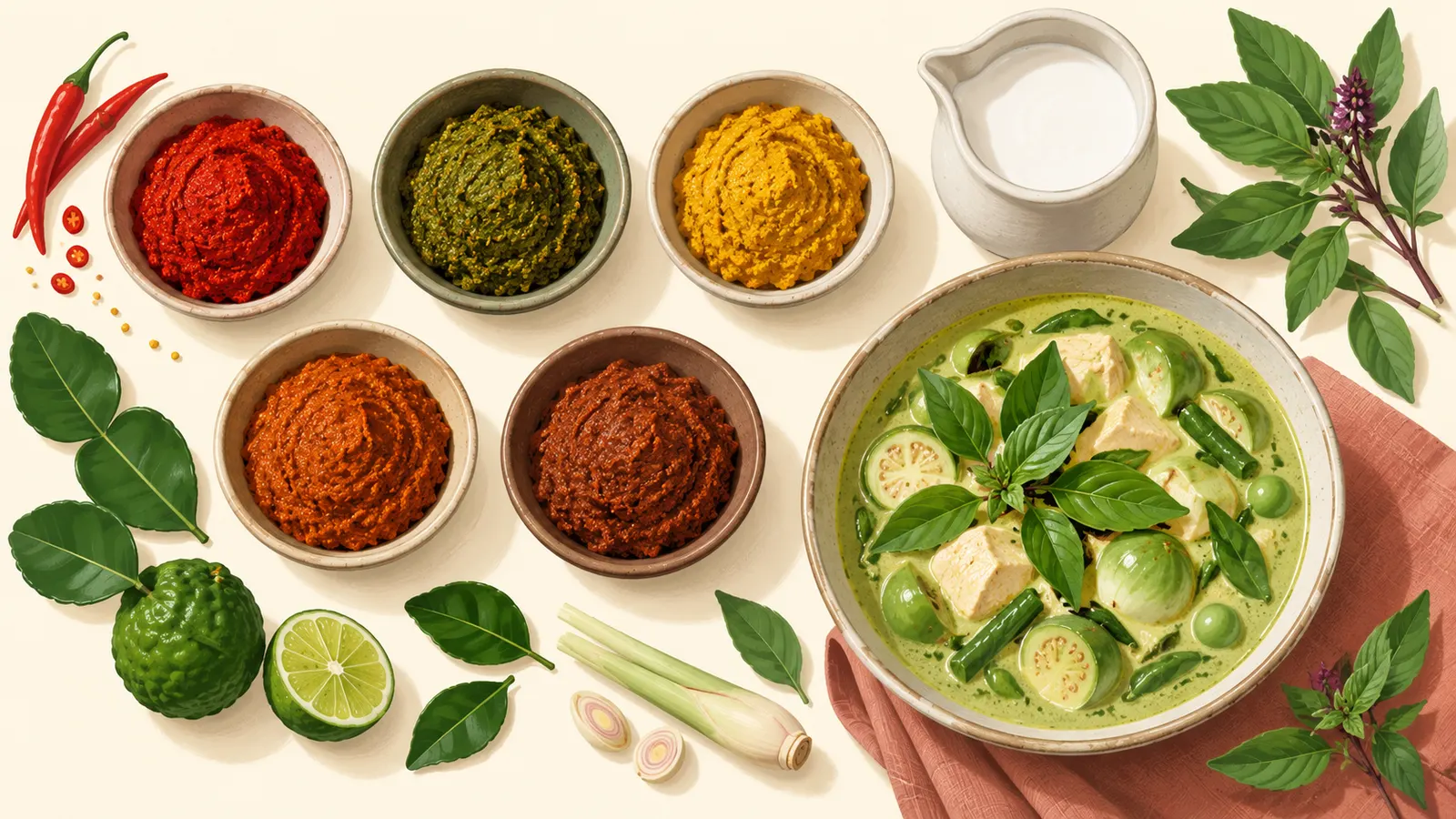
Green curry paste is made from fresh green chillies and is usually the hottest and most herbal; red curry paste uses dried red chillies for a deeper, rounder heat; yellow, massaman and panang are milder pastes built on dried spices such as turmeric, cumin, coriander and cinnamon. Whichever you buy, the secret to a good curry is the same: fry the paste in coconut cream until fragrant, then balance it with fish sauce and palm sugar.
A pounded Thai curry paste (prik gaeng) is a blend of chillies, shallots, garlic, lemongrass, galangal, makrut lime zest, coriander root and shrimp paste. Making one from scratch takes half an hour with a pestle and mortar, but a good shop-bought paste plus a few fresh aromatics gets you most of the way. Here is how the main pastes differ, how much to use, and how to make a jar taste like it came from a Bangkok market.
Red vs green curry paste: what's the difference?
The core aromatics are almost identical. The difference is the chilli. Green curry paste (prik gaeng khiao wan) is pounded from fresh green bird's eye chillies, sometimes with fresh coriander leaves for colour, so it tastes bright, grassy and sharp, and the heat hits fast. Red curry paste (prik gaeng phet) uses soaked dried red chillies, which give a deeper colour, a slightly smoky, sweeter flavour and a heat that builds more slowly.
Many people assume red is hotter because of the colour, but in Thailand green curry is generally the fiercer of the two. Shop-bought pastes vary so much that you should always taste a little first.
Yellow vs massaman vs panang curry paste
These three lean on dried spices as much as fresh herbs, which makes them milder, warmer and more forgiving, so they are a good place to start if you do not like much heat.
- Yellow (gaeng karee): dried chillies with turmeric and curry powder spices. Mild, golden and gently sweet. Classically cooked with chicken and potatoes and served with a cucumber relish (ajad).
- Massaman (gaeng matsaman): the most aromatic, with cinnamon, cardamom, cloves and cumin reflecting its Persian and Indian-Muslim influences. Mild, rich and sweet-sour once tamarind and palm sugar go in. Best with slow-cooked beef or chicken thighs, potatoes and roasted peanuts.
- Panang (phanaeng): close to red paste but with more coriander and cumin, and often ground peanuts. It makes a thick, rich curry that clings to the meat, finished with finely shredded lime leaves.
| Paste | Colour and heat | Key aromatics | Classic dish | Goes with |
|---|---|---|---|---|
| Green (khiao wan) | Pale green; hot | Fresh green chillies, lemongrass, galangal, makrut lime zest, coriander root | Gaeng khiao wan gai (green chicken curry) | Chicken, fish balls, prawns, Thai aubergine |
| Red (phet) | Brick red; medium-hot | Dried red chillies, lemongrass, galangal, garlic, shrimp paste | Gaeng phet bpet yang (red curry with roast duck) | Duck, pork, beef, pumpkin, fishcakes |
| Yellow (karee) | Golden; mild | Turmeric, dried chilli, cumin, coriander seed, lemongrass | Gaeng karee gai (chicken and potato) | Chicken, potatoes, prawns, tofu |
| Massaman | Reddish brown; mild | Cinnamon, cardamom, cloves, cumin, roasted shallot and garlic | Massaman beef with potatoes and peanuts | Beef shin, chicken thighs, lamb, potatoes |
| Panang | Deep red; mild to medium | Dried red chillies, coriander, cumin, peanuts, makrut lime | Panang neua (beef panang) | Beef, pork, chicken, shredded lime leaves |
You will also see jungle curry paste (gaeng pa), a fiery paste used in a brothy curry made without coconut milk, and sour curry paste (gaeng som), which is used for tamarind-sour fish and vegetable soups.
How much curry paste should I use?
There is no single answer, because pastes vary hugely in strength. Tubs and tins from Thai brands, sold at Asian grocers, are concentrated, salty and often very hot. Jars from UK supermarkets are usually milder and padded out with oil, sugar or water. As a rough guide for a 400ml tin of coconut milk serving four:
- Thai-brand tub or tin: start with 1–2 tbsp and go up to 3 tbsp if you like heat.
- Supermarket jar: start with 3 tbsp; you may need 4–5 tbsp for a properly flavoured curry.
- Homemade paste: 2–3 tbsp, depending on how many chillies went in.
How to make shop-bought curry paste taste better
1. Fry the paste in cracked coconut cream
This is the step that makes the biggest difference. Don't shake the tin; scoop the thick cream off the top into a wok (affiliate link, opens in a new tab) and simmer it, stirring, for 3–5 minutes until it thickens and the oil separates out into little shining pools. Thai cooks call this cracking the coconut cream. Fry the paste in that oil for 2–3 minutes, stirring constantly. It is ready when the raw garlic and shallot smell has gone, the kitchen smells of lemongrass and toasted chilli, and red or green oil seeps out around the edges.
Some tinned coconut milk contains stabilisers and refuses to split. If nothing happens after five minutes, add 1 tbsp neutral oil and carry on; the paste still needs that hot fat to bloom. Cartons of coconut cream from Asian grocers usually crack more easily.
2. Add fresh aromatics
Shop-bought pastes lose some of their fresh top notes in the jar. Pound or finely chop a bruised stalk of lemongrass, a thumb of galangal, a couple of garlic cloves and some coriander stalks, and fry them with the paste. Tear makrut lime leaves into the sauce as it simmers, and finish with a big handful of Thai basil off the heat. Our guide to storing Asian herbs explains how to keep lemongrass, galangal and lime leaves fresh, and most of them freeze well.
3. Balance with fish sauce, palm sugar and lime
Season at the end, once the coconut milk has simmered. Add fish sauce for salt and depth, a teaspoon at a time, and palm sugar to round off the heat. Green and red curries should taste rich, salty and spicy with sweetness in the background. A small squeeze of lime can lift a paste that tastes flat, but go easy; most coconut curries are not meant to taste sour. Massaman is the exception, where tamarind gives it a definite sweet-sour edge. See our guide on how to use fish sauce for more on balancing it.
Quick fixes
- Too hot: add more coconut milk and a little palm sugar, and serve with plenty of jasmine rice.
- Too salty: add coconut milk or unsalted stock and more vegetables; don't add sugar to mask it.
- Tastes flat: it usually needs fish sauce, not more paste.
- Too thin: simmer uncovered for a few minutes; don't thicken with flour or cornflour.
How to store curry paste
Once opened, press cling film onto the surface of the paste or cover it with a thin layer of oil, close the lid and keep it in the fridge. Use it by the date on the label. Large tubs are much cheaper per gram, so freeze what you won't use soon in tablespoon portions in an ice cube tray, then bag them up. They can go straight from the freezer into the pan.
Thai green curry with chicken
This recipe takes a shop-bought paste and upgrades it with cracked coconut cream and fresh aromatics. It uses chicken thighs, which stay juicy in the sauce. Serve it with steamed jasmine rice; our guide to cooking perfect rice covers the method.
Recipe
Thai green curry with chicken
A fragrant, properly balanced green curry made with shop-bought paste upgraded with cracked coconut cream, fresh lemongrass, galangal and Thai basil.
- Serves
- 4 people
- Prep
- 15 min
- Cook
- 25 min
- Total
- 40 min
Ingredients
- 400ml tin full-fat coconut milk, unshaken
- 1 tbsp neutral oil (if needed)
- 2–4 tbsp green curry paste (less for a Thai-brand tub, more for a supermarket jar)
- 1 lemongrass stalk, tough outer layers removed, finely chopped
- 2cm galangal (or ginger), peeled and finely chopped
- 2 garlic cloves, finely chopped
- Small handful coriander stalks or 2 coriander roots, finely chopped
- 500g boneless, skinless chicken thighs, cut into bite-sized pieces
- 150ml chicken stock or water
- 6 makrut (kaffir) lime leaves, torn
- 150g Thai aubergines, quartered (or 1 small aubergine, cubed, or 150g green beans)
- 1½–2 tbsp fish sauce
- 1–2 tsp grated palm sugar or soft brown sugar
- Large handful Thai basil leaves (about 20g)
- 1 red chilli, sliced, to garnish
- Steamed jasmine rice, to serve
Method
- 1Open the coconut milk without shaking it and scoop the thick cream from the top (about 4–5 tbsp) into a wok or wide pan. Simmer over a medium-high heat, stirring, for 3–5 minutes until it thickens and the oil starts to separate. If it won't split, add the oil.
- 2Add the curry paste, lemongrass, galangal, garlic and coriander stalks. Fry for 2–3 minutes, stirring constantly, until the raw garlic smell has gone, it smells strongly of lemongrass and green chilli, and green-tinged oil seeps out at the edges.
- 3Add the chicken and stir to coat it in the paste. Cook for 2–3 minutes until the outside of the chicken turns opaque.
- 4Pour in the remaining coconut milk and the stock, add the lime leaves and bring to a gentle simmer. Don't boil hard or the sauce can turn grainy.
- 5Add the aubergines and simmer for 10–12 minutes, until the chicken is cooked through and the aubergine is tender.
- 6Season with 1½ tbsp fish sauce and 1 tsp palm sugar, taste, then add more of either until it tastes rich, salty and hot with a gentle sweetness behind it.
- 7Turn off the heat, stir in the Thai basil so it just wilts, scatter with sliced chilli and serve with jasmine rice.
Stock your pantry
Curry paste, good coconut milk and a mortar for the fresh aromatics.
- Thai red curry pasteLook for chillies, lemongrass and galangal near the top of the ingredients.See options on Amazon (affiliate link, opens in a new tab)
- Thai green curry pasteFresher and more herbal; usually hotter than red.See options on Amazon (affiliate link, opens in a new tab)
- Coconut milkFull-fat tins give curries and laksa their body; check the coconut percentage on the label.See options on Amazon (affiliate link, opens in a new tab)
- Fish sauceLook for a short ingredient list: anchovies, salt and maybe sugar.See options on Amazon (affiliate link, opens in a new tab)
- Granite mortar and pestlePounds lemongrass, chillies and garlic into a paste far better than a blender for small amounts.See options on Amazon (affiliate link, opens in a new tab)
Some links on this page are affiliate links: if you buy through them we may earn a small commission, at no extra cost to you. It never affects which shops we list. How we make money.
Where to buy Thai curry paste in the UK
Supermarkets stock jars, but Asian grocers sell the concentrated Thai-brand tubs and tins, plus the fresh lemongrass, galangal, makrut lime leaves, Thai basil and Thai aubergines that lift a curry. Our directory lists 98 stores that stock Thai groceries, 22 Thai specialists among them.
Specialists worth a look include Nara Thai Store in Birmingham, which lists fresh herbs, curry pastes and sauces, and Nong Fern Thai Supermarket in Leeds, which stocks curry pastes, sauces and pre-made Thai seasonings. In Scotland, Isan Thai Food Market in Glasgow lists Thai sweet basil among its specialities, and Thai@Haymarket serves Edinburgh.
Thai specialist grocers in the directory
- Aroy-d Tum Thai FoodCambridge · EnglandThaiCambridge
- Bee's Baan FoodPortsmouth · EnglandThaiPortsmouth
- ChokDee Thai SupermarketBasingstoke · EnglandThaiBasingstoke
- Dada Oriental ThaiShrewsbury · EnglandThaiShrewsbury
- Isan Thai Food MarketGlasgow · ScotlandThaiMalaysianGlasgow
- Mon Thai SupermarketSouthampton · EnglandThaiSouthampton
- Nara Thai StoreBirmingham · EnglandThaiBirmingham
- Nong Fern Thai SupermarketLeeds · EnglandThaiLeeds
- Pranee's Thai ShopNorthampton · EnglandThaiNorthampton
- Raan Nuch Thai SupermarketAshton-in-Makerfield · EnglandThaiAshton-in-Makerfield
- Ruay Thai SupermarketTaunton · EnglandThaiTaunton
- Rumwong Thai Market GuildfordGuildford · EnglandThaiGuildford
- Siam Smile Thai SupermarketAmesbury · EnglandThaiAmesbury
- Taste of Asia / El Rincón LatinoChelmsford · EnglandThaiChelmsford
- Thai and Asian Food Store TruroTruro · EnglandThaiTruro
- Thai Food StoreHitchin · EnglandThaiHitchin
- Thai Market RochesterRochester · EnglandThaiRochester
- Thai SupermarketWarrington · EnglandThaiWarrington
- Thai@HaymarketEdinburgh · ScotlandThaiEdinburgh
- Thais R UsCanterbury · EnglandThaiCanterbury
- The Rueanthai ShopBroadstairs · EnglandThaiBroadstairs
- TryThai ShopWrexham · WalesThaiWrexham
The best-served city for Thai groceries is London, with 17 stores stocking Thai products. These pages list them by city:
Thai groceries by city
- Thai groceries in London17 stores
- Thai groceries in Edinburgh4 stores
- Thai groceries in Birmingham3 stores
- Thai groceries in Glasgow7 stores
- Thai groceries in Cambridge3 stores
- Thai groceries in Nottingham4 stores
- Thai groceries in Oxford3 stores
- Thai groceries in Canterbury3 stores
- All Thai grocers98 stores