
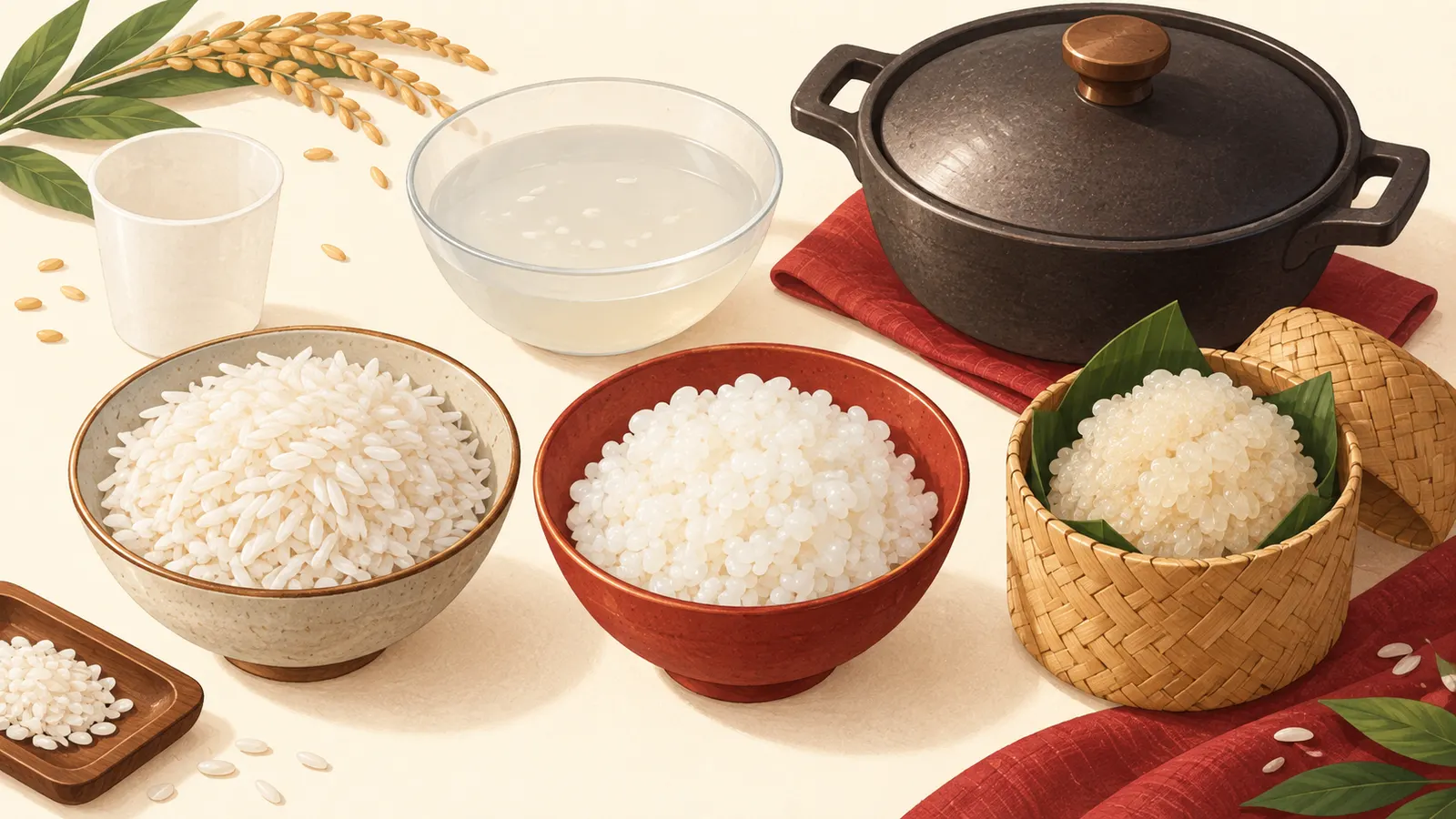
To cook jasmine rice, rinse it two or three times in cold water, then simmer 1 part rice to 1.25 parts water by volume (300 g rice to 450 ml water) in a covered pan on the lowest heat for 12 minutes, and leave it to rest with the lid on for 10 minutes before fluffing. That gives tender, fragrant, separate grains with no crust and no sog.
Other Asian rices need different handling. Japanese short-grain rice wants a longer rinse and a soak, sushi rice is cooked a little firmer and then seasoned, and glutinous (sticky) rice is soaked for hours and steamed rather than boiled. This guide covers all of them, with the ratios, timings and fixes that make the difference between good rice and great rice.
What is the right rice to water ratio?
Every rice in this guide is cooked by the absorption method: you add exactly as much water as the grains will soak up, rather than boiling them in a big pan and draining. That makes the ratio the single most important number. Measuring by volume works if you use the same cup for rice and water. Measuring by weight (grams of rice, millilitres of water) is more reliable, because the weight of a cupful varies from one rice to another.
| Rice | Rinse? | Soak | Water by volume | Water by weight | Cook | Rest |
|---|---|---|---|---|---|---|
| Thai jasmine (white) | Yes, 2–3 times | No | 1 : 1.25 | 1 : 1.5 (300 g : 450 ml) | 12 min on lowest heat | 10 min |
| Japanese short-grain (everyday) | Yes, 4–5 times | 30 min, then drain | 1 : 1.1 | 1 : 1.3 (300 g : 400 ml) | 12–13 min | 10–15 min |
| Sushi rice | Yes, 4–5 times | 30 min, then drain | 1 : 1 | 1 : 1.2 (300 g : 360 ml) | 12–13 min | 10 min |
| Glutinous (sticky) rice | Yes, 2–3 times | 4 hours to overnight | Steamed, no cooking water | Steamed, no cooking water | 20–25 min steaming | 5 min covered |
| Broken rice | Yes, gently, twice | No | 1 : 1.25 | 1 : 1.5 | 12 min | 10 min |
| Brown jasmine | Yes, once | Optional, 30 min | 1 : 1.75 | 1 : 2.2 (300 g : 660 ml) | 30–35 min | 10 min |
Should you wash rice before cooking?
Yes, for jasmine and Japanese rice. Milling leaves a coat of loose starch on each grain, and in the pan that starch turns the cooking water gluey, so the grains clump and the bottom layer turns pasty. Rinsing removes it and gives cleaner, glossier grains.
- Put the rice in a bowl, cover with cold water and swirl it with your fingertips. Pour off the cloudy water, holding the rice back with your hand or a sieve, and repeat.
- For jasmine, two or three changes of water is enough; it doesn't need to run perfectly clear.
- For Japanese rice, pour off the first rinse straight away, because dry grains absorb the first water they meet. Then rinse four or five times until the water is only faintly cloudy.
- Skip rinsing only when the pack says it is no-rinse rice (musenmai in Japanese shops), which has been polished so it can go straight into the pan.
How to cook jasmine rice on the hob
Use a heavy-based saucepan with a tight-fitting lid, roughly 18 cm across for 300 g of rice. A thin pan scorches; a loose lid lets steam escape and leaves the top layer hard. Bring the rice and water to the boil uncovered, cover, turn the heat to its lowest setting and walk away for 12 minutes. The rest at the end is not optional: it lets the moisture even out so the top grains finish cooking and the bottom ones firm up.
What perfect jasmine rice looks like
When you lift the lid, the surface should be flat and dotted with small steam holes, with no water pooling at the bottom when you tilt the pan. The grains should be tender all the way through, slightly sticky so they hold together on a spoon, but separate when you fluff them. Jasmine is meant to be softer and more fragrant than basmati, so don't aim for completely loose grains.
Common mistakes and how to fix them
- Soggy or mushy: too much water, or the rice was stirred while it cooked. Rescue it by leaving the lid off over the lowest heat for 2–3 minutes. Next time cut the water by 2 tablespoons.
- Hard or chalky in the middle: not enough water, or the lid was lifted. Sprinkle over 2–3 tbsp boiling water, cover and leave on the lowest heat for 5 minutes.
- Burnt on the bottom: the heat was too high after covering. Don't scrape the crust into the rice; serve from the top. Use a heavier pan or the smallest burner.
- Wet on top, dry underneath: the pan was too wide, so the rice layer was too shallow. Choose a pan where the rice sits at least 3 cm deep.
- Scaling up: for double quantities, use slightly less than double the water, because the amount that evaporates stays roughly the same.
Recipe
Perfect hob jasmine rice
Fluffy, fragrant Thai jasmine rice cooked by the absorption method in an ordinary saucepan, no rice cooker needed.
- Serves
- 4 people
- Prep
- 10 min
- Cook
- 25 min
- Total
- 35 min
Ingredients
- 300 g Thai jasmine rice
- 450 ml cold water
- Pinch of salt (optional)
Method
- 1Put the rice in a large bowl, cover with cold water and swirl with your fingertips. Pour off the cloudy water and repeat two more times, then drain well in a sieve for a few minutes.
- 2Tip the rice into a heavy-based saucepan with a tight-fitting lid, add the 450 ml cold water and the salt if using, and shake the pan so the rice lies level.
- 3Bring to the boil over a high heat, uncovered. After about 4–5 minutes the water will have dropped to just below the surface of the rice and small steam holes will appear.
- 4Cover the pan, turn the heat down to the lowest setting and cook for 12 minutes. Don't lift the lid or stir.
- 5Take the pan off the heat and leave it to rest, still covered, for 10 minutes.
- 6Fluff the rice gently with a fork or rice paddle, lifting from the bottom, and serve straight away. Cool any leftovers quickly and refrigerate within an hour.
How to cook sushi rice
Use Japanese-style short-grain rice, often sold simply as sushi rice. Much of what you'll find in the UK is grown in Italy or California rather than Japan, and it works perfectly well. Rinse it thoroughly, soak it in fresh water for 30 minutes, then drain for 10 minutes. Cook it in a little less water than everyday Japanese rice (1 : 1.2 by weight), because the seasoning adds liquid later. For plain rice to serve with miso soup or curry, use the everyday ratio in the table instead; our miso guide and Japanese grocery guide cover what to eat with it.
Seasoning sushi rice with rice vinegar
For 300 g of raw rice, warm 60 ml rice vinegar with 1½ tbsp caster sugar and 1 tsp fine salt, stirring until dissolved; don't let it boil. While the rice is still hot, turn it out into a wide, shallow wooden, glass or ceramic dish rather than a metal bowl. Pour the seasoning over a rice paddle so it spreads evenly, then cut through the rice with sideways slicing strokes and fold it over. Don't stir or press, or the grains break and turn gummy.
Fan the rice as you fold (a magazine works) until it is roughly body temperature and has a light gloss. Cover with a damp, clean tea towel and use it within a few hours. Sushi rice goes hard in the fridge, so make it on the day and refrigerate only what is left over.
How to cook sticky (glutinous) rice
Glutinous rice, also sold as sticky rice or sweet rice, is chalky white and opaque when raw. Despite the name it contains no gluten; the word refers to its glue-like texture. It is the rice behind Thai mango sticky rice, the sticky rice served with larb in Laos and north-east Thailand, and Cantonese lo mai gai wrapped in lotus leaves.
- Rinse it two or three times, then cover with plenty of cold water and soak for at least 4 hours, ideally overnight. It is ready when a grain crushes easily between your fingernails.
- Drain well. Line a bamboo steamer (affiliate link, opens in a new tab) or Thai woven basket with damp muslin and spread the rice over it in an even layer, leaving a few gaps for steam.
- Steam over boiling water for 20–25 minutes, turning the whole mass over halfway through so it cooks evenly.
- It is done when every grain is translucent and chewy with no chalky centre. Keep it covered or wrapped in a cloth so it doesn't dry out.
Don't boil glutinous rice in a pan like jasmine: it collapses into paste. If you have no steamer, a rice cooker (affiliate link, opens in a new tab) can do soaked sticky rice with roughly equal volumes of rice and water, though the texture is softer. Our bamboo steamer guide explains how to set one up over a wok or saucepan.
Broken rice and other varieties
Broken rice is jasmine rice whose grains cracked during milling. It cooks slightly quicker and softer, and is the base of Vietnamese cơm tấm. Rinse it gently and use the jasmine ratio. Brown jasmine keeps its bran, so it needs more water and roughly three times as long. Black glutinous rice is usually soaked overnight and simmered for desserts rather than served plain.
Rice cooker or hob: which is better?
- Rice cooker: consistent results without watching the pan, a keep-warm setting, and pre-set programmes for sushi, brown or porridge rice. Worth it if you cook rice several times a week. Follow the cup and water lines inside the bowl, which assume the cup that came with the cooker (about 180 ml).
- Hob: needs nothing but a decent pan and a timer, and once you know your burner it is just as reliable. It is also quicker for small amounts.
- Either way: the rinse, ratio and rest matter more than the equipment.
How to store and reheat leftover rice safely
Cooked rice needs the same care as cooked meat. Uncooked rice can carry spores of a bacterium called Bacillus cereus that survive cooking. If cooked rice is left warm for too long, they can multiply and produce toxins that reheating won't destroy. Following the UK Food Standards Agency's guidance avoids the problem:
- Cool leftover rice as quickly as possible, ideally within an hour. Spread it out in a shallow container or on a tray to speed this up.
- Put it in the fridge once cool, and eat it within a day.
- Reheat it only once, until it is steaming hot all the way through.
- Don't leave rice in a switched-off rice cooker or on the side overnight.
- For longer storage, freeze cooled rice in portions and reheat it from frozen until piping hot.
To reheat, sprinkle the rice with a tablespoon of water, cover and microwave for 2–3 minutes, stirring halfway, or steam it for 5–8 minutes. Chilled leftover rice is also exactly what you want for egg fried rice: the grains are firmer and drier, so they fry rather than steam. Our stir-fry guide shows how.
What you'll need
A pan with a tight lid is enough, but if you eat rice most days these make it effortless.
- Rice cookerCooks consistent rice and keeps it warm without watching the pan; look for a non-stick inner pot.See options on Amazon (affiliate link, opens in a new tab)
- Rice washing bowl with strainerRinses rice clean without losing grains down the sink.See options on Amazon (affiliate link, opens in a new tab)
- Rice paddleFluffs and serves rice without crushing the grains.See options on Amazon (affiliate link, opens in a new tab)
- Japanese short-grain riceThe right rice for sushi and Japanese meals; it cooks soft and slightly sticky.See options on Amazon (affiliate link, opens in a new tab)
- Glutinous (sticky) riceNeeds soaking and steaming rather than boiling; essential for mango sticky rice and zongzi.See options on Amazon (affiliate link, opens in a new tab)
Some links on this page are affiliate links: if you buy through them we may earn a small commission, at no extra cost to you. It never affects which shops we list. How we make money.
Where to buy jasmine, sushi and glutinous rice in the UK
Supermarkets sell small bags of jasmine and sushi rice, but Asian grocers carry the full range in 1 kg to 20 kg sacks, which usually cost less per kilo. Look for Thai Hom Mali on jasmine rice, and for bags marked glutinous or sweet rice for sticky rice. Of the 438 shops in our directory, 98 stores stock Thai groceries, 111 stores stock Japanese groceries and 259 stores stock Chinese groceries, and most of them sell rice by the sack. The cities with the most Asian supermarkets in our listings are London, Manchester, Edinburgh, Birmingham and Glasgow.
Rice by the sack, by city
- Thai groceries in London17 stores
- Thai groceries in Glasgow7 stores
- Thai groceries in Edinburgh4 stores
- Thai groceries in Nottingham4 stores
- Japanese groceries in London19 stores
- Japanese groceries in Glasgow8 stores
- Japanese groceries in Edinburgh7 stores
- All Thai grocers98 stores
- All Japanese grocers111 stores
While you're there, pick up a bottle of fish sauce and a curry paste to go with that jasmine rice: see our guides to using fish sauce and Thai curry pastes.