
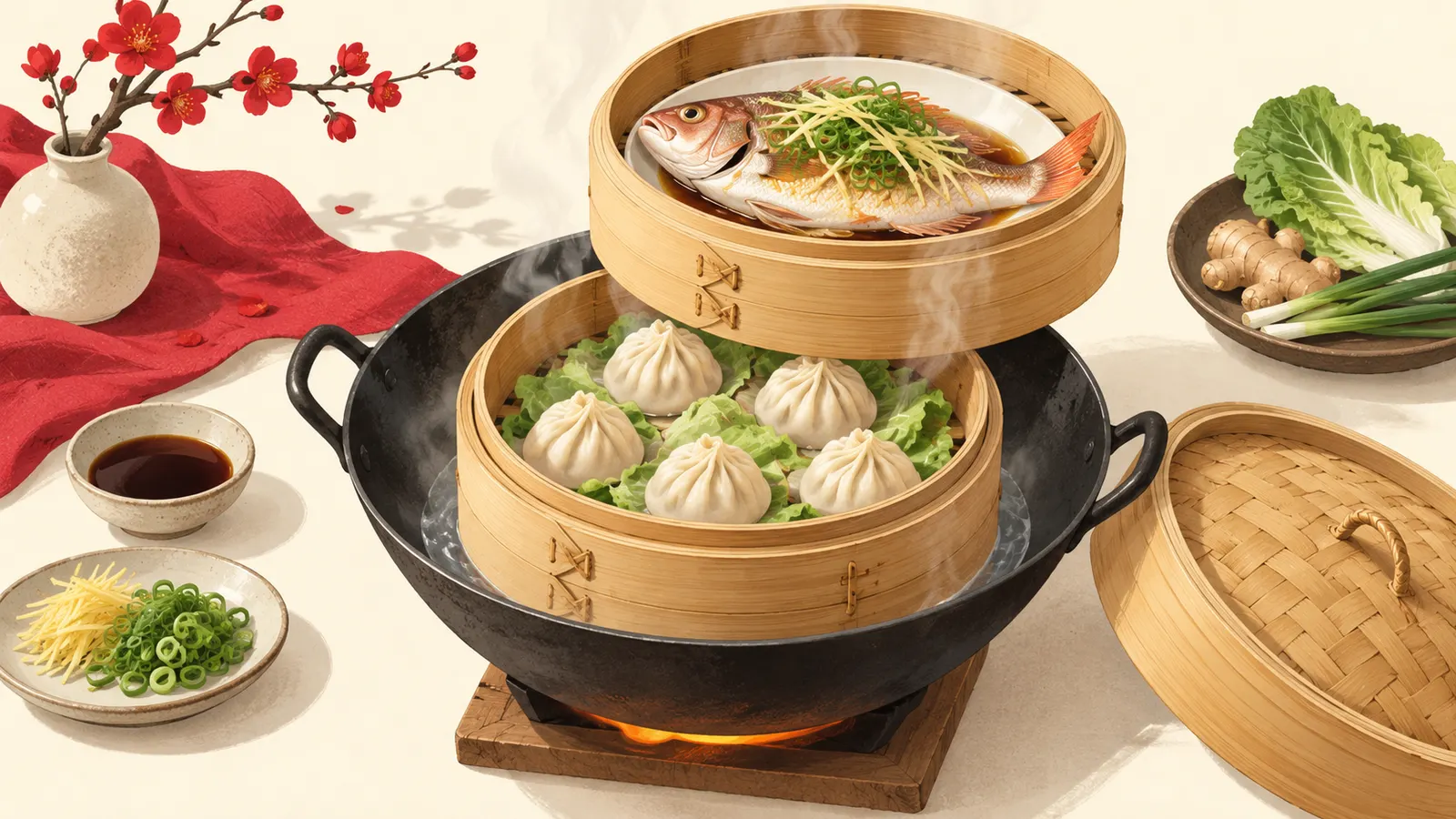
To use a bamboo steamer (affiliate link, opens in a new tab), line the basket with perforated baking paper or cabbage leaves, set it in a wok (affiliate link, opens in a new tab) over 3–5 cm of simmering water so the water sits below the basket, add the food in a single layer with gaps between pieces, cover with the bamboo lid and steam over a steady medium-high heat. Frozen dumplings take 8–10 minutes and a 500 g whole fish about 8–10 minutes.
A bamboo steamer is one of the cheapest and most useful things in a Chinese kitchen. The woven lid absorbs condensation instead of dripping it back onto the food, so bao stay smooth and dumpling wrappers don't go soggy, and the tiers stack so you can steam a whole meal over one burner. Here is how to set one up, what to line it with, how long common foods take, and how to look after it so it lasts for years.
What size bamboo steamer should you buy?
- 20 cm: enough for 6–8 dumplings or two bao. Fine for one or two people, or for a saucepan.
- 25–27 cm: the most versatile size for a household, and it sits well in a standard 30–35 cm wok.
- 30 cm or more: needed for a whole fish on a plate, a large batch of buns or a bed of sticky rice.
Two tiers and a lid is the usual set; buy extra tiers separately if you often cook for a crowd. Check the weave is tight, the rims are smooth and the lid sits snugly without rocking.
What you'll need
A basic set-up costs little and lasts for years if you dry it properly.
- Two-tier bamboo steamer (25 cm)Fits most woks and large pans; two tiers cook a full batch at once.See options on Amazon (affiliate link, opens in a new tab)
- Perforated steamer linersStop dumplings and bao sticking without blocking the steam.See options on Amazon (affiliate link, opens in a new tab)
- Steamer adapter ringLets a bamboo steamer sit safely on a saucepan instead of a wok.See options on Amazon (affiliate link, opens in a new tab)
- Shallow heatproof plateFor steaming fish with its juices, sized to sit inside the basket with a gap round the edge.See options on Amazon (affiliate link, opens in a new tab)
Some links on this page are affiliate links: if you buy through them we may earn a small commission, at no extra cost to you. It never affects which shops we list. How we make money.
How do you prepare a new bamboo steamer before first use?
A new steamer can smell strongly of raw bamboo and may have dust from the factory. It doesn't need oiling or seasoning like a wok. Instead:
- Rinse every tier and the lid under warm running water, without soap, and brush off any loose fibres.
- Set the empty steamer over simmering water with the lid on and steam it for 10–15 minutes. This drives off the raw smell.
- Leave it to dry completely, tiers apart and lid off, before you stack it away.
Before each use, run the basket under the tap for a few seconds. Damp bamboo is less likely to scorch where the rim touches the hot side of the wok.
Should you steam over a wok or a saucepan?
A wok is ideal. Its sloping sides hold the steamer rim above the water and leave a wide surface of boiling water underneath, which makes plenty of steam. Choose a steamer about 5–8 cm narrower than the top of the wok, so it wedges in securely with the base a couple of centimetres above the water. Flat-bottomed woks work on induction and electric hobs just as well.
A saucepan works too, as long as the steamer sits on the rim without falling in: a 20 cm steamer on a 20 cm pan is a good match. If your steamer is wider than all your pans, a metal steamer ring (an adapter that sits on the pan and supports the basket) solves it. Keep the pan's water topped up, because a saucepan holds less than a wok and boils dry sooner.
How much water to use
Pour in 3–5 cm of water, enough to last the cooking time but at least 1–2 cm below the base of the basket. If water touches the food, it boils rather than steams. Bring it to a full boil before the food goes in, then keep it at a lively simmer. For anything over 15 minutes, check the level and top up with boiling water from the kettle, never cold. A wok that boils dry will scorch the bamboo and can damage the wok.
What should you line a bamboo steamer with?
Always line the basket. Food steamed straight on bamboo sticks to it, tears when you lift it, and stains or flavours the slats. The lining must still let steam through.
- Perforated baking paper: the all-rounder for dumplings, bao and dim sum. Buy pre-cut liners or make your own (see tip below). Cut it a couple of centimetres smaller than the basket so steam can rise around the edge.
- Cabbage leaves: Chinese leaf or Savoy leaves make a free, non-stick base for dumplings and add no strong flavour. Lettuce also works for short steams.
- Banana leaves: for fish, sticky rice and parcels. Frozen packs are sold in Thai, Filipino and Vietnamese shops. Wipe them and pass them briefly over hot water or a flame to make them pliable.
- Damp muslin: best for sticky rice, as it lets you lift and flip the whole batch.
- A heatproof plate or shallow bowl: for fish, marinated chicken and anything with a sauce, so the juices stay with the food. Leave at least 2 cm around the plate for steam.
- Silicone mats: reusable and non-stick; choose a perforated one.
How long to steam dumplings, fish and bao
These times assume the water is at a full boil before the food goes in and the lid stays on. Thickness matters more than weight, so check the thickest piece. If you're making dumplings at home, steam a test one first.
| Food | Time | Tips |
|---|---|---|
| Frozen dumplings (jiaozi, gyoza, wontons) | 8–10 min | Steam from frozen. Space them 2 cm apart so they don't stick together. |
| Fresh homemade dumplings | 6–8 min | Wrappers turn slightly translucent and the filling feels firm. |
| Frozen dim sum (har gow, siu mai) | 8–10 min | Har gow wrappers should be glassy, with no white patches. |
| Frozen filled bao (char siu, custard) | 10–12 min | Medium-high heat so they don't burst. Check the filling is hot in the centre. |
| Freshly made bao | 10–12 min | Turn the heat off and leave the lid on for 3–5 minutes so they don't wrinkle. |
| Whole fish, 500–600 g (sea bass, bream) | 8–10 min | On a plate. Allow 12–15 min for a fish of 800 g–1 kg. |
| Fish fillets, about 2 cm thick | 5–7 min | Skin side down on a plate or banana leaf. |
| Boneless chicken thigh pieces | 15–18 min | On a plate. Cooked when the juices run clear and there's no pink. |
| Chinese steamed egg (1 part egg to 1.5 parts stock) | 10–12 min | Low to medium heat for a silky, smooth surface. |
| Pak choi, choi sum | 3–4 min | Halve thick stems lengthways. |
| Broccoli florets, green beans | 4–6 min | Season with oyster sauce or soy afterwards. |
| Soaked glutinous (sticky) rice | 20–25 min | On damp muslin. Turn it over halfway. |
| Reheating rice, buns or leftovers | 5–8 min | Until steaming hot all the way through. |
Stacking tiers
Put the food that takes longest, or anything raw such as fish or chicken, in the bottom tier so nothing drips from it onto other food. Add tiers with quicker items partway through. The top tier gets slightly less heat, so for even batches of buns, swap the tiers round halfway.
Recipe: Cantonese steamed fish with ginger and spring onion
Steamed whole fish (清蒸魚) is the classic way to show off really fresh fish in Cantonese cooking. Gentle steam keeps the flesh moist, and the sauce is added at the end: shredded ginger and spring onion, a splash of seasoned light soy and a ladle of smoking-hot oil poured over the top. Ask the fishmonger to scale and gut the fish. If it's too long for your steamer, cut it in half and lay the halves side by side.
Recipe
Cantonese steamed fish with ginger and spring onion
A whole sea bass steamed until just tender, then dressed with sizzling ginger, spring onion and seasoned soy. A Cantonese classic that takes about 25 minutes.
- Serves
- 2 people as a main, or 4 as part of a shared meal
- Prep
- 15 min
- Cook
- 12 min
- Total
- 27 min
Ingredients
- 1 whole sea bass or sea bream (500–600 g), scaled and gutted
- 40 g fresh ginger, peeled
- 4 spring onions
- 2 tbsp light soy sauce
- 2 tbsp water
- 1 tsp caster sugar
- 1 tbsp Shaoxing wine (optional)
- 3 tbsp groundnut or other neutral oil
- Small handful of coriander (optional)
Method
- 1Pat the fish dry inside and out, then cut 2–3 diagonal slashes down to the bone on each side. Slice half the ginger into thin coins and cut the rest into fine matchsticks. Cut 2 spring onions into 5 cm lengths and shred the other 2 finely; drop the shreds into cold water so they curl.
- 2Lay the ginger coins and spring onion lengths on a heatproof plate that fits inside your steamer with a 2 cm gap around it. Put the fish on top, tuck a few ginger slices into the cavity and drizzle over the Shaoxing wine, if using.
- 3Bring 4–5 cm of water to a rolling boil in a wok. Put the plate in the steamer, set it over the wok, cover and steam on high for 8–10 minutes.
- 4Meanwhile, warm the soy sauce, water and sugar in a small pan until the sugar dissolves. Keep warm.
- 5Check the fish: the flesh at the thickest point near the head should be white and flake easily from the bone. If it's still translucent, steam for another 1–2 minutes.
- 6Carefully lift out the plate, pour away the liquid that has collected and discard the cooked ginger and spring onion. Scatter the ginger matchsticks and drained spring onion shreds over the fish.
- 7Heat the oil in a small pan until just smoking, then pour it over the ginger and spring onion so they sizzle. Spoon the warm soy mixture around the fish, scatter with coriander and serve straight away with rice.
How to tell when fish is done
Push a chopstick into the thickest part behind the head: it should slide in easily and the flesh should lift away from the backbone. The eyes turn white and bulge slightly. Overcooked fish turns dry and cottony, so check at the lower end of the time. For more on the soy sauce, see light vs dark soy sauce; light soy is the one you want here. Serve with perfectly cooked jasmine rice.
How to clean a bamboo steamer so it doesn't go mouldy
Mould is the main reason bamboo steamers get thrown away, and it almost always comes from putting them away damp. Look after it like this:
- Rinse it under hot water as soon as it's cool enough to handle, scrubbing off any stuck bits with a soft brush. Avoid washing-up liquid: bamboo absorbs it and the taste comes out in the next batch.
- Never put it in the dishwasher or leave it soaking in the sink. Long soaks warp the tiers and loosen the weave.
- Shake off the water and dry it with tiers separated and the lid off, somewhere airy, for several hours or overnight. A sunny windowsill is ideal.
- Store it unwrapped in a ventilated cupboard or on an open shelf, not in a plastic bag or under the sink.
- Using liners every time keeps the slats clean, and makes cleaning a quick rinse.
If mould appears
Small spots on the surface can usually be cleaned off. Scrub them with a paste of bicarbonate of soda and water, or with diluted white vinegar, rinse well, steam the empty basket for 10 minutes, then dry it thoroughly in the sun. If the mould has spread deep into the weave or keeps coming back, replace the steamer; they are inexpensive.
Common bamboo steamer mistakes
- Starting with cold water. Food sits in lukewarm vapour and turns gummy. Wait for a full boil.
- Overcrowding. Dumplings stick together and bao merge. Leave 2 cm between pieces and steam in batches.
- Lifting the lid to check. Every peek lets out the heat and adds time. Trust the timings, then check once.
- Letting the wok boil dry. The base scorches and the smell lingers. Set a timer to check the water on long steams.
- No lining. Food sticks and the slats stain. Line it every time.
Where to buy a bamboo steamer in the UK
Chinese supermarkets are the most reliable place to find bamboo steamers in several sizes, along with spare tiers, perforated paper liners, steamer rings, woks and the sauces and condiments that go with steamed food. Our directory lists 259 stores stocking Chinese groceries, and 98 stores with Thai groceries, where you'll often find frozen banana leaves. Kitchenware ranges vary from shop to shop, so call ahead if you're travelling for a particular size. The cities with the most Asian supermarkets in our listings are London, Manchester, Edinburgh, Birmingham and Glasgow. Fresh fish, pak choi and Chinese leaf are best used quickly; our guide to storing Asian herbs and vegetables explains how to keep them fresh until you steam them.