
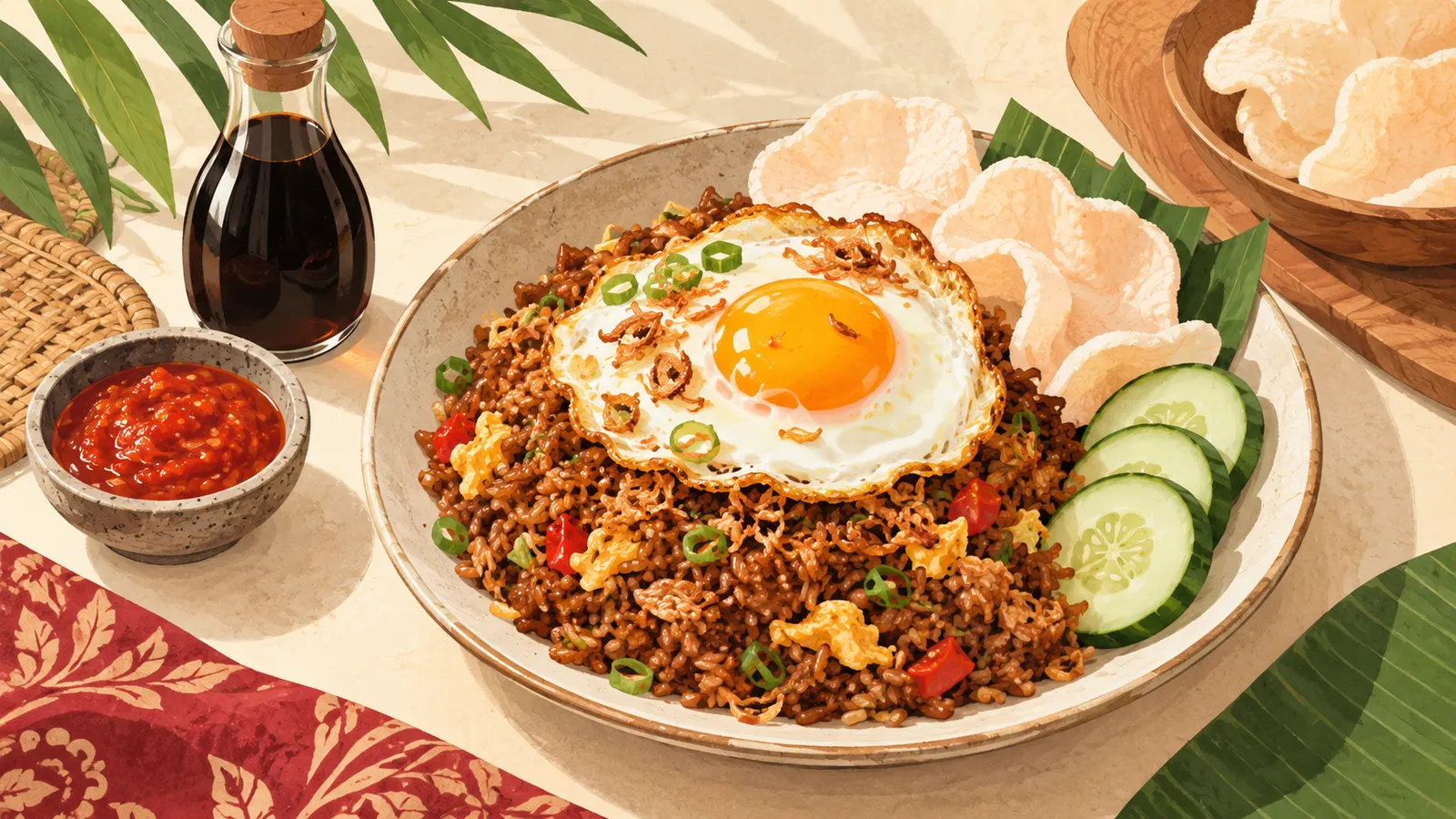
To make nasi goreng, fry a paste of shallots, garlic, red chilli and toasted shrimp paste (terasi) in oil until it smells sweet, add cold cooked rice and stir-fry it over a high heat, then season it with kecap manis, the thick, sweet Indonesian soy sauce that gives the dish its dark colour and caramel flavour. Serve it topped with a crisp-edged fried egg, with prawn crackers, cucumber and tomato on the side.
Nasi goreng simply means fried rice in Indonesian and Malay, and it is eaten everywhere from street stalls to breakfast tables, often made with yesterday's rice. It is quick, cheap and very adaptable, and once you have a bottle of kecap manis and a block of terasi in the cupboard, it is a 20-minute supper.
Nasi goreng vs Chinese egg fried rice
Both start with cold cooked rice and a hot wok (affiliate link, opens in a new tab), but they taste very different. Chinese egg fried rice is light and clean, seasoned with salt or light soy and spring onion, with the egg scrambled through. Nasi goreng is built on a pounded spice paste (bumbu) and tastes sweet, smoky, savoury and gently spicy. If you want the Chinese version, our guide to egg fried rice covers it step by step.
| Feature | Nasi goreng | Chinese egg fried rice |
|---|---|---|
| Flavour base | Shallot, garlic, chilli and shrimp paste, pounded | Garlic and spring onion |
| Main seasoning | Kecap manis (sweet soy) | Salt or light soy sauce |
| Colour | Dark brown and glossy | Pale gold |
| Egg | Fried and served on top (sometimes stirred in too) | Scrambled through the rice |
| Served with | Prawn crackers, cucumber, tomato, fried shallots, sambal, pickles | Usually part of a larger meal |
What is kecap manis?
Kecap manis is Indonesian sweet soy sauce: soy sauce cooked with palm sugar until it is thick, glossy and almost syrupy, sometimes flavoured with spices such as star anise or galangal. It tastes of molasses and caramel with a salty finish. In Malaysia it is spelt kicap manis. Indonesian labels also use kecap asin for ordinary salty soy sauce, and some brands sell a medium-sweet version labelled sedang.
It is not the same as Chinese dark soy sauce, which is thicker and darker than light soy but only mildly sweet and mainly used for colour. Swapping one for the other changes the dish completely. Our light vs dark soy sauce guide explains the Chinese soy sauces.
What is terasi (belacan)?
Terasi is fermented shrimp paste: tiny shrimp or krill salted, fermented and pressed into firm, dark blocks. In Malaysia and Singapore the same thing is called belacan, and Thai kapi is a softer, moister cousin. Raw, it smells very strong. Cooked, it melts into the background and gives nasi goreng, sambals and stir-fried greens a deep, savoury roundness that is hard to get any other way.
- Toast it first. Crumble a teaspoon into a dry pan and toast for 1–2 minutes, or wrap a slice in foil and toast both sides, until it smells roasted and turns dry and crumbly. Open a window; it is pungent while it cooks.
- Store it well. Wrap the block tightly in cling film and keep it in an airtight jar, or the smell will find its way through the cupboard.
- Use a little. About 1 tsp (5g) is plenty for two portions of rice.
- Leaving it out. Nasi goreng is still good without it. For a vegetarian version, skip it and add a little more kecap manis and salt.
How to make the spice paste (bumbu)
The classic nasi goreng bumbu is shallots, garlic, red chillies and terasi, pounded together. Some cooks add a candlenut for body or a little tomato. Pound it with a pestle and mortar or blitz it in a mini chopper; it should be a rough, moist paste, not a smooth purée. Small Asian shallots are sweeter and less watery than onions, and they make a real difference here.
Asian grocers also sell ready-made nasi goreng paste in sachets and jars. It is a decent shortcut on a busy night, but fry it properly, as below, and taste before adding the full amount of kecap manis, because many are already sweetened.
Which rice is best for nasi goreng?
Use cooked jasmine or long-grain rice that has been chilled, ideally overnight. Cold rice has firmed up and dried slightly, so the grains stay separate and fry instead of turning into mush. If you only have freshly cooked rice, spread it on a tray, let it steam off for 10 minutes and then chill it uncovered for an hour. Our guide to cooking perfect rice covers the method.
Common nasi goreng mistakes
- Not cooking the paste long enough. Raw shallot and garlic taste harsh. Fry until the paste darkens and smells sweet, 3–4 minutes.
- Pouring kecap manis into the middle of the rice. It is mostly sugar and catches quickly. Drizzle it around the edge of the wok and toss straight away.
- Too much kecap manis. Start with 1 tbsp per portion; you can always add more. The rice should taste savoury first, with sweetness behind it.
- Crowding the pan. Cook no more than two portions at once so the rice fries rather than steams.
Nasi goreng toppings and sides
- Fried egg (telur mata sapi): fried in hot oil until the edges are lacy and crisp and the yolk is still runny.
- Krupuk: prawn crackers, bought ready to eat or fried from dried discs.
- Fresh cucumber and tomato: sliced, to cool things down.
- Bawang goreng: crisp fried shallots, sold in tubs at Asian grocers.
- Acar: a quick sweet-sour pickle of cucumber, carrot and shallot.
- Sambal: sambal oelek or sambal terasi for extra heat.
- Satay skewers or shredded chicken to make it a bigger meal.
Popular variations include nasi goreng ayam with chicken, seafood versions with prawns and squid, and Malaysian nasi goreng kampung, made with fried anchovies (ikan bilis) and water spinach.
Nasi goreng with fried egg
This is a classic home-style nasi goreng with chicken, for two. Leave out the chicken for a simpler version, or swap in prawns, which need only 2 minutes in the wok.
Recipe
Nasi goreng with fried egg
Indonesian fried rice with a pounded shallot, garlic, chilli and shrimp paste bumbu, glossy kecap manis and a crisp-edged fried egg on top.
- Serves
- 2 people
- Prep
- 15 min
- Cook
- 15 min
- Total
- 30 min
Ingredients
- 500g cold cooked jasmine or long-grain rice (from about 200g uncooked)
- 4 Asian shallots (or 2 banana shallots), roughly chopped
- 3 garlic cloves
- 1–2 red chillies, roughly chopped
- 1 tsp (5g) terasi or belacan
- 4 tbsp neutral oil
- 200g boneless, skinless chicken thighs, finely diced (optional)
- 2 tbsp kecap manis, plus extra to taste
- 1 tsp light soy sauce
- Pinch of salt
- 2 spring onions, sliced
- 2 eggs
- To serve: crispy fried shallots, sliced cucumber and tomato, prawn crackers, sambal
Method
- 1Toast the terasi in a dry frying pan over a medium heat for 1–2 minutes, turning, until it is dry, crumbly and smells roasted.
- 2Pound or blitz the shallots, garlic, chillies and toasted terasi into a rough, moist paste. Break up any clumps in the cold rice with your fingers.
- 3Heat 2 tbsp oil in a wok over a medium heat and fry the paste for 3–4 minutes, stirring, until it darkens slightly and smells sweet rather than raw.
- 4Turn the heat to high, add the chicken and stir-fry for 3–4 minutes until it is cooked through with no pink showing.
- 5Add the rice and toss for 3–4 minutes, pressing out any lumps, until every grain is hot and coated in the paste and some are starting to toast.
- 6Drizzle the kecap manis and soy sauce around the edge of the wok and toss for 1–2 minutes until the rice is evenly brown and glossy. Taste, adjust with salt or more kecap manis, then stir in the spring onions.
- 7Meanwhile, heat 2 tbsp oil in a frying pan over a medium-high heat and fry the eggs, spooning the hot oil over the whites, for 2–3 minutes until the edges are crisp and the whites set but the yolks still runny.
- 8Pile the rice onto plates, top each with a fried egg and scatter with fried shallots. Serve with cucumber, tomato, prawn crackers and sambal.
Stock your pantry
Three cupboard ingredients do most of the work.
- Kecap manis (sweet soy sauce)Thick, molasses-sweet soy that gives nasi goreng and satay their colour.See options on Amazon (affiliate link, opens in a new tab)
- Prawn crackers (krupuk)The crunchy side for nasi goreng; fry the dried discs at home.See options on Amazon (affiliate link, opens in a new tab)
- Flat-bottomed carbon steel wok (35 cm)Heats fast and works on gas, electric and induction; season it once and it becomes non-stick.See options on Amazon (affiliate link, opens in a new tab)
Some links on this page are affiliate links: if you buy through them we may earn a small commission, at no extra cost to you. It never affects which shops we list. How we make money.
Where to buy kecap manis and terasi in the UK
Some supermarkets sell kecap manis, but terasi, krupuk, fried shallots, sambal and Indonesian paste sachets are much easier to find at an Asian grocer. Our directory lists 20 stores that stock Indonesian groceries, and 39 stores with Malaysian groceries, where you will find belacan and kicap manis.
In Edinburgh, Starlight Chinese Supermarket lists Indonesian products alongside tempe and tofu, and in Leicester, Super Tiger stocks Indonesian and Malay products. In London, New Loon Moon carries Indonesian, Malaysian and Singaporean groceries and Sriracha Supermarket sells Indonesian groceries next to its Thai range.
Stores stocking Indonesian groceries
- BHL Oriental Food StoreExeter · EnglandChineseKoreanJapaneseThaiVietnamese+3 moreExeter
- Chung Wah Chinese SupermarketDerby · EnglandChineseKoreanThaiVietnameseMalaysian+1 moreDerby
- Daily Fresh SupermarketCroydon · EnglandChineseKoreanJapaneseThaiVietnamese+3 moreCroydon
- Far East Oriental FoodPreston · EnglandChineseKoreanJapaneseThaiFilipino+1 morePreston
- Go EastIpswich · EnglandChineseKoreanJapaneseThaiVietnamese+2 moreIpswich
- hengxinOriental FoodOrpington · EnglandChineseKoreanJapaneseThaiVietnamese+3 moreOrpington
- Hoo Hing LtdBletchley · EnglandChineseKoreanJapaneseThaiVietnamese+2 moreBletchley
- Lynne's Grocery StorePaignton · EnglandThaiFilipinoIndonesianPaignton
- New Loon MoonLondon · EnglandKoreanThaiMalaysianIndonesianLondon
- Oriental Food Shop (OFS store)Loughborough · EnglandChineseKoreanJapaneseThaiFilipino+2 moreLoughborough
- Oriental Mart (Beeston)Beeston · EnglandChineseKoreanJapaneseThaiVietnamese+3 moreBeeston
- Oriental Mart (Hydrogen)Nottingham · EnglandChineseKoreanJapaneseThaiVietnamese+3 moreNottingham
- Sing LongNorthampton · EnglandChineseKoreanJapaneseThaiMalaysian+1 moreNorthampton
- Sriracha SupermarketLondon · EnglandChineseKoreanJapaneseThaiIndonesianLondon
- Starlight Chinese SupermarketEdinburgh · ScotlandChineseKoreanJapaneseIndonesianEdinburgh
- Starry Asian MarketCanterbury · EnglandChineseKoreanJapaneseThaiVietnamese+2 moreCanterbury
- Sun Wah Mini-Mart ltdStirling · ScotlandChineseKoreanJapaneseThaiFilipino+2 moreStirling
- Super TigerLeicester · EnglandChineseKoreanThaiIndonesianLeicester
- Yau BrothersSouthampton · EnglandChineseKoreanJapaneseFilipinoMalaysian+1 moreSouthampton
- 星光便利 StarlightEdinburgh · ScotlandChineseKoreanJapaneseIndonesianEdinburgh