
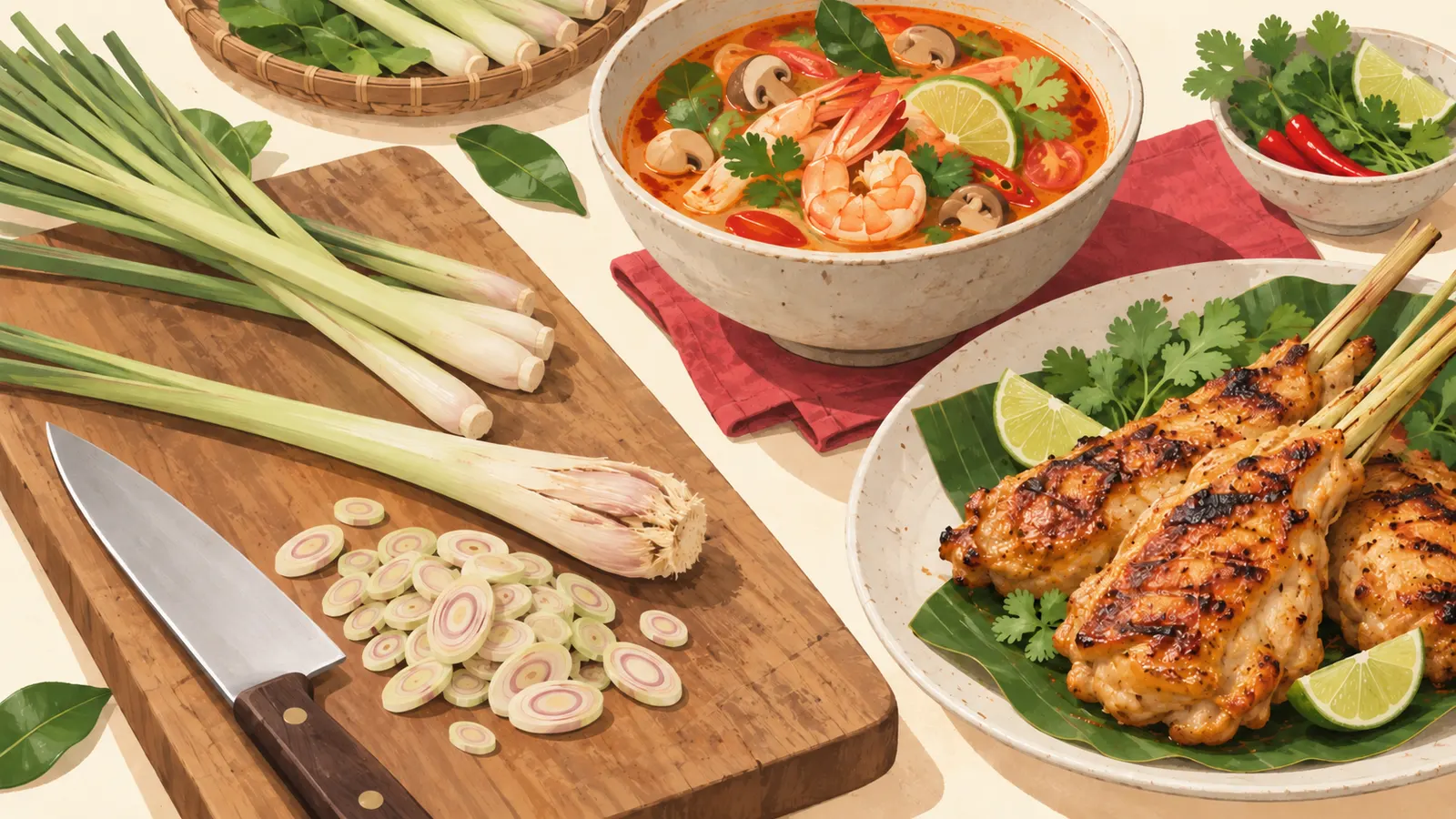
To use lemongrass, cut off the root end and the dry green top, peel away the tough outer layer or two, and use only the pale, tender lower 10 to 12cm. Slice that part very thinly across the grain, or pound or blitz it to a paste, for marinades, stir-fries and curry pastes. For soups and broths, bash whole lengths with the back of a knife so they release their oils, then fish them out before serving.
Lemongrass gives Vietnamese, Thai, Malaysian and Indonesian cooking its clean, citrusy, slightly floral perfume, without the sourness of lemon juice. It is easy to use once you know which bits are edible and which are only there for flavour. This guide covers preparing it, making a paste, choosing between fresh, frozen and dried, what to use if you can't find it, and a quick Vietnamese lemongrass chilli chicken to put it all into practice.
Which part of lemongrass do you use?
A lemongrass stalk has three parts, and each has a different job.
- The root end: the hard, flat base. Cut off the bottom 5mm or so and discard it.
- The lower stalk: the pale, cream to pale-green section with tightly packed layers, roughly the bottom third. This is the part you eat. Peeled, it is tender enough to slice thinly and chew.
- The upper stalk and leaves: the green, fibrous top. It is too woody to eat, but it is full of flavour. Bruise it and use it to infuse stocks, soups, rice, poaching liquids or tea, then remove it.
To find where the tender part stops, slice upwards from the base. While you can see tight concentric rings, often tinged purple, you are in the edible part. When the rings loosen and the knife starts to meet resistance, switch to using the rest for infusing.
How to prepare and chop lemongrass
- Trim off the root end and cut the stalk where the pale part turns green and woody. Keep the tops for stock.
- Peel off the outer one or two layers, which are usually dry, papery or tough. Fresh stalks from an Asian grocer often need only one layer removed.
- For slicing, cut the pale section crossways into the thinnest rounds you can manage, 1 to 2mm. Thin slices across the fibres are what stop it being stringy.
- For mincing, gather the rounds together and rock a heavy knife through them until fine, or pound them in a mortar.
- For infusing, cut whole stalks into 5cm lengths and bash them with the back of a knife or a rolling pin until they split and smell strongly of lemon.
How to make lemongrass paste
A paste is the most useful way to use lemongrass in marinades and stir-fries, because it spreads its flavour evenly with no stringy bits. Four average stalks give about 60g of trimmed, tender lemongrass, which makes roughly 4 tablespoons of paste.
- In a mini chopper or small blender: slice the trimmed stalks thinly first, then blitz with 1 to 2 tablespoons of neutral oil, scraping down often, until fine and fluffy. Whole chunks just wrap around the blade.
- In a mortar and pestle: add a pinch of salt as an abrasive and pound the thin slices for several minutes until mushy. It takes longer but gives a smoother, more fragrant paste.
- Flavoured paste: for Vietnamese cooking, pound or blitz in garlic, shallot and chilli as well. For Thai curry pastes, lemongrass goes in with galangal, coriander root and makrut lime zest; our Thai curry paste guide gives full recipes.
Fresh vs frozen vs dried lemongrass
Fresh stalks have the brightest flavour, but every other form has a place, especially as lemongrass can be patchy in supermarkets. As a rough guide, one fresh stalk gives about 1 tablespoon of finely chopped lemongrass.
| Form | What it is | Flavour | Best for | Roughly equals 1 stalk |
|---|---|---|---|---|
| Fresh stalks | Whole stems, sold in bundles at Asian grocers | Brightest, most floral | Everything | 1 stalk |
| Frozen minced (sả xay) | Ready-chopped lemongrass in tubs or bags from the freezer | Very close to fresh | Marinades, stir-fries, pastes | 1 tbsp |
| Frozen whole stalks | Trimmed stalks, sometimes split | Close to fresh | Soups, broths, slicing | 1 stalk |
| Jarred paste | Lemongrass blended with oil, salt and sometimes acid | Good, slightly sharper | Marinades and quick sauces | 1 tbsp |
| Dried slices or chopped | Dried pieces of stalk | Milder, more hay-like | Infusions, soups, tea, curry pastes after soaking | 1 tsp chopped, soaked |
| Ground (sereh powder) | Dried and powdered stalk | Muted | Spice rubs and dry marinades | ½ tsp |
Dried lemongrass needs soaking in warm water for an hour or two before you can chop or pound it, and even then it stays a little chewy, so it works best where it is strained out or blitzed into a paste. For anything where lemongrass is the main flavour, frozen beats dried. How long fresh stalks keep in the fridge, and how to freeze your own, is covered in our guide to storing Asian herbs and vegetables.
How to cook with lemongrass
- Vietnamese marinades: minced lemongrass with garlic, shallot, fish sauce and sugar is the classic marinade for grilled pork (thịt nướng), chicken and beef skewers.
- Stir-fries: fry minced lemongrass in oil for a minute or two before adding meat, tofu or vegetables, as in the recipe below.
- Curry pastes: the backbone of Thai green, red and yellow curries and of Malaysian and Indonesian rempah.
- Soups: bruised lengths simmered in Thai tom yum and tom kha with galangal and makrut lime leaves, or in Vietnamese bún bò Huế. Leave them in the bowl as flavourings, but don't eat them.
- Rice and stocks: tuck a bruised stalk into a pan of jasmine rice or a chicken stock as it cooks.
- Drinks and desserts: steep the green tops in hot water for tea, or in sugar syrup for poaching fruit or flavouring sorbets.
Lemongrass pairs naturally with garlic, ginger, galangal, chilli, coriander, makrut lime leaves, coconut milk and fish sauce. It goes in early to sizzle in oil for stir-fries and pastes, and stays in for the whole simmer in soups and curries.
What can I use instead of lemongrass?
Nothing quite matches its floral, fresh-cut-grass aroma, but these come close enough for cooking. Per stalk of lemongrass:
- Lemon or lime zest: the zest of half a lemon, plus a little grated ginger, is the most common swap. Add zest at the end, as long cooking makes it bitter.
- Makrut lime leaves: one or two shredded leaves give a different but similar citrus perfume, and work especially well in Thai curries and soups.
- Lemon verbena or lemon balm: a few leaves of either, if you grow them, are closer in aroma than zest. Use them in infusions rather than stir-fries.
- Jarred or frozen lemongrass: if it's only fresh stalks you lack, use 1 tablespoon of either.
Avoid swapping in lemon juice: it adds sourness rather than fragrance and can split coconut-based sauces.
Vietnamese lemongrass chilli chicken (gà xào sả ớt)
Gà xào sả ớt is a home-style Vietnamese stir-fry of chicken with plenty of lemongrass and chilli, finished in a sticky, savoury-sweet glaze. It uses lemongrass two ways: half in the marinade and half fried until golden, which is where the best flavour comes from. Chicken thighs stay juicy and are forgiving if cooked a minute too long. Serve it with jasmine rice and something fresh like sliced cucumber.
Recipe
Vietnamese lemongrass chilli chicken (gà xào sả ớt)
Chicken thighs marinated with lemongrass, garlic and fish sauce, then stir-fried with more golden lemongrass and chilli until sticky. A quick weeknight Vietnamese main.
- Serves
- 4 people, with rice
- Prep
- 50 min
- Cook
- 15 min
- Total
- 65 min
Ingredients
- 700g boneless, skinless chicken thighs, cut into bite-sized pieces
- 4 lemongrass stalks (about 60g trimmed), very finely minced, divided
- 4 garlic cloves, finely chopped, divided
- 2 tbsp fish sauce, plus extra to taste
- 1 tbsp light brown or palm sugar
- ½ tsp ground turmeric (optional, for colour)
- ½ tsp ground black pepper
- 2 tbsp neutral oil
- 2 banana shallots, finely chopped
- 1–3 red bird's eye chillies, finely chopped
- 1 onion, cut into thin wedges
- 60ml water
- 3 spring onions, cut into 3cm lengths
- Fresh coriander and cooked jasmine rice, to serve
Method
- 1Mix the chicken with half the lemongrass, half the garlic, the fish sauce, sugar, turmeric and pepper. Cover and marinate in the fridge for at least 30 minutes, or up to overnight.
- 2Heat the oil in a wok or large frying pan over a medium heat. Add the rest of the lemongrass and garlic with the shallots and chilli and fry, stirring, for 2 to 3 minutes until golden and fragrant. Don't let it brown too far, or it turns bitter.
- 3Turn the heat to high and add the chicken in a single layer. Leave it for 2 minutes to colour, then stir-fry for 4 to 5 minutes until browned all over.
- 4Add the onion and water, stir and cook for 3 to 5 minutes more, until the liquid has reduced to a sticky glaze and the chicken is cooked through, with no pink meat and clear juices when you cut the thickest piece.
- 5Taste and adjust with a few drops more fish sauce for salt, a pinch of sugar for sweetness or more pepper for heat. Toss in the spring onions for 30 seconds.
- 6Scatter with coriander and serve straight away with jasmine rice.
What you'll need
Fresh lemongrass is best, but these help when you can't get it.
- Granite mortar and pestlePounds lemongrass, chillies and garlic into a paste far better than a blender for small amounts.See options on Amazon (affiliate link, opens in a new tab)
- Lemongrass pasteA jar in the fridge for quick weeknight cooking.See options on Amazon (affiliate link, opens in a new tab)
- Fish sauceLook for a short ingredient list: anchovies, salt and maybe sugar.See options on Amazon (affiliate link, opens in a new tab)
Some links on this page are affiliate links: if you buy through them we may earn a small commission, at no extra cost to you. It never affects which shops we list. How we make money.
Where to buy lemongrass in the UK
Supermarkets usually sell lemongrass in small packs of three or four stalks, often already drying out. Asian grocers sell it in larger, fresher bundles for less, along with frozen minced lemongrass, frozen whole stalks and pastes. In our directory, 46 stores stock Vietnamese groceries and 98 stores stock Thai groceries, and most of them sell lemongrass in at least one form. Look for firm, heavy stalks with a pale, moist base and a strong citrus smell when you scratch them.
In London, Sriracha Supermarket lists fresh lemongrass and galangal among its produce, and HuongViet Asian Supermarket in Feltham stocks Vietnamese ingredients and Thai pastes alongside fresh produce. Vietnamese grocers' freezers are the most reliable place for frozen minced lemongrass.