
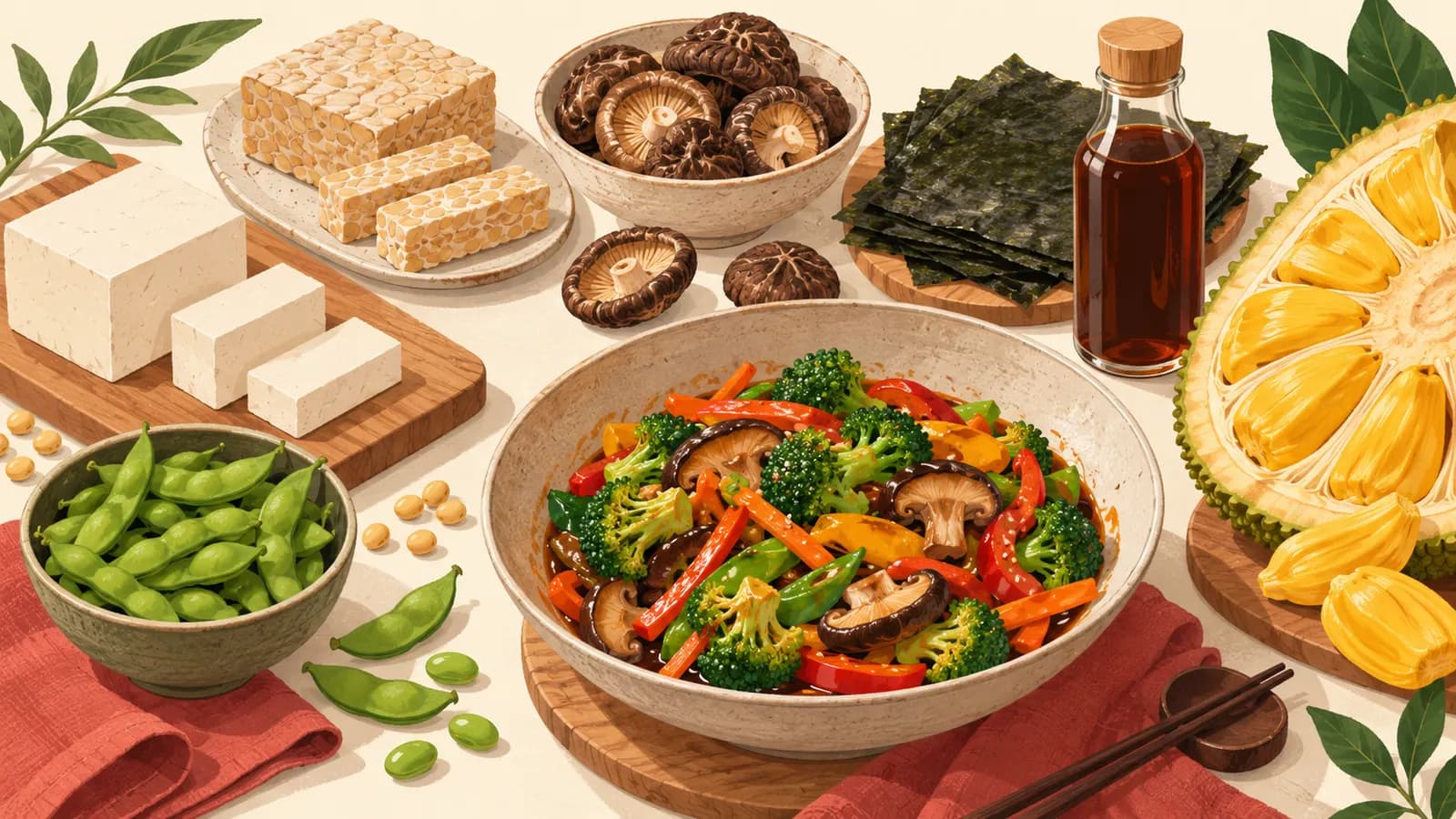
The best vegan staples at an Asian supermarket are tofu in all its forms, tempeh, wheat gluten (mian jin), dried tofu skin, dried shiitake and kombu, mushroom-based stir-fry sauce in place of oyster sauce, soy sauce, miso, doubanjiang, rice and noodles. Most cost less than their high-street equivalents, and several, such as mian jin and tofu skin, are hard to find anywhere else.
The catch is that plenty of Asian sauces, pastes and snacks contain fish, shrimp or other animal ingredients that are not obvious from the front of the pack. This guide lists the proteins and sauces worth buying, the vegan swaps for fish sauce and oyster sauce, and the ingredients to look for on labels, then puts the shelf to work in a mushroom mapo tofu.
Which Asian ingredients are naturally vegan?
A large share of an Asian pantry contains no animal products by default, though recipes vary by brand, so the label is always the final word.
- Seasonings: light and dark soy sauce, mushroom dark soy, tamari, rice vinegar, Chinkiang black vinegar, Shaoxing wine, toasted sesame oil and Chinese sesame paste.
- Pastes: most doubanjiang (broad bean chilli paste), miso, many gochujang, and fermented black beans.
- Dried goods: shiitake and wood ear mushrooms, kombu, wakame, nori, dried tofu skin, glass noodles and rice noodles.
- Store cupboard: rice, coconut milk, chilli oil (check for shrimp), Sichuan peppercorns, star anise and five-spice.
- Freezer: vegetable dumplings and spring rolls labelled vegan, frozen tempeh, frozen edamame and frozen tofu puffs.
Tempeh, seitan (mian jin), TVP and yuba explained
Beyond tofu, Asian grocers sell several high-protein foods that give vegan dishes bite and chew. Our tofu guide covers the different tofu types, pressing and crisping.
| Ingredient | What it is | Texture | How to use it |
|---|---|---|---|
| Tofu | Pressed soya milk curd | Silky to very firm | Fry, braise, steam or serve cold |
| Tempeh | Whole soybeans fermented into a cake (Indonesian) | Firm, nutty, slightly crumbly | Slice thinly and fry until golden; tempeh goreng, sambal goreng |
| Mian jin / seitan (面筋) | Wheat gluten, washed from dough | Chewy, meaty | Braise in soy; sold fresh, frozen, fried in balls or canned |
| Kao fu (烤麸) | Spongy steamed wheat gluten | Porous, soaks up sauce | Shanghai braised kao fu with mushrooms |
| TVP (textured soya protein) | Dried, defatted soya flour | Mince-like once rehydrated | Soak in hot stock 10 min; use in place of mince |
| Yuba / tofu skin (腐竹, 腐皮) | Skin lifted from heated soya milk | Chewy sheets or sticks | Soak, then braise, add to hot pot or wrap fillings |
| Dried tofu (豆腐干) | Very firmly pressed tofu | Dense, chewy | Slice and stir-fry, no pressing needed |
Mushroom stir-fry sauce vs oyster sauce
Oyster sauce is made from oyster extract, so it is not vegan. The vegan equivalent is sold as vegetarian stir-fry sauce, mushroom stir-fry sauce or vegetarian oyster sauce, and it is usually thickened soy and sugar flavoured with shiitake. It has the same glossy body and savoury-sweet taste and is used exactly the same way, 1:1, in stir-fries and over blanched greens.
Mushroom dark soy sauce is a different product: a dark soy for colour, not a thick sauce. Many cooks keep both. Our Chinese sauces guide explains where each sits on the shelf.
Vegan fish sauce alternatives
Fish sauce gives Thai and Vietnamese food its salty, savoury depth. Vegan fish sauces, sold in Vietnamese and Thai grocers, are usually made from soy, seaweed or pineapple. If you cannot find one, make a quick substitute.
- Quick swap: 2 tbsp light soy sauce, 1 tsp rice vinegar and ½ tsp sugar replaces about 2 tbsp fish sauce in a dressing or stir-fry.
- Deeper flavour: simmer 250ml water with a 10cm piece of kombu and 3 dried shiitake for 15 minutes, strain, then stir in 3 tbsp light soy and 1 tsp salt. Keep it in the fridge and use within a week.
- For nước chấm and som tam: use a vegan fish sauce or soy sauce with extra lime juice and a pinch of salt.
- In curries: a little light soy or salt does the job of fish sauce; taste at the end.
How to make vegan dashi and stock
Standard Japanese dashi is made with bonito flakes, but kombu and dried shiitake make an excellent plant-based version. Soak a 10cm piece of kombu and 4 dried shiitake in 1 litre of cold water for at least 30 minutes, or overnight in the fridge. Heat slowly and lift out the kombu just before the water boils, as boiling it can make the stock bitter and slimy. Simmer the shiitake for another 5 minutes, then strain. Use it for miso soup, noodle broths and braises, and slice the rehydrated shiitake into the dish. It keeps for three days in the fridge or can be frozen in portions. Our dashi guide covers both versions in more detail.
Hidden animal ingredients to check on labels
Recipes differ between brands and even between export markets, so read every label rather than assuming. These are the ones that most often catch people out.
- Fish sauce: in many Thai curry pastes, Vietnamese dipping sauces, Korean kimchi and some sambals.
- Shrimp paste (belacan, terasi, kapi): in Thai curry pastes, Malaysian sambal and laksa paste. Vegan curry pastes exist; look for them.
- Salted shrimp or anchovy in kimchi: most traditional cabbage kimchi uses fermented shrimp, anchovy sauce or fish sauce. Buy kimchi labelled vegan, or see our kimchi guide.
- Dried shrimp and scallop: in XO sauce, some chilli crisps and many dried snack mixes.
- Bonito (katsuobushi): in Japanese dashi, dashi-iri miso (miso with added dashi), many noodle soup bases and furikake.
- Meat extracts: in many instant noodle seasoning sachets, even on vegetable-flavoured packs.
- Lard: in some Chinese flaky pastries, mooncakes and traditional baked goods.
- Gelatine: in many gummies, jellies, marshmallow snacks and some mochi-style sweets.
- Egg and milk: in egg noodles, egg tofu, many biscuits, milk tea powders and creamer.
A vegan Asian pantry shopping list
- Firm tofu, silken tofu and a pack of tofu puffs.
- Dried shiitake and a sheet pack of kombu for stock.
- Light soy, mushroom dark soy and vegetarian stir-fry sauce.
- Doubanjiang and fermented black beans (check the labels).
- Chinkiang black vinegar and toasted sesame oil.
- White or mixed miso without added dashi.
- Tempeh, frozen mian jin or a bag of TVP.
- Rice noodles and dried wheat noodles (check for egg).
Recipe: vegan mushroom mapo tofu
Mapo tofu is usually made with minced pork or beef, but finely chopped mushrooms fried until browned give the same savoury depth and texture. The heat and the numbing tingle come from doubanjiang and Sichuan pepper, both vegan in most brands.
Recipe
Vegan mushroom mapo tofu
Soft tofu simmered in a fiery doubanjiang and black bean sauce with browned mushrooms in place of mince, finished with ground Sichuan pepper. Ready in 30 minutes.
- Serves
- 2–3 people
- Prep
- 15 min
- Cook
- 15 min
- Total
- 30 min
Ingredients
- 400g soft or medium tofu, cut into 2cm cubes
- 4 dried shiitake mushrooms, soaked in 300ml hot water for 20 minutes
- 200g chestnut mushrooms
- 2 tbsp vegetable oil
- 2 tbsp doubanjiang (check the label)
- 1 tbsp fermented black beans, rinsed and roughly chopped
- 3 garlic cloves, finely chopped
- 2cm piece ginger, finely chopped
- 1 tbsp chilli oil, or to taste
- 250ml mushroom soaking liquid or vegetable stock
- 1 tbsp light soy sauce
- 1 tsp mushroom dark soy sauce
- 1 tsp caster sugar
- 1 tbsp cornflour mixed with 3 tbsp water
- 1 tsp Sichuan peppercorns, toasted and ground
- 2 spring onions, thinly sliced
Method
- 1Squeeze the soaked shiitake, keeping the liquid. Discard the stalks and finely chop the caps with the chestnut mushrooms until they look like coarse mince.
- 2Bring a pan of lightly salted water to a simmer, slide in the tofu and simmer for 2 minutes to firm it up. Drain carefully.
- 3Heat the oil in a wok or deep frying pan over a medium-high heat. Add the mushrooms and fry for 6–8 minutes, stirring now and then, until their liquid has evaporated and they are well browned.
- 4Lower the heat to medium, add the doubanjiang and fry for 1 minute until the oil turns red. Add the black beans, garlic, ginger and chilli oil and stir for 30 seconds.
- 5Pour in 250ml of the mushroom liquid (strained to remove grit), add the soy sauces and sugar and bring to a simmer. Slide in the tofu and simmer for 3–4 minutes, nudging the pan rather than stirring so the cubes stay whole.
- 6Stir the cornflour mixture and add it in two or three additions, nudging gently, until the sauce clings to the tofu. Scatter with ground Sichuan pepper and spring onions and serve with rice.
Stock your pantry
Plant-based swaps that keep the flavour.
- Mushroom stir-fry sauceA vegetarian alternative to oyster sauce.See options on Amazon (affiliate link, opens in a new tab)
- Vegan fish sauceSeaweed- or soy-based, for Thai and Vietnamese dishes.See options on Amazon (affiliate link, opens in a new tab)
- Dried shiitake mushroomsSoak for a deep savoury stock and meaty texture.See options on Amazon (affiliate link, opens in a new tab)
- Kombu (dried kelp)Makes a vegan dashi in minutes.See options on Amazon (affiliate link, opens in a new tab)
- Tofu pressGets firm tofu crisp instead of soggy.See options on Amazon (affiliate link, opens in a new tab)
Some links on this page are affiliate links: if you buy through them we may earn a small commission, at no extra cost to you. It never affects which shops we list. How we make money.
Where to buy vegan Asian ingredients in the UK
A Chinese supermarket is the best one-stop shop: tofu, mian jin, tofu skin, dried mushrooms and vegetarian stir-fry sauce sit on the same shelves. Our directory lists 259 stores stocking Chinese groceries, with the most in London, Edinburgh and Birmingham. For tempeh and kecap manis, the directory lists 20 stores stocking Indonesian groceries. Japanese grocers sell kombu, miso and yuba, and Korean shops often stock vegan kimchi.
In London, Tian Tian Market lists tofu and seitan among its fresh produce, and in Edinburgh Starlight Chinese Supermarket sells tofu and tempeh.
Baixing Chinese Supermarket in Edinburgh stocks vegan frozen dumplings, and Man Fung Store in Cardiff lists vegan options alongside Chinese, Korean and Japanese food.